
.png)
When gamification came onto the scene around 2017, the majority of those in the fintech space reacted with doubt and skepticism, assuming the new approach to user engagement would not apply to the industry. Now in 2022, the addition of gamification elements to digital platforms has become essential and expected by users across all industries, no matter how seemingly serious or separate.
At its core, gamification is when typical game-like components—problem solving, competition, points and rewards systems—are applied to non-game activities—say, investing in stocks on a fintech app or banking online—to appeal to users and keep them engaged. In other words, and in this case, gamification is about making fintech fun! In 2022, game-like elements have been proven to help financial businesses in particular to engage their users more effectively and turn routine banking tasks into fun, rewarding activities.
Despite the early skepticism, the introduction of gamification to the fintech sector has since been welcomed by many different companies and brands worldwide, rendering it one of the most effective techniques for fan engagement. In fact, according to a study by Finances Online, companies that introduce gamification tools into their platform have been shown to realize a 700% increase in conversion rates. In this article, we’re taking a look at the five major benefits of engaging customers with gamified banking solutions.
1. Interactivity Attracts New Customers
Let’s face it, people don’t always have a lot of patience when it comes to app sign-ups, and fintech platforms can be highly set-up intensive. Often, they require users to input personal information, submit financial statements, or even integrate with their existing external bank accounts.
Introducing gamified elements to the sign-up process can help to attract new customers and maintain momentum for curious users, guiding them through the steps without getting bored, distracted, or simply fed up. In other words, turn your onboarding steps into an interactive game and new users are more likely to stick around!
A great example of a fintech gamification tool often used to attract new users is the use of progress bars or quests during user onboarding. Quests are sets of tasks that must be completed in order to achieve a quest goal; such as in this case of getting to the end of an app sign-up process.
With the completion of each onboarding task, users are given a visual display of their progress and proximity to the final step, giving them a sense of encouragement, reminding them of their end goal, and motivating them to keep going so as not to lose the progress they’ve already made.
You might even choose to add a reward that comes with the completion of each task to incentivize users further, whether that be in the form of points, discounts, or even fun, entertaining graphics.
With the use of fintech gamification tools like quests, you can work to address typical onboarding roadblocks, and reduce the friction customers may experience that would deter them from signing up, ultimately attracting new users to your platform.
2. Gamification Makes Fintech Fun!
One of the major challenges of conventional banking or fintech services is that not all customers are going to have a personal interest or even an understanding of typical industry jargon and financial matters. What’s more, even those who do may still associate the industry with dull platform interfaces, boring charts, complex calculations, and general seriousness—but fintech doesn’t have to be tedious!
The key to standing out amongst the crowd is by using gamification to make your platform accessible, intuitive, hassle-free, and fun. Interactive tools like quiz challenges, competitive leaderboards and live chats can turn your fintech platform into a place users come to connect, learn, and even play.
A perfect example of a platform that uses gamification to make fintech fun is Monobank, the first Ukrainian mobile-only bank known in part for its cute feline mascot, QR cat. The corporate character is already a cheeky giveaway of the bank’s fun approach to banking services, and personifies the brand in the mind of its 6 million customers.
QR cat appears all over the app’s interface, including on the many achievement badges available for Monobank’s most loyal customers. To earn these badges, users are challenged to perform certain banking tasks, such as splitting bills with friends, making transactions in different countries, spending in certain categories, and more.
Alongside offering the typical conveniences of a virtual bank, Monobank’s gamification efforts have resulted in a customer base of over 3.8 million, with around 120,000 new users joining each month.
When your users can associate your fintech platform with games, quizzes, and unique creative branding, suddenly the experience of banking becomes a fun activity rather than a tedious chore.
3. Nurture Your Audience: Loyalty & Rewards Programs
As well as aiding in customer acquisition, making your fintech app fun is a great way to keep your users coming back for more, and making sure they stay loyal to your brand. And what better way to keep users coming back to your platform than to integrate gamified loyalty rewards programs?
In an article published earlier this year, we looked at the importance of building and maintaining customer loyalty, and the massive impact it can have on a business when done effectively. This becomes even more relevant in the case of fintech, an industry that is becoming increasingly competitive as the demand for digitization climbs, and one where the most loyal customers often become lifelong devotees.
In fact, according to a study by Bain & Company, customers who feel truly loyal to their bank are up to 6x more likely to recommend it to others, on average spend around 25% more on their credit cards and are much less likely to switch to a competitor than customers who feel no sense of brand loyalty.
Introducing rewards programs for your most devoted customers makes them feel like you care about their experience on your platform and you value their loyalty enough to thank them for it. These programs can include the use of points earned for completing certain actions, leaderboards to show off top points earners, and badges awarded to celebrate customer milestones.
All in all, gamification is about mobilizing the psychological human tendency to want to play games and be rewarded; and when customers are rewarded for their loyalty to an app or platform, they feel appreciated and are more likely to return.
4. Gamification Boosts Platform UX
As previously mentioned, most users of fintech platforms are seeking out simplified ways to solve certain problems they are having, whether it be with saving more money, navigating their finances, or increasing their wealth. In other words, taking financial goals that are often complicated to meet on one’s own and making them easier. Therefore, the use of gamification on a fintech platform should have the same end goal of simplifying these processes to make them more achievable for users, to enhance the overall user experience.
With this in mind, it only makes sense that fintech gamification, when used effectively and responsibly, should actually help to foster positive financial habits for its users, such as curbing overspending, hitting money-saving milestones, and more.
Of course, fintech gamification is not always about making things easier; there’s also strategy in using it to make things more difficult. Introducing more friction on a fintech platform can make it harder for users to commit financial mistakes—overspending, making hasty investments, miscalculating hidden fees—a feature they will be extremely grateful for. Either way, the end result is an enhanced user experience on the platform that works to attract and retain customers.
5. Interactive Features Provide Useful Customer Insights
Finally, gamification is about more than just playing games and improving UX; it can also be a great way to learn more about your customers in terms of their behavior, usage habits and platform preferences. Especially considering the amount of fintech platforms out there, understanding your audience can mean the difference between standing out amongst competitors and falling behind. In other words, the better you know your users, the more easily you’ll be able to create a UX that satisfies their needs and turn them into loyal fans.
The issue with collecting data, however, is finding ways of doing it that don’t bother your customers or make your motives overly obvious. For example, sending out a long-form survey about what users are looking for on your platform might come across as, at best, disruptive, and at worst, spammy. Instead, using interactive gamification tools like trivia quizzes, predictions, and polls, offers a fun and subtle way to gather first-party data while providing an entertaining experience that encourages their participation.
All in all, the use of gamification tools—whether it’s interactive widgets, informative widgets, live chat capabilities, or loyalty programs—appeals to natural human desires, including the need for entertainment, social interaction, rewards, and competition. By introducing gamification to a fintech app or banking solution site, users are given the chance to earn points, compete with their friends, or get to the top of a leaderboard, and consequently, become emotionally invested in staying on returning to the platform.
Still not sure if gamification can be applied to your fintech platform? Get in touch today to learn more about how our user engagement elements can enhance your user experience.
Improving Your Odds of Winning Fans on Social
Today, on The Future of Fandom, we get to read a few pages from a sports book via a content juggernaut: Senior Vice President of Content Liam Roecklein of PointsBet. and the way it innovates within revenue driven content to grow a responsible, diehard following
This isn’t Liam’s first rodeo when it comes to shaking up an industry via content approach; he was previously the first content hire at Cheddar, and saw the brand through its ascent to the pinnacle of financial media. Now, he has turned his sights to sports gambling as the next space well worth disrupting. And on the show today, Liam explains how they do that at PointsBet with a “Thrill Bill” mentality.
We also talk about how the Company differentiates their content experience across acquisition platforms to win on social, and how to win the newest generations of sports fans who are increasingly fanatic about individual players rather than teams. Seeing as sports gambling is legal in just 12 states in the US, the fandom yet to come isn’t just fantasy, it’s real, and it’s right now.
So, let’s predict the rest with PointsBet and Liam Roecklein.
Connect with Liam Roecklein on LinkedIn: https://www.linkedin.com/in/liam-roecklein/
Read more about PointsBet: https://pointsbet.com.au/
Full episode here:
FULL TRANSCRIPT BELOW
(01:24):
Liam, thank you for joining me. How are you? Good to talk to you.
Liam Roecklein (01:27):
Adam, it’s awesome to be here. It’s really exciting to chat with you about the future of media. I’m excited to talk with you about all these things.
Adam Conner (01:34):
Yeah, the future is something that you have seen many times before in specific points in history. I will ask about that. And it’s just refreshing to talk to somebody who thinks about content, similarly to me, personally, but similarly to people who actually want to watch it. And I feel like weirdly you don’t see that a whole lot within areas where things trend very quickly, like in sports betting over the last year or two as states have brought it on.
(02:00):
We’re going to talk about all this, we’re going to talk about those definitions of those two F words, future and fandom. We’re going to begin with the move to PointsBet, because you had a pretty sweet deal there for a little while as the first employee to Cheddar, who just blew up business media. I’m sure they have you to thank. What about sports betting, PointsBet, the potential disruption you saw there made you jump when you jumped?
Liam Roecklein (02:26):
Well, what I would say is I wasn’t the first employee of Cheddar, but I was the first content hire. And I was there as the first executive producer, which might as well meant nothing, because there was one of us, so I was doing everything in the content creation. And left six years later as the SVP and GM. And the reason I made the move to PointsBet, is because, like you said at the top of this discussion, I’m tracking the user behaviors. And I’m looking for disruption within the media industry.
(02:54):
And when I look at sports media, I think there’s an unrecognized explosion in growth, in fantasy and sports gambling. And I think you see it everywhere now, it’s going to be even bigger, a 100, a 1,000 X bigger. And I think the content that’s being created for gambling around sports, along with fantasy content, which is related to props, et cetera as well, it’s just not great yet. And I think if there’s a leader and a winner in that space, they will dominate the next 10 years as this adoption happens nationally, with more and more legalization across states. And I’m just really excited to be a part of this.
(03:32):
My background has been in digital and OTT media my entire career. One of my early jobs was with Time Inc and Sports Illustrated and GOLF Magazine. I’ve always been a sports fan. I was a two sport college athlete myself. So this is a little bit of a return for myself, personally, but the reasoning for it is the behavior. I’ve been tracking the data. I see what the consumer demands, and I don’t think it’s being done well yet. I think we can provide it to our customer at PointsBet as we build this content strategy going forward.
Adam Conner (03:59):
So you saw some of this sports betting content, not to call out anybody particular, but what’s the trope in terms of type of content that you sit back and you think, “Really?” That caused this push? Is it just content that’s made with the old style gambler in mind sitting at the horse track? Or is it just this overly broad fan polarization type of deal? What about this content made you sit back and think, “I can do better than this?”
“Well, when I look at the content ecosystem for gambling, it really is dominated by the two extremes. So you have the VSINs of the world, which is an OTT platform that is focused on what I would describe as a historic better. They feel like old men in smoky rooms, in Vegas casinos, talking about lines in an antiquated fashion. And then you have the BR Betting and the Barstool Sports of the world, where it feels like very young, 22-year-old, five leg parlays, it is more viral short form, but there’s nothing in the middle. And that is where we see value.”
— Liam Roecklein (4:27)
(05:02):
I think that’s where most advertisers, most companies see value in that 30 to 50-year-old demographic, where there’s a maturity an interest, people searching for news and information. And what our content strategy will do is bring that news and information, data and analysis to our consumer who demands it. They are watching the games through that lens. Yet, right now it’s being seen immaturely, from a very hyper viral standpoint on social media from the companies that are building with that strategy, and then from an old school matter, which feels like Las Vegas casinos, and it kind of loses the main demographic.
(05:40):
So for us, we think there’s a massive opportunity right in the middle, providing news and information, bringing data and analysis, using the different content acquisition platforms and distribution platforms that are most relevant today, so that is social media, organic search, which is mostly dominated by Google, and then email newsletters. So we’re really looking for that more mature better in the middle of those two extremes.
Adam Conner (06:06):
It’s funny on this show we’ve spoken across many industries, but that finding the middle between those two ends of any spectrum has often been the key in disrupting within that, or maybe even just producing for the first time, where not much has been made to specialize. I think about within, well, the financial world, the difference between your old style just maxed out your 401(k), you moron, and the 18-year-old meme stock, which might be today’s Parlay Piranha. Finding something in the middle, which we’ve tried to cover on this show, has been a specialty for folks.
(06:38):
To bring that to sports betting, I agree, you’re not looking for the 18-year-old necessarily. You’re not looking for the old guy in the smoky casino. You’re looking for a better named Billy. Who’s Billy by the way? Can you tell us about this?
Liam Roecklein (06:51):
So Billy is just a cohort, it’s honestly just an internal metric that we use, and we’re trying to attract a traditionally 30 to 45-year-old consumer, who is going to be betting often on our platform. And really it’s a departure from our competitors, who traditionally have gone for mass consumption. We really just want to delight our customers and when we think about Billy, we think about the sports gambler who really just enjoys the experience. It is our job to provide them with the best product experience, with the best lines, the best sports book experience, and also the best content experience.
(07:29):
And we have just come up with this cohort, and our absolute goal is to delight Billy. We do not look at it through the traditional metrics, and a lot of the content we’ll be providing will be making content for Billy. And what that means is we’ll provide him with the news and information so that he is informed to make his bets.
(07:47):
We will have fun and interesting content that will entertain Billy, and we will also be participating during the live events themselves. Those being the sporting events, so that we are there with live opportunities for Billy as he’s consuming on the television, but also dominating the second screen experience. So he’s on, likely, his, but also her phone, sharing memes, sharing betting opportunities. We want to be participatory in that experience and recognize that that is where the consumer is living. They are as much on their phone while watching a game as they are dedicated to the game.
(08:21):
And I think that’s a dramatic departure that is still not recognized, and is a white space for content creators and different operators. Our strategy will be to focus on that second screen experience to make sure that we are in the conversation that they are having with their group. And that all those groups are Billys, they’re focused on winning at sports gambling, and we’re going to provide that information for them.
Adam Conner (08:44):
So to specialize in content, to make the most entertaining thing possible. As the head of content, you’re sort of the Tarantino of your group, and you’re looking to “Thrill Bill.” Winning on social, then, becomes focusing on that entertaining content, rather than maybe what I’ve seen broadly within sports betting over the last year or two, which have been commercials which start with an offer, join us, become a customer with us. Very acquisition focused, rather than necessarily something, which I don’t know if it’s bringing awareness, but it’s just, well, as you said, delighting.
(09:23):
You and I think agree that winning on social is much better to do through that entertainment medium than by focusing on acquisition first. But I want to know why you believe that within gaming broadly that strategy gets disregarded.
Liam Roecklein (09:39):
Well, I can’t speak for my competitor’s strategy, and what I would say is I can talk for PointsBet. We feel that there’s an opportunity to delight our customers with a top tier product experience along with a top tier content experience. And even our new advertising campaign called Sanctuary features a Billy on his throne in the bathroom, placing bets where he can find a few minutes of silence and of peace, and can do what he believes is fun and entertaining and participatory.
“…for us on the content team, it is our job to recognize that life is hectic, life is stressful for the customers and the segment that we talked about at the top of this call, they’re often busy, they have young families, they have stressful jobs, sports gambling is a relief. It is fun. It is entertainment. But at the same time they want to be informed about those behaviors and those bets they will be placing.”
— Liam Roecklein (10:10)
(10:35):
And it is our role on the content team to do two things, to provide them that news and information, so that they feel informed, so that they’re able to place their bets on either side of the equation and that they are confident that they have done their homework. Which they’re looking for, especially within that middle of the road demographically outlined. And then also for them to have some fun, and to recognize that this is a fun behavior that happens within groups of individuals. To brag a little bit to their friends when they win and then to feel it when they lose, obviously, responsibly.
(11:06):
But I think that’s all of part of what is driving the user behavior we talked at the top, too, is that the experience of consuming sports as a fan is being driven by these fantasy behaviors, along with these gambling behaviors as opposed to just the sporting conversation. And if you look at what is being shared, and we see some of this data now, the gambling conversation is replacing the sporting conversation, in terms of priority, when it comes to the events of a football matchup or a basketball game, et cetera.
Adam Conner (11:35):
So in creating this super entertaining content you can enjoy from any throne of your choosing, at the same time you’re maybe helping Bill get paid a little bit, but you also got bills to pay. Can you talk a little bit about being a revenue-driven content producer within the lens of seeking to entertain and thrill first?
Liam Roecklein (11:54):
Yeah, I mean first and foremost, I think our job is to be authentic to our customer. That is content’s functionality within the business. And I recognize that this is a business, but we truly feel as a company, at PointsBet, that if we provide authentic news and information to the customer, we’re going to do fine, ultimately. And actually our strategy, and maybe you’ve heard about this from other guests on your show, is much more about customer-driven capitalism versus profit-driven capitalism, it’s net promoter score. And we are even grading ourselves on how delighted is Billy versus how much profit can we extract from our customers?
(12:37):
And we found that the most profitable companies, Apple, Amazon, Discover, et cetera, have shifted to this metric. And we really are wholeheartedly diving into, how can we make the best possible experience? And I think on the content team, we really want to make sure that the betters within the 12 states were present. And Louisiana just came online, we’re very excited to be in Louisiana this past week. We want to make sure that they have all they need to participate on our platforms, that they have the information, and that when they get to our platforms, our product is best in class.
(13:11):
And if they feel that way, they’re going to be an evangelist for the company, because they’re going to tell their friends within their groups, “Hey, I had a much better experience at PointsBet. I think you should check this out.” And I think if we do that, it’s kind of like the score will take care of itself. Like the old Bill Walsh metaphor, if we do the little things, if we’re making sure at every step the customer feels like they are listened to, that they have everything they need, not only to function, but also because they’re delighted to just participate, we’re sure that they’ll come and that they will share with their friends
Adam Conner (13:43):
Being where the consumers is, is something I admittedly have heard a lot more rather than the first part of the answer, so I’m glad that you gave me the full spectrum there. And, yeah, Louisiana natives and residents, you got a better book coming to the bayou soon.
(13:57):
Now, I want to switch gears a little bit, because I haven’t been as deeply involved in sports gambling from a customer point of view. In fact, well, I’m guessing the majority of the US really hasn’t, because it’s not there yet in this sense. But something that maybe follows the old gambler smoking in the casino is another stereotype that I’m hoping we can dispel here or at least that you try to dispel as you create content for PointsBet. Which is that, “Well, this is really just a casino, the book is against me, they’re trying to get as much money from me and I’m never going to win.” How do you avoid falling into those, I guess, like negative reinforcement loops and biases as you cultivate fans? My guess is the answer here is going to be in the content, but I have to ask.
“Well, what I would say is that dichotomy I think is toxic, and really what we want to do at PointsBet is to authentically engage with our customers and fans. And whether that’s a traditional content audience, we don’t have all the answers, but we’re going to the best of our ability to provide the latest stats, information, original insights, original reporting that will give our customer and our audience and edge, we hope. And then even we want to make sure that we have best in class pricing. So we’re going to be minus 107, we’re going to commit to being better than all of our competitors in the space when it comes to pricing. And when we’re distributing that from a content perspective, we are outlining on social media our pricing versus the competitors.”
— Liam Roecklein (14:44)
(15:27):
We also have done different promotions. So we’ve had relief on MVP bets for example. So we had a promotion where Russell Wilson, those MVP bets, the betters who bet on Russell Wilson, and hee performed so poorly through the first two weeks, we forgave all those bets, and re-credited those accounts. So, for us, it’s not always about beating the individual as a better, in all regards, we want to make sure they’re enjoying the experience, that they’re being entertained. And we’re going to take different tactics, whether it’s through content, product, pricing, and even forgiveness to make sure that we are delighting our customer. To keep saying it again and again, we need to delight the customer.
Adam Conner (16:06):
Yeah, that’s rare too. I mean that’s not something that I would’ve thought that any sports gambling company would do. A nice gesture, of course. It’s tough if you’re a Denver fan, but that’s the point, maybe you got help. And it’s that kind of thing, whether it be in the content or the promotional or the forgiveness aspect of some of these things, if you know are on the wrong side early, that’s how I would think you grow some of those people who are just interested in the content to consumers, fans, to diehards. And that is what any brand wants. I don’t care what industry you’re in, you’re looking for those diehards.
(16:39):
So not on the exact same note as the last question, but I have to also ask, as you cultivate fans that become diehards, are there lessons that you’ve learned or principles that you keep in mind as you do that, within an inherently addictive industry? Because it’s great if somebody’s just consuming the content and being responsible with it, but you can’t possibly control what they’re going to do after that. So I’m curious how you think about that from the producer standpoint.
Liam Roecklein (17:08):
Well, what I would say is, first and foremost, content’s role is to create that authentic experience. And if we’re doing it right, you’re right, we want out of our million total followers, once we get there to have 10,000 diehards. But I also want to say that to your point on gambling, we want to do it responsibly. And what I’m so excited about joining PointsBet is that since the advent of PASPA and the legalization first in New Jersey and now in the 12 states we’re in, but will continue to be adopted in the next three to five years across the United States, is that we have the tools on our platform to reach out.
(17:47):
We are actively tracking customers who may display problematic behaviors, and we will have them limited to avoid problems. We also have support hotlines that we can direct customers to. So I think versus where the industry was prior to the legalization of gambling, the behavior was happening, I think we’re in a much better place. And I think content’s role is, yes, to grow the biggest total audience, to have those diehards consuming our content, but to encourage at all points responsible gambling, because that is first and foremost in our industry.
Adam Conner (18:21):
Yes, it’s good that you’re a steward of that and I think that, well, I think they’ll have to, but every sort of gaming partner that’s legalized in the US will have to maybe meet your standards on that, always be the best there. And I’m just thinking about, even in the past couple of weeks, listeners, we’re recording this in very, very late September, with the pressures among the creator community and the gaming community where platforms like Twitch have just banned streams that will use services that aren’t at least regulated in America, maybe not even legal in America, gambling, because they recognize that potentially toxic cycle in an inherently addictive industry.
(18:58):
It’s great that you have, whether it’s automated or harshly regulated guidelines in place to weed that out. Because, like you said, you want to build responsible, diehard fans. People who are thinking clearly about it. When Billy thinks clearly, everybody wins.
(19:14):
Now let’s go back to being where the consumer is, because I love talking about this topic with people. You have several different acquisition platforms across PointsBet’s content ecosystem. Within each of those different places, each of those thrones, let’s say, where Billy is, how do you tailor experiences across to ensure that they are seeing something new and different and specific every single time they interact with one of your individual properties?
“Well, what I would say is, first you have to recognize the user behavior. And what I would say is traditionally media companies have tried to apply a one size fits all content strategy to diverse distribution platforms. And even within the three distribution networks that I just outlined, organic social media, organic search, email, newsletters, and really we are talking about organic here, there are a lot of different tactics and subtactics that we will employ.”
— Liam Roecklein (19:40)
(20:07):
So first and foremost, we are debuting a brand new studio in lower Manhattan called the PointsBet Studio, where we will record linear shows. But the purpose of those linear shows, as much as I love the linear shows, and they’re going to be distributed on OTT or digital platforms, maybe even eventually on networks, and also wherever podcasts are consumed from an audio only perspective, the real goal of those shows are to reverse engineer different clips.
(20:34):
And what I mean by that are 45 to 60 second clips that we can prioritize on social media. And we will cut that with subtitles in vertical format, really in different frames with different markets that they’re discussing within that to ease the user experience across the platforms. And they will have different cuts for whether it’s Instagram or TikTok or Twitter or YouTube. We have to be very specific to the platform, and employ different strategies and tactics to ensure that they are optimized for consumption on those platforms.
(21:06):
When it comes to search, we’ve debuted a new blog for hustle.pointset.com. The Hustle is our brand new text based consumption acquisition channel, and really our editorial publication, it is a newsletter that we’ve partnered with Front Office Sports that is written three times a week right now, but will be expanding to five times a week. That will hit inboxes, where people read their information right around the time they’re thinking about gambling on games.
(21:32):
So right now we’re on Sunday, in the early mornings, before the full slate of football, and Monday, right after, recapping and pushing towards Monday Night Football, and then on Thursday as well. There will be more articles, original reporting as well going to digital. But, for us, it’s about recognizing the behaviors. Individuals who are interested in this space are constantly on social media, and when they’re on social media and they’re interested in a game, they’re using Google to look up information around those games and opportunities to bet on markets.
(22:01):
And they’re constantly, just because of the Billy cohort we talked about, on email, likely for work, but also for pleasure and for community. And using those email platforms and recognizing that these are the acquisition channels that are most relevant is a white space I believe. I think a lot of our competitors are focused on more traditional media acquisition channels like linear television or radio or out of home, where for us we really want to pivot towards where is the behavior, the consumption behavior happening? And how do we provide the best possible experience on those individual distribution platforms, with the tactics I outlined?
(22:36):
You need to make sure you’re optimized and you need to make sure that you’re delighting your customer just from a distribution standpoint, too. Because if you put up any barrier, if it becomes difficult, even a little bit, they will choose to go elsewhere. And my goal and I really look at the future of content is easing those barriers, so that it becomes easy to either read, listen, or watch our content, and then, ultimately, make a decision and use our product
Adam Conner (23:01):
Listeners, you could take the last roughly two minutes of that explanation… First of all, roll this back two minutes and play that again to yourself, and then listen to it and ask, what industry you think that that perspective is from? Without knowing that this is sports gaming. Because let me tell you something that is so clearly different in my mind from the way that, well, just gambling in general has been approached forever. But that specific POV is the same way that education got disrupted in the digital age, that tech has been disrupted forever, that financial sector has been disrupted over the last like six, seven, eight years. This is just the model that is going to win.
(23:41):
And I’m geeking out a little bit over here, because as somebody who builds podcasts all the time, but also has these great conversations and builds almost for the short form, even though it’s in a long form shell, that funnel of engagement and consumption is going to make people like PointsBet win. And it’s what makes Liam one of the experts in his craft.
(24:02):
So I’m thrilled to have that foundation for this final question, which is focused on the future, listen to that alliteration. And I want to ask about it, because, when I think about fans of sport, so different even from where we were 10 years ago, and we’ve talked about this a little bit on the show in a couple different lenses.
(24:22):
Fans who are new are not necessarily fans of their teams where they grew up or their teams where they went to school, I mean they might be, but more so they are fans of players. And this makes for a much different fan in aggregate than somebody who is just a Pittsburgh diehard. So in your mind as a content producer and as a steward of a brand which is not only placing bets on teams, placing bets on players, how does that change your strategy, if at all, across sport to hook this maybe Billy of the future as compared to the stereotype in the smoky Casino? I’d be curious as we round out, how you think of the future in terms of the other F word, fandom?
Liam Roecklein (25:09):
Well, what I would say is, you know started this conversation by saying, why sports gambling? And I was traditionally in financial news, at least in the last six years, even prior to that, when I was with Time Inc, I worked agnostically with content. I worked with Time Magazine and Fortune, Essence, People en Español, I even created content in Spanish. So to me the optimization we just outlined in the prior section is applicable to all the different industries you were touching on, education or gaming, et cetera.
(25:37):
The reason why, just answer your exact question, I came to this industry is because I’m following that user behavior, that fandom behavior that you just outlined, which is with Gen Z, and the even more so with Gen Alpha, which is, obviously, almost in its infancy right now, the next generation coming up behind it. I was the individual, I’m in my mid-30s, who watched six hours straight of SportsCenter, who was a diehard, I’m from the New York area, Yankee fan, and checks the box scores in The Daily News every day.
(26:05):
That behavior is not happening. And we are seeing, through data, a shift in individual fandom, especially with the younger demographics towards individuals. And you could see this on social media, whether you’re a Cristiano Ronaldo fan or you are a LeBron James fan, or to your point on Twitch, you’re a streamer fan as well of your favorite gaming platform. And there’s so many of them, I won’t even name them, because it’s so niche to that specific, whether it’s Call of Duty or FIFA, et cetera. It’s so niche to those individual games.
“I think the future of sports consumption is gambling in fantasy, because when you’re no longer interested in the team, for the team’s sake, I want to see the Pittsburgh Steelers win on Sunday, you are more interested in the games, because they are interesting and they are participatory. I need Juju Smith-Schuster, former Steeler, now the Chiefs, to hit on his yards. I am very invested in watching this game to win my fantasy matchup. I am very invested, even to use that exact example, to see him go over 65 yards as a prop bet this weekend. And that behavior will exist.”
— Liam Roecklein (26:37)
(27:12):
Where watching the games to see if the Pittsburgh Steelers win the AFC North or are positioning themselves to get in the playoffs, is less relevant. I also think you talked about from a strategy perspective, I think it’s actually made the league more popular in the fact that more parity exists, there’s less relevance in terms of dominant teams. You used to see the Cowboys dominate for years on end. We do not see that happening anymore. And I think that’s because of a lot of the measures the NFL and the league itself has taken. But it also is better for the league from a media consumption and the gambling and fantasy behaviors we saw, because it makes it more of a global and domestic phenomenon.
(27:50):
So if I’m in Pittsburgh, I care as much about the Los Angeles Chargers game or the Kansas City Chiefs game because it is equally interesting to me as the Steelers’ game. So from a content strategy perspective, I think we become less localized. We’ve become more national, and we’ve even seen that adoption when we talk about sports gambling on European soccer or different types of match-ups that we’ve seen boom in popularity in this country, in the United States most recently.
(28:16):
So I just am following the user behaviors to wrap this up. And there are not a lot of new fans of teams being born. Of course, they exist and they will continue to persist, but there are much more Aaron Judge fans than there are Yankee fans. And I think if we follow that behavior, if we program to that behavior, we’ll win with media now and in the future.
Adam Conner (28:37):
Agreed. As somebody who is 30, grew up with the SportsCenter bingeing as well, even the new sports that I’ve picked up and watching, since four, five, six years ago, those are sports in which I have immediately gone player first, not teams. Sure, I’m Baltimore born and bred, kind of weird being in Pittsburgh, but I’m an Orioles and Ravens diehard guy. I’ll follow those people forever. But in 2010, I watched soccer for the first time, and I got into it, because I was a big fan of Fernando Torres as the player, not Liverpool, FC at the time. I became a fan of the team, but that was much later.
(29:11):
I’ve been a lifelong Motorsport fan, of NASCAR specifically. And these days it’s just about individual personalities, drivers, not necessarily the team for which they drive. If I were a fan of golf, I don’t know too much about golf, but if I did, I know enough to know that I’d suck on my golf course, but other than that, if I were a fan of an individual golfer, I’d be a fan of the golfer, not the country for whom they play, not the tour on which they play.
(29:34):
So I see that perfectly and now that you say it, yeah, you’re just following the behavior. It’s not that hard folks, just look at what maybe Gen Z, Gen Alpha, look at what you’ve done over the last three or four years, and then build for that.
(29:47):
Liam, I’m thrilled to have learned so much from you here, and I’m just, again, refreshing to talk to somebody on the content side of the game who thinks about this in a similar way to the way I do. I’m glad you are shaking it up in sports gambling. Maybe you don’t wish it, but I wish there were three more you to disrupt other boring industries, because we need more people like that thinking forward.
(30:09):
Thanks for talking about the Future of Fandom with us. And hey, if you’re in one of these 12 states that has it now, folks, you might want to consider PointsBet for your premium content and gambling experience. This is all been an ad! No. Anyway, I’m thrilled that you’ve been here. Thanks so much for joining us.
Liam Roecklein (30:25):
Adam, thank you so much for having me.
Adam Conner (30:29):
Take it from someone who works in content production every single day and has interviewed hundreds of brand leaders on how to do it right, Liam knows his stuff. If PointsBet ends up being the foremost content fixture in sports gambling over the coming years, color me unsurprised. Thanks very much to Liam Roecklein for joining us, and thanks to you, the listener, for exploring the Future of Fandom today.
(30:54):
I’d encourage you to stay connected, so you can do this, livelike.com/podcast, go visit that, you can listen to all of our shows. You can also read along, view clips, things like that. And of course we are across social media too, primarily LinkedIn and Twitter, LinkedIn at LiveLike and Twitter @LiveLikeInc. I look forward to predicting the future again with you real soon. And until then, I’m Adam Conner saying so long and thanks for being a fan.
Integrating new technologies into existing ecosystems can be a pain—but it doesn’t have to be. We have ensured that the LiveLike suite can be easily implemented and is accessible for any type of user or use case, from an individual non-coder to a team of experienced developers. In this blog, we are taking a deep dive into why easy integration is so crucial for the success of your platform, and why it was such a major priority when building the LiveLike product.
1. One Product, 3 Types of Integration
At LiveLike, we are always looking for ways to make our customers’ lives easier; and as a part of this goal, we made sure to create a product that is highly flexible and responsive in terms of integration. When implementing our product, our customers have the freedom to choose from three different integration types:
- Embed Codes: Copy and paste HTML5 integrations for websites
- SDKs: Embed customizable functionality into apps and websites
- APIs: Server-side integrations and automation
Each of these methods have their own unique benefits and disadvantages. The most advanced way to integrate our Audience Engagement Suite is through APIs. Though requiring more advanced coding skills and slightly more time, this method allows customers to create a fully customized and bespoke experience for their end-users.
If clients are looking to spend less time on implementation and desire a faster approach, they have the option of using our SDK, which is available on iOS, Android, and the Web. This enables them to use our core feature without any issues, although they may be left wanting more in terms of customization.
Finally, the easiest way to implement our solution is by using Embed Codes. This method only works for Web implementation but is highly efficient for specific use cases. Check out this video showcase for our Embed Code Publishing process:
Of course, these three methods can also coexist, meaning our clients aren’t limited to just one approach when integrating our technology into their existing ecosystems.
Why Does It Matter?
Having a variety of options for product integration is a huge advantage because it widens the realm of possibilities for clients regarding resource allocation, roadmaps, task priorities, and execution time. If our clients have multiple projects working simultaneously, they can rest assured knowing LiveLike’s three integration solutions ensures they aren’t stuck with only one way to manage them.
2. Obtaining Quick Wins
When integrating the LiveLike solution, our clients benefit from the ability to realize several wins very early on in the implementation process. As an example, editorial activations can be done in just a couple of minutes with the use of Embed Codes. Similarly, clients can start the SDK initialization process as well as some basic UI in only a few days’ time.
While it can often take time to see results with product integrations, we think it is mandatory to guarantee some kind of tangible positive outcome in the early stages of the implementation.
Why Does It Matter?
Quick wins provide project momentum because they drive value at the early stages of the integration. They give team members confidence in the work they are doing as they can see the progress they are making.
3. Iterative Integration Strategy
We provide our clients with an ever evolving set of tools, and each of these tools can be used separately so that they can integrate one thing at a time. Using LiveLike, customers are able to experiment and discover what works for them and what their priorities are. What’s more, as we continue to add new features to our suite, our clients can add them to their apps without modifying any of the work they previously did.
Why Does It Matter?
Deciding to integrate LiveLike doesn’t mean having to use 100% of our solution or nothing. As even just the first few steps of implementation can result in significant progress, customers can integrate step by step as they navigate the process and grow or evolve their ecosystem. On top of that, if clients decide to change their strategy, they can be assured that all the work they have done beforehand will not be lost, but instead can be altered and added to.
4. A Global Off-the-Shelf Loyalty Solution
With all the different behaviors, scenarios, and personas that exist within an audience, it is often very complicated to set up a community loyalty strategy that adheres to your specific customer base.
At LiveLike, we make this process easy and scalable through our wide range of reward integration possibilities. Every API is built and available for any use case or ecosystem, from earning points to rewarding users based on specific behaviors.
For example, you may start with the simplest low-code rewards program solution, giving points to your users for widget interactions that are automatically tracked on a leaderboard. If you decide you want additional loyalty solutions down the line, you may then integrate our APIs to reward your users with points, badges, and/or NFTs based on completing specific behaviors such as making a purchase, spending a certain amount of time on the platform, logging in a certain amount of times per week, etc.
You can even transform our LiveLike Points feature by creating Virtual Currencies to let users purchase exclusive and premium experiences on your platforms.
Why Does It Matter?
While implementing strong loyalty rewards programs can take a lot of development effort, our fan engagement suite allows you to do all of it from one single place. In addition, the diversity of our loyalty features and the flexibility of how you can integrate them allows you to adjust your goals and experiment with what works best for your community.
5. A Powerful CMS
Finally, our engagement suite and interactive features derive solely and directly from our CMS. Once you have integrated LiveLike and the solution is up and running, there is nothing left to change, implement or navigate: You can create, modify, and delete your different interactive experiences all from the CMS. What’s more, the CMS can be used manually at first, but once you have settled on your workflows, they can be automated via the APIs, making the overall process even more seamless and hands-off.
Why Does It Matter?
A powerful and robust CMS is key to avoiding the need for additional development efforts after the solution has been implemented. Our CMS allows our clients to work more efficiently and streamline their workflows, which we believe is a mandatory step to allowing them to prioritize other crucial tasks at hand.
In addition to being highly navigable and user-friendly, our solution is also extremely easy to integrate. When developing our product, we made sure to do it in a way that would benefit as many organizations as possible, with different methods of integration (Embed Code, SDK, or API) to eliminate any barriers to success.
With the LiveLike Audience Engagement Suite, our objective is clear: We want to take interactivity and loyalty to the next level. We want companies to create deeper relationships with their clients, consumers, and fans, and build strong communities that can stand the test of time. We want the brands that work with us to create new, unique experiences by putting their communities at the center of it.
If you want to learn more about the different ways to integrate our solution within your ecosystem, you can check out our comprehensive integration guides featured on our LiveLike Developer Hub. We update this hub regularly so our customers have all the information they need to integrate our solution with ease. For more assistance, we also have a support team on hand that can guide you through the various stages of implementation.
Still not sure if our engagement suite is right for your business platform? Get in touch today to learn more about how gamification can enhance your user experience.
Integrating new technologies into existing ecosystems can be a pain—but it doesn’t have to be. We have ensured that the LiveLike suite can be easily implemented and is accessible for any type of user or use case, from an individual non-coder to a team of experienced developers. In this blog, we are taking a deep dive into why easy integration is so crucial for the success of your platform, and why it was such a major priority when building the LiveLike product.
1. One Product, 3 Types of Integration
At LiveLike, we are always looking for ways to make our customers’ lives easier; and as a part of this goal, we made sure to create a product that is highly flexible and responsive in terms of integration. When implementing our product, our customers have the freedom to choose from three different integration types:
- Embed Codes: Copy and paste HTML5 integrations for websites
- SDKs: Embed customizable functionality into apps and websites
- APIs: Server-side integrations and automation
Each of these methods have their own unique benefits and disadvantages. The most advanced way to integrate our Audience Engagement Suite is through APIs. Though requiring more advanced coding skills and slightly more time, this method allows customers to create a fully customized and bespoke experience for their end-users.
If clients are looking to spend less time on implementation and desire a faster approach, they have the option of using our SDK, which is available on iOS, Android, and the Web. This enables them to use our core feature without any issues, although they may be left wanting more in terms of customization.
Finally, the easiest way to implement our solution is by using Embed Codes. This method only works for Web implementation but is highly efficient for specific use cases. Check out this video showcase for our Embed Code Publishing process:
Of course, these three methods can also coexist, meaning our clients aren’t limited to just one approach when integrating our technology into their existing ecosystems.
Why Does It Matter?
Having a variety of options for product integration is a huge advantage because it widens the realm of possibilities for clients regarding resource allocation, roadmaps, task priorities, and execution time. If our clients have multiple projects working simultaneously, they can rest assured knowing LiveLike’s three integration solutions ensures they aren’t stuck with only one way to manage them.
2. Obtaining Quick Wins
When integrating the LiveLike solution, our clients benefit from the ability to realize several wins very early on in the implementation process. As an example, editorial activations can be done in just a couple of minutes with the use of Embed Codes. Similarly, clients can start the SDK initialization process as well as some basic UI in only a few days’ time.
While it can often take time to see results with product integrations, we think it is mandatory to guarantee some kind of tangible positive outcome in the early stages of the implementation.
Why Does It Matter?
Quick wins provide project momentum because they drive value at the early stages of the integration. They give team members confidence in the work they are doing as they can see the progress they are making.
3. Iterative Integration Strategy
We provide our clients with an ever evolving set of tools, and each of these tools can be used separately so that they can integrate one thing at a time. Using LiveLike, customers are able to experiment and discover what works for them and what their priorities are. What’s more, as we continue to add new features to our suite, our clients can add them to their apps without modifying any of the work they previously did.
Why Does It Matter?
Deciding to integrate LiveLike doesn’t mean having to use 100% of our solution or nothing. As even just the first few steps of implementation can result in significant progress, customers can integrate step by step as they navigate the process and grow or evolve their ecosystem. On top of that, if clients decide to change their strategy, they can be assured that all the work they have done beforehand will not be lost, but instead can be altered and added to.
4. A Global Off-the-Shelf Loyalty Solution
With all the different behaviors, scenarios, and personas that exist within an audience, it is often very complicated to set up a community loyalty strategy that adheres to your specific customer base.
At LiveLike, we make this process easy and scalable through our wide range of reward integration possibilities. Every API is built and available for any use case or ecosystem, from earning points to rewarding users based on specific behaviors.
For example, you may start with the simplest low-code rewards program solution, giving points to your users for widget interactions that are automatically tracked on a leaderboard. If you decide you want additional loyalty solutions down the line, you may then integrate our APIs to reward your users with points, badges, and/or NFTs based on completing specific behaviors such as making a purchase, spending a certain amount of time on the platform, logging in a certain amount of times per week, etc.
You can even transform our LiveLike Points feature by creating Virtual Currencies to let users purchase exclusive and premium experiences on your platforms.
Why Does It Matter?
While implementing strong loyalty rewards programs can take a lot of development effort, our fan engagement suite allows you to do all of it from one single place. In addition, the diversity of our loyalty features and the flexibility of how you can integrate them allows you to adjust your goals and experiment with what works best for your community.
5. A Powerful CMS
Finally, our engagement suite and interactive features derive solely and directly from our CMS. Once you have integrated LiveLike and the solution is up and running, there is nothing left to change, implement or navigate: You can create, modify, and delete your different interactive experiences all from the CMS. What’s more, the CMS can be used manually at first, but once you have settled on your workflows, they can be automated via the APIs, making the overall process even more seamless and hands-off.
Why Does It Matter?
A powerful and robust CMS is key to avoiding the need for additional development efforts after the solution has been implemented. Our CMS allows our clients to work more efficiently and streamline their workflows, which we believe is a mandatory step to allowing them to prioritize other crucial tasks at hand.
In addition to being highly navigable and user-friendly, our solution is also extremely easy to integrate. When developing our product, we made sure to do it in a way that would benefit as many organizations as possible, with different methods of integration (Embed Code, SDK, or API) to eliminate any barriers to success.
With the LiveLike Audience Engagement Suite, our objective is clear: We want to take interactivity and loyalty to the next level. We want companies to create deeper relationships with their clients, consumers, and fans, and build strong communities that can stand the test of time. We want the brands that work with us to create new, unique experiences by putting their communities at the center of it.
If you want to learn more about the different ways to integrate our solution within your ecosystem, you can check out our comprehensive integration guides featured on our LiveLike Developer Hub. We update this hub regularly so our customers have all the information they need to integrate our solution with ease. For more assistance, we also have a support team on hand that can guide you through the various stages of implementation.
Still not sure if our engagement suite is right for your business platform? Get in touch today to learn more about how gamification can enhance your user experience.
This week on the Get to Know LiveLike series, we’re excited to introduce you to iOS Developer Ljupcho Nastevski.
We’re proud to have someone like Ljupcho on our team, and excited to give you a chance to hear about his unexpected career path, his secret ingredient for making magnificent code, and so much more.
Tell us a little bit about your career path. How did you get into iOS development?
It was completely random! I was always interested in problem solving and learning more about CPP (a general-purpose, object-oriented programming language), but I had no idea how to start my career—I just knew that those two things needed to be involved somehow. Then, I remember seeing an ad about an internship in Objective-C (another object-oriented language derived from C). Until that moment, I had never done any mobile programming, and ObjC was so foreign to me, but I simply knew I had to go for it.
I guess I was just lucky because what started as a quick decision ended up leading me down a career path that continues to be challenging and interesting.
Can you describe what an iOS Developer does and what your typical workday looks like?
Input: Coffee
Output: Magnificent Code
Did you always want to work in a developer role?
Not at all! To be honest, if you had asked me what I wanted to be before starting college, I don’t believe I would have said developer, but I’m happy it turned out the way it did.
What have you learned about LiveLike (as both a business and a team) since you joined?
A lot! While being part of the LiveLike team, I’ve met some amazing people that ask the right questions, and make thorough, well-thought-out decisions. So I would say that I’ve learned that there is no such thing as over communicating or over iterating. Also being open and transparent and having a clear vision for the future really helps developers make better engineering decisions.
Is there anything else you’d want to share with aspiring developers?
Some things just take time. A big part of developing is not just learning processes by memorizing them, but by properly understanding the steps, and dissecting them to the smallest components. By truly understanding how something works, you can manipulate it to your advantage.
Thank you, Ljupcho!
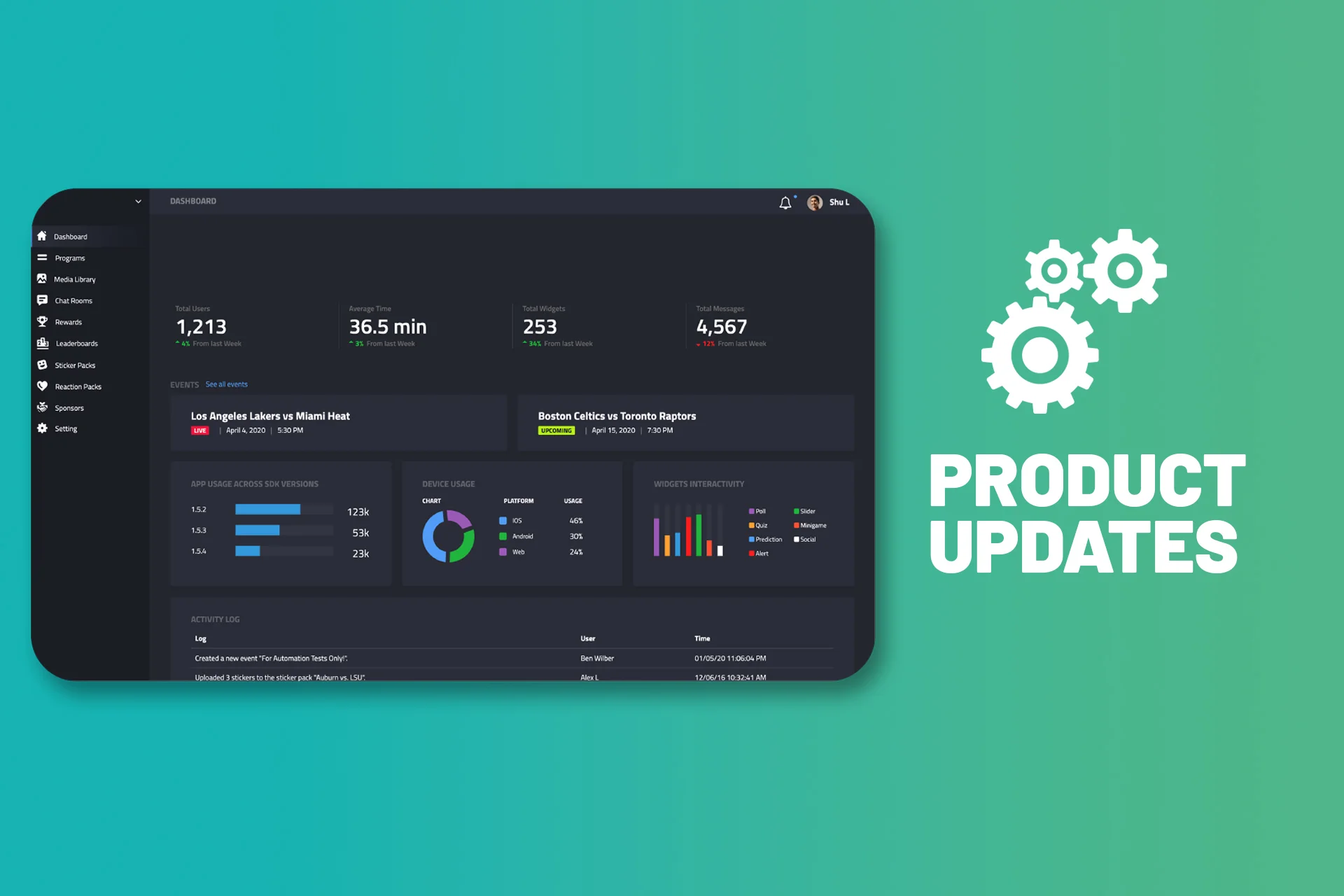
September has officially begun, which means we have an exciting roundup of August updates to share with you! We are pleased to announce that we have made some great new changes to the CMS, integrated our solution within one of the AWS products, and more. So, let’s get into it!
Expanded Reaction Capabilities
What users can react to on your platform shouldn’t be limited! Previously, reactions were only available to use within a chat—users could react to any individual chat message sent—now, users can use reactions anywhere. With this latest update, our clients can now provide access for their fans to react to anything on their platform, whether it’s a sentence in a blog post, a moment in a live game, or even the appearance of a team player.
LiveLike x Amazon IVS
As part of the AWS Partner Network (APN), LiveLike solutions can now be easily layered with Amazon Interactive Video Services (Amazon IVS), providing customers with more options to build and interact with audiences via live video.
Requirements:
- A LiveLike account
- A LikeLike application that can be created through the [LiveLike Producer Suite]
- A LiveLike Client ID
- An AWS account to use AWS IVS
- A stream URL to load videos
Check out the full steps below to integrate the LiveLike SDK with Amazon IVS, as part of your interactive application.
Access Reward Transaction History
The LiveLike audience engagement suite allows you to reward your users for their loyalty and interaction with your platform. With this new update, you will be able to generate a reward transaction history. This history provides a data feed of each instance of a user earning rewards. It can be filtered by profile, reward items, reward actions, widgets, and dates. It can also be integrated on your platform so that users can review their activity and understand their rewards balances.
If you want to learn more about LiveLike and what we are doing, feel free to contact us here. We would be delighted to learn more about your needs and expectations!
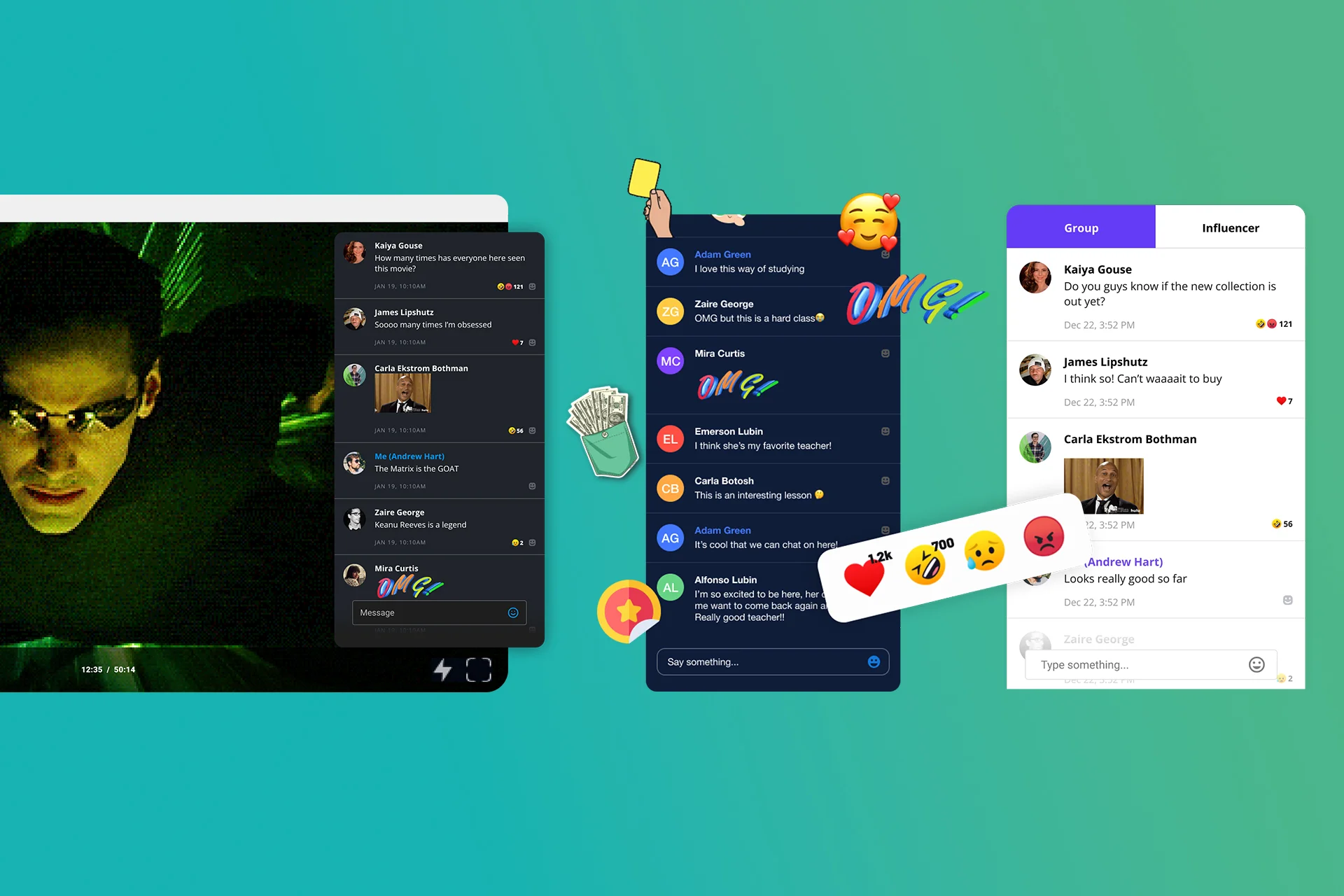
If there’s one thing people love to do, it’s chat. Whether it’s about themselves, their passions, or their opinions, it’s a part of human nature to want to socialize to connect with others, enjoy communal moments, and create and manage our personal reputations.
Conversing with others is a considerable part of our everyday lives, and since being able to do it online, it has only accelerated: Messenger has almost 1 billion monthly active users (source), more than 100B messages were sent each day on WhatsApp in 2020 (source), and the most popular category on Twitch is “Just Chatting” (source). The more people are connected to others and can chat—even virtually—the more they feel they are part of a greater community.
With all this in mind, we have always made sure to prioritize powering three different types of live chats that allow users to connect effectively in real time. In this product feature, we’re focusing on the most commonly used of our three chat types: Public Live Chat.
Introducing Public Live Chat
In order to empower positive social experiences among your platform users, we have developed a feature that enables engaging, easy-to-use and easy-to-monitor real-time public discussion.
With our public chat feature, your users get to engage in live conversation with other fans of your platform who likely share the same interests, passions, goals, or opinions, all without needing to know each other beforehand. Our public chat feature has the ability to bring together thousands of people simultaneously to interact on your platform, and discuss your live events or product offering in real time. It is an amazing tool to engage people, empower a community and incentivize users to return to your platform more frequently.
Main Features:
Our Audience Engagement Suite provides you with Chat UI and APIs to create a fully customized public chat experience that is tailored to your brand and your users. The supported features of the chat system include In-App Notifications, Room Member Lists, Avatars, Stickers, Reactions, Spoiler Prevention, the ability to report offensive messages, and of course, Moderation Tools.
When creating a chat room, you will get access to all the basic information you need in order for it to run smoothly: Room ID, Room Title, and Visibility (whether or not you want your chat to appear for members only or for all site visitors). The chat UI elements, including input windows, chat body, and chat bubbles, can be customized per your design guidelines.
Public Chat & Reactions:
The only thing that comes more naturally to us than talking to one another is reacting to the things other people say; and so of course, we had to make sure reacting to messages was an option in the digital world as well.
Whether your users disagree or are perfectly aligned with what someone else has said in a public live chat, our chat capabilities allow them to express their feelings and react with relevant emojis. The reactions you allow your fans to choose from are grouped into “Reaction Packs” and can be uploaded to your producer suite. Each reaction pack can contain up to four reactions.
Reaction packs can be customized based on your brand guidelines or on those of your partners if you wish to activate your partnership through our Chat feature.
Public Chat & Stickers
Have you heard the saying that a picture is worth a thousand words? Sometimes, an image is the only way to truly and accurately express a person’s feelings, evoke an emotion, or get a message across. Using our chat feature, your audience will be able to interact with chats not only by sending text messages but also by sending visual stickers (images, GIFs, etc.). This simple yet powerful feature works to drive engagement and draws in users to make them even more inclined and excited to chat with other fans. This holds especially true when the stickers fans have the option of using are relevant to the platform, typical user discussion topics, or the feelings they are likely looking to express during a live event. For example, users of a sports platform chat are likely to want a sticker pack that features GIFs of their favorite teams celebrating a goal, major athletes playing on the field, or even famous moments in sports that evoke an emotion. Giving fans a selection of stickers that are funny, relevant to their niche or to your industry, or entertaining in any way, will make them more inclined to use them and in turn drive higher engagement in your chat and on your platform.
Moderation Tools
Moderation is a mandatory feature when integrating a public chat, as it allows you to control what people are saying, and avoid the use of inappropriate language, insults, and other bad behavior that might deter people from using your platform.
As a part of the LiveLike Public Chat toolkit, we have developed key solutions to help you create the safest public chat experience for your fans. Firstly, we have enabled Automatic Filtering, a feature that allows you to ensure chat messages are being automatically moderated and filtered based on their contents. Automatic filters can be set up to work in a keyword-driven way (if a message contains a word from a customized list of bad words, it will be filtered) or in an AI-driven way (if an AI model recognizes a message as being objectionable, it will be filtered).
Adding to our moderation tools, if you don’t trust machines and want to moderate your public live chats yourself, you have the ability to do so as Moderator, and can delete messages, make user reports other users to moderators, block users, or mute them.
Leveraging Public Chat to Drive Business Objectives
Not only does the Public Chat widget have the ability to draw in new users and engage your existing audience, it can also help you to meet some of your key business objectives and monetization goals.
By pairing it with the rest of our Audience Engagement Suite—including our widgets, leaderboards, and loyalty rewards programs— you’ll be able to create a complete user journey and incentivize users to spend more time on your platform and sign up for your product or service. Of course, logged-out users will get a modified UI provided by the integrators that prompt them to log in or sign up to participate.
Case Study
Many brands across the industries have successfully activated our Public Chat feature to empower their community:
- GIGSET, a music platform for artists to perform online for their fans, used our chat feature to let audience members share their love for the event with other fans during concerts.
- LaLiga used it to bring more interactivity to the watch parties they organized for their fans over the 2021 football season.
- FloSports uses our public live chat on top of their programs in their mobile applications to better engage users. 19% of unique users on the FloSports app typed at least one message and they registered a significant increase in time spent on their application.
All in all, it’s important to give your users every opportunity to voice their opinion, provide feedback on your platform experience, and engage with other members of the community.
When used effectively and paired with relevant stickers, protective moderation tools, and useful reaction packs, Public Live Chat allows you to empower social experiences, foster a sense of community, and engage users on your platform.
How to Fuel Fandom From Couch to Cashier
Today on The Future of Fandom, we dive deep into the behavioral mechanics of purchase, with an ever-so-slightly nerdy illustration of the next-gen, couch-to-cashier journey with guest, Brittany Billings.
Brittany is the EVP of Marketing and Strategic Markets at Shopkick, and brings some commerce insight to the show that most can’t even provide. When you think about learning who your customer is, most brands will look to their social analytics and their receipt level purchase data. Not a whole lot is captured at least with true attribution about interim activity, that which happens between the couch and the cashier. But Brittany actually does thanks to Shopkick’s rewards based platform. And today we chat about how something as simple as watching a video or simply walking into a store is and should be rewarded.
What we describe on the show is truly next gen, and hopefully you get a glimpse into what the future of commerce really holds. So kick back, (yes, we went there) and listen in as we predict the future with Shopkick and Brittany Billings
Connect with Brittany Billings on LinkedIn: https://www.linkedin.com/in/brittanybillings/
Read more about Shopkick StockX: https://www.shopkick.com/
FULL TRANSCRIPT BELOW
Adam Connor (1:20):
Brittany, thank you so much for joining me on the show today. How are you?
Brittany Billings (01:34):
I am well, thank you, Adam. My daughter is back to school, so we’re back to normalcy now. Thank goodness.
Adam Conner (01:41):
Hey, well that must have been a while shopping season, huh?
Brittany Billings (01:44):
It certainly was challenging for many, many Americans out there, but I’m sure we’re all back, we’re happy to have our kids back in school now.
Adam Conner (01:53):
Well, hey, there have been a number of things that have confused shoppers. At least this year, we’ll get into a little bit of that as we move through this conversation. But of course, I know you’ll know the most and we’ll talk the most about Shopkick. So let’s start there. Let’s kick it right off from the top. Oh, didn’t even mean to make that pun, but no pun intended. What is Shopkick for those who don’t know, but should?
Brittany Billings (02:14):
Shopkick is a leading shopping rewards app for consumers and a leading shopper engagement platform for brands. So we allow consumers to earn rewards through many engagements they can have with a brand, whether that’s digesting content in app through perhaps watching a video through walking into a store, they earn rewards. We call them kicks here at Shopkick. They can pick up a product, scan it and earn rewards. And then they can actually earn incremental rewards for actually purchasing that product as well. And then our shoppers get to redeem those kicks for gift cards, cash and products.
Adam Conner (02:56):
All right. So this is fascinating. We have gone into this tangentially so far on this show in the lens of rewards and in the lens of appreciating people’s pre-purchase behavior, which is critical, but not often incentivized, truly incentivized. So we’ll get into that as well. And listeners, you can tune back into people like Rakuten and Baseline earlier this year for conversations like that, but it won’t be like this.
I’ll start with the broad view of what you’ve put in my head right there with that description, which is that because the consumer is rewarded every step of the way in an interim basis and on a final basis, and because the brand knows ideally what that consumer is doing through the purchase funnel, it seems to create this two way connection that let’s say a CPG or something like that, who doesn’t typically have first party data might not get. This is a two way connection, which is, I would think somewhat unique, at least something I haven’t heard of. It’s worth noting that Shopkick is part of a company based in retail analytics, which is great, because that’s where I started my career.
So I’m sure there’s plenty of data that’s getting passed between both entities. How do you accomplish that true two-way connection. And why is it critical when it ultimately comes to conversing with the consumer to be fan?
Brittany Billings (04:20):
Yeah, absolutely. I think first and foremost, you touched on a really good point from a CPG lens and our clients are Unilever, Kraft Heinz, Nestle. Their main points of distribution are through these major retailers. Those major retailers aren’t giving Nestle and Kraft Heinz a lot of information about the end customer because it’s Kroger’s end customer, it’s Target’s end customer, it’s Walmart’s end customer. So at Shopkick, we believe, and we’re able to facilitate that with our CPG partners, that there should be this two way value exchange before a transaction even takes place. So consumers have dedicated a lot of time and energy engaging with brands pre-transaction or consumers as well. We watch ads, we read content, we research, we follow brands on social.
Why shouldn’t the shopper be acknowledged for those behaviors? And at Shopkick, we think that they should. So as I mentioned earlier on our platform, we reward shoppers and through our brands throughout the entire purchase funnel. So we call it from couch to cashier as our cheeky, little way of saying it. So again, members, we sit on our couch, we watch videos, we digest a piece of content and then we can earn rewards for simply walking into a store.
So already right there, these brands are being associated with an incentive, with award, with a value exchange saying, “Hey shopper, we appreciate you taking your time and energy to learn more about my product. Let me give you something back before a transaction even takes place.” And so we’re treating these amazing shoppers as more than just a transaction.
Adam Conner (06:08):
Well, yeah. And in a way that is slightly more proactive than the commercials of [your 00:06:15]. Imagine listeners who are thinking about that traditional experience of watching a TV ad and you may have noticed on digital platforms that sometimes those ads are not coupled with the QR. Well, normally that QR will just take you to a website to go buy something, but it doesn’t really reward you for taking that interim step.
It seems like this is something that Shopkick is covering off and it is certainly a data treasure trove that somebody like a Walmart when they were real heavy into retail link, I know that they’re doing something new now, or DunnHumby, that will just have consumption level metrics, are unable to capture. This is a really nice, well, interim data set to match that interim action.
Brittany Billings (06:55):
Yeah. From a data perspective, we’re actually sharing it with our brand partners as well. So here, customer 1, 2, 3, 4 has watched your video. She is the chief household officer based outside of Atlanta, Georgia. She has two kids and actually she’s also shopped at these retailers. She’s also purchased these brands. Here’s the type of content she’s engaging with.
So we’re also utilizing it to optimize their campaigns, even within our own platform. A lot of times, they don’t have access to do that. As you said, with more traditional advertising, you can’t just change a television ad because that demographic wasn’t responding to it or those display banners or just going to bots. So it’s really exciting that we get to have such a meaningful relationship and value exchange with our brand partners as well.
Adam Conner (07:47):
Yeah, the creation of, and we’re going into a bit of a weed here, listeners, but the creation of a behavioral data set, just so that you’re aware if you’re not, is extraordinarily difficult to do, if all you’re getting is a transaction log. And unless you have something like an entire credit card profile, I know the major payment switches will do things in creation of psychographics.
But again, these are just data sets that well, ultimately you don’t see, you may not even care about, but are things that are critical for finding the path that a shopper takes, as you said, from couch to cashier. These interim steps that are taken along the way and incentivized and rewarded. You talked about watching a video, maybe downloading something. I wonder if there are a few examples of interim steps that people wouldn’t immediately think of as being rewarded, which Shopkick is able to unlock.
And then I also want to know to the degree that you’re able to tell us what you know about consumers who take those interim steps and their incremental proclivity to buy, having been rewarded for those steps.
Brittany Billings (08:48):
Absolutely. So our app right now, and of course we’re always iterating really amazing features and looking for all of those behaviors and those engagements that our members can be rewarded for. So right now it’s watching a video, an ad. We have 99% completion rate within our app on video ads from our brand partners.
Adam Conner (09:11):
That’s unheard of.
Brittany Billings (09:12):
That is unheard of. Absolutely. We have other more static content or lookbooks where our users can go through and get inspiration on what’s the next best thing that they should be making for dinner or spring cleaning tips or festival fashion ready. They can be rewarded for it. Our shoppers can be rewarded for simply walking into a store. So walk through Whole Foods and get rewarded, walk into a Publix, walk into a TJ Maxx, get points. Half the battle is even getting the customer out of their car and into your store. Our shoppers can then go into an aisle and pick up a product.
So at the moment of truth, when it’s the most important time, what product are you going to put into your shopping cart, we can actually influence our Shopkickers, as we call them, to pick up the product, scan it and get rewarded. And then when they go through to purchase the product, they upload a receipt into our app. So what’s even more, I know you as a data geek as I am, we at Shopkick are then receiving the full receipt, the full basket data, which also generally isn’t shared very broadly with those major [inaudible 00:10:22].
Adam Conner (10:22):
No, it’s not. It’s normally just a hash. It’s a hash credit and a total, unless you’re… Yeah, that’s cool.
Brittany Billings (10:26):
Yeah, absolutely. As well as online shopping. So we think omnichannel is very important, especially to the consumers. So you can shop online or shop mobile within the app and then through all of those major points during the shopping funnel, and get rewarded as well. Then we also do really fun things like contesting through social channels with our partners and sweepstakes and some wonderful surprise and delights that our community loves.
Adam Conner (10:49):
So based on the data that you are seeing and the incredible success of that interim content that you have on Shopkick, wonderful internal validation, I want to hook you with a curve ball just because this came up in the news yesterday. And listeners, you’re hearing this on Monday, we’re recording this last week, just so that you know.
Yesterday, Amazon basically released some news that it would be layering in TikTok style content into its app to incentivize people to consume that content and then to buy. At least externally, do you all find that as additional validation that maybe you were first to this and now that other players are beginning to catch up in whatever shape that may take that you’re on the right track with something or maybe that they smell some opportunity that you were first to?
Brittany Billings (11:36):
Yeah, absolutely. It’s really funny because as we think about Amazon and we think about online, a recent US commerce study just came out that 54% of consumers still prefer to shop brick and mortar compared to any other channel. So I think Amazon’s trying to approach that angle. And what we tried to do here at Shopkick is when we’re looking on Amazon, we have the ability to search and to filter. We can’t do that in the in-store world.
We wanted to harness that power within Shopkick and make this gamified experience where it’s very curated and you can learn about brands and you’re purchasing in-store and you’re getting that same fun gamified online experience within your store experience as well. So I agree, we are a trendsetter beyond Amazon.
Adam Conner (12:27):
Yeah, I would hope so. And the fact that you are able to do things like geolocate users and reward them for just walking into a store-
Brittany Billings (12:34):
Absolutely.
Adam Conner (12:34):
… very, very, helpful. And something that I’m not sure that Amazon’s even thinking about, which is probably again good for you.
Brittany Billings (12:40):
No. And your point of geolocation, we’re actually seeing as we are a native app, we are able to actually send push notifications to our users as well if they’re near a location where they could earn kicks.
Adam Conner (12:52):
Who wouldn’t like that? Listeners, if you don’t have Shopkick, I’m guessing you’ve never had a notification like that, offering to give you something as opposed to have you buy something, which is nice. We’ve talked a lot here so far and this is just fascinating to me. Again, I started my career in retail analytics and just to know the deep mechanics that go into getting somebody to buy something is much more than the first couch to the final cashier, plenty in the middle.
But on the show, we also talk about what that means for the end consumer who have probably to this point only really thought about it in those two end points. Do you have a few favorite stories of Shopkickers? I might not even saying that right. People who use the app to buy things and get rewarded. I’m sure through your tenure, you heard a couple of highlights. Could you share some with us?
Brittany Billings (13:43):
Yeah, absolutely. And I don’t want to get too sappy here on this podcast with you, but I would say the stories that we hear from our Shopkicking community on a daily basis, what motivates us here as a team to get up every day, it inspires our CPG brand partners to continue partnering with us and engaging with our shoppers in this way. We hear from one element of help during these really difficult economic times. As I mentioned earlier, our Shopkick users are America. They’re middle America. They’re worried about gas prices. They’re worried about how to pay for their children’s back to school supplies. And a lot of the stories we hear is that they use Shopkick to help them during these really hard financial times.
So one of the redemption options that we have is PayPal. So we hear that they’re using their Shopkick rewards to cash out, to get cash through PayPal, to help pay for groceries and gas. That they’ve been laid off during these times, that it’s helping ends meet. ‘There’s grandmas, who are helping buy back to school supplies for their grandkids. There’s a single mom who writes in and says that she is the best daughter in the world, and she saves her Shopkick kicks to redeem for a birthday gift every single year. So if that’s not motivating to you or to our brand partners, and if that’s not creating fandom between our community and the brands that are enabling them to do this, it’s pretty spectacular.
Adam Conner (15:20):
I agree. Being able to hear those stories either as a steward of the brand or somebody simply listening to one, that is what the essence of fandom is. It’s experiential in nature. Listeners will readily know what it’s like to be a fan of a TV show or a celebrity or sports team. Why is that? Well, it’s probably based on something that you’ve felt when you were engaging with that person or that good or that service. The stories that you get in the middle here are critical to that conversion from consumer to fan.
And once again, though I’ve harped on it a few times here, that is historically not something that I have seen when it comes to eCommerce companies’ ability to figure out what that path looks like much similar to the path to purchase.
So when we talk about that word fandom, and in this lens of eCommerce where it seems like you have an upper hand on learning behaviors and interim actions of people in that parallel path, how would you define that word? If we flipped open the Shopkick dictionary and we turned to F and got to fandom and maybe your personal dictionary, what would that definition read?
Brittany Billings (16:28):
Wow, that’s a great question. That’s a big one. I think and going on to your point too earlier, we normally don’t hear about fandom in those experiences when it comes to vitamins and household cleaners and… Right.
Adam Conner (16:43):
Right. Totally.
Brittany Billings (16:44):
It comes more in different categories of sports or entertainment, but making that connection. So how I would define fandom in the lens of what we do here at Shopkick and you mentioned eCommerce before, but I would really approach it from a standpoint of omnichannel or everywhere commerce. As I mentioned before, consumers still want to go into store, but they also want to shop online.
So I think it’s more about shoppers wanting choice. And can you provide the benefits of eCommerce, the search, the filter, the compare to the store experience and vice versa. So many of our customers, partners, excuse me, and this is just an anecdote, we’re originally D2C. Right, so they’re a D2C brand, their only purchasing eCom. And there’s been a huge wave of them moving to distribution through major retailers. And why is that? It’s because they heard from their customers that they want to find those products at those major retailers where they’re doing a majority of their shopping.
So to me, creating fandom is about listening to your customers and providing them that experience that they’re looking for.
Adam Conner (17:59):
So let’s turn for a moment to the other F word we pursue on this show, which is future. And colored by what’s recently been going on, at least in the US macroeconomically, we’ll stick here, is that retail made a huge bet through 2021 and first half of 2022 stocking up on excess inventory, which has now led to a bloat not only there, but with inflationary worries, we are starting to see a few cracks in the US retail landscape. Now Walmart’s earnings beat this week, not withstanding, certainly is going to provide, I believe, downward pressure on price at the, maybe the store or something like that, in the case that inventory becomes a real problem.
For somebody who is running the shop at Shopkick, what does that cause you to adapt to where if a consumer is really only concerned with the final price that they’re going to pay, does that bear some weight on the potential interim awards they can get? Does it further incentivize them to do that because their money goes longer? What do you have to say about this current macroeconomic environment and how it affects retail Shopkick eCom and the consensus they’re in?
Brittany Billings (19:08):
Yeah, absolutely. So I think first, the majority of our shoppers are value driven, and so they’re already going to be concerned. And even though Target might have mismanaged their merchandising buys and predicting the trends up front, yes, consumers want couponing. Yes, they’re going to find discounts at retail. The brands, however, and I think what’s really unique about Shopkick is our Shopkickers are earning kicks. They’re not earning discounts. And so they still need to go in and buy milk and buy eggs. They’re still necessities that families need for their family.
So how can we provide the best alternative in terms of providing additional value to shoppers? And so brands can come in and instead of majorly eroding margin by deeply discounting and deeply couponing, they can give this reward award in terms of kicks to the end user. So it’s also not discounting directly at point of sale, but we’ve heard that from our Shopkickers that a majority of them will actually buy a new brand compared to the one that they’re generally loyal to, if they can earn kicks for it. So I think it’s also a really interesting time that was 87%, excuse me, of our Shopkickers, would buy a new product as opposed to their go-to brand.
And so I think in these times, we’ve seen loyalty waiver, whether it was during the pandemic when consumers were moving more to private label and they had the ability to comparison shop when they’re online, sitting at home, not going out, going through supply chain issues, when maybe their preferred brand wasn’t there. So I think in this time, brands need to not rest on the laurels of their loyalty and discounting here and there just to get a customer. They need to go back, as we talked about earlier, that value exchange of making sure they’re awarding and recognizing a consumer at every step of that purchase funnel.
Adam Conner (21:13):
Yeah, that’s a good point too, because while loyalty has eroded, at least through the middle of ’22, personal consumer expenditure has largely stayed the same or risen a tiny bit. Now my guess is there’s a great deal of trade off beneath that, and that has to be incentivized by something, whether it is a price difference and availability difference or an incentive difference, maybe in terms of some intern award. It’s interesting then to try to, without having the data sitting on this side of the interview table, knowing exactly what the best in class path looks like.
And so that’s what I’d like to round this out with. I want to hear from the other side of the table, because in, let’s say, the future, beyond a high inflationary environment, beyond Target maybe mismanaging the merchandising, beyond Amazon looping in content and seeing if it can get beyond content creators wanting to boycott purchasing from there at all, based on labor practice. All this stuff, eventually there will be, and even if there isn’t, I’m sure you’re thinking about it, some utopian best in class shopping experience for a next gen consumer who is incentivized to meaningfully move through every step of the funnel.
That’s a huge context for the question, which is what do you foresee for the future of that experience, but I’m interested as we round out to just peer into that looking glass with you, because so far you seem to have been a step ahead.
Brittany Billings (22:34):
Absolutely. So incentives should be just one of the many elements of the future best in class shopping experiences as you’re looking for. But it’s really interesting. I believe that the stages of the funnel as we marketers have traditionally defined it is being altered, and it’s no longer going to be linear. So this next gen consumer, and we’re seeing it a little bit right now, anyway, with your Amazon example and my push notifications where we’ll follow you around everywhere that you’re going, consumers are navigating their day with brands and products and services completely competing for their attention.
And we see it as the winners that convert them into buyers is going to create that most frictionless experience. And again, I’m going to come back to this, the greatest value. So if loyalty is no longer guaranteed, brands can’t rely on the customers they once had. So how can they treat this new generation in a different way than how they used to rest on their laurels of past?
So I think it’s about just continuing to always strengthen the habitual and emotional connection that consumers have with your brand. And through incentives is one of them, incentivizing those desired behaviors. It’s how can you blur the lines of physical and digital and make the benefits of the online shopping experience relevant in store and the benefits of the in-store shopping experience relevant online. So I think it’s that seamless frictionless experience where we have all of our data and knowledge and power in our hands and consumers can make smart choices immediately.
That’s how I see the future. And again, I would say you don’t just end with the transaction. So we’ve talked about it a lot in this moment of, “Okay, you see some content, you get awareness, you get education, you get discovery and then you purchase.” One transaction is really great, but how do you guarantee that second one? So how do you follow up post engagement as well? So ensuring that there’s that solid loop between the transaction and those behaviors that lead to it, and then the behaviors that lead to the next transaction is where we’re going to win.
Adam Conner (24:51):
And no music fan ever became a lifelong die hard after one concert ticket. It’s always about that prolonged experience, one where they feel that they belong to a community. And that’s one thing that I’ve personally learned over this year, even via this podcast, is that when we say next gen consumers, which is essentially just, well, the youngest consumers out there, doesn’t matter where they shop, where they bank, how they’re entertained, they want to feel like they belong.
And that is just another way of saying emotional experiential is here to stay, and that will be dominant. Actually, I’m going to do one bonus question here because sometimes I like to flip this question on its head. Based on everything you know about what the next gen best in class experience, could you fill this blank for me? And the blank is, “Well, I could tell you for sure that a best in class next gen experience will not include,” blank. What’s that blank for you?
Brittany Billings (25:41):
It would not include waste.
Adam Conner (25:43):
What kind of waste?
Brittany Billings (25:44):
I think waste of time, waste of money, mental bandwidth. Again, I think we have so many things coming at us from a daily basis and I think the next gen wants something clean and open and honest, and that meets their expectations and is conscientious and wants to get it quickly and has just the power in their hands to make that quick decision to move on to the next one.
Adam Conner (26:13):
Yeah. And that makes sense too. I think, well, it goes hand in hand with that frictionless goal, that ideal where there is no slip up. And the reason why I asked about waste is because that’s taken so many different various definitions and various societal context even this year and last year. But yeah, very interesting. I do hope for at some point a wasteless experience with regard to any of this because it’s hard to do. And that’s the thing that I talk about with people all the time. It’s nice to talk in terms of ideals in the future will definitely include that, but it’s going to be a bit of a slog, I think, because we’re always going to be surprised by whatever, whether it’s macro conditions, societal implications, geopolitical issues, whatever. There’s always something that’s pressuring that bubble, but it’s nice to think about it. It’s nice to conceptualize.
Brittany Billings (26:59):
An ideal world, ideal world.
Adam Conner (27:00):
Yeah, in an ideal world, and we’ll get as close to it as we can. But in the meantime, I mean, hey, this journey to purchase and learning all of this behavior in the middle seems like a pretty ideal way to build that future. And so for that, I’m really appreciative to have you come on here and share your expertise and to share the story of Shopkick. Brittany, thank you so much for joining us today.
Brittany Billings (27:19):
Thank you so much, Adam. I really appreciate it.
Adam Conner (27:24):
Thanks again to Brittany Billings for joining us today. I’m glad you played along with me, even as we approached the weeds on retail macroeconomically and its implications on what’s to come. And thanks to you, the listener for exploring The Future of Fandom with us. I’d encourage you to stay connected. Here’s how you can do it, livelike.com/podcast, where you’re going to get all of our shows from 2022.
Of course, you can also subscribe to The Future of Fandom across podcast networks. And finally, we’re on social media, too, LinkedIn @livelike and Twitter @livelikeinc. I look forward to predicting the future again with you real soon. And until then I’m Adam Conner saying so long and thanks for being a fan.

It’s time to meet the man, the myth, the legend!! This week, we’re excited to introduce you to an employee who always gives 100%: Design Lead Shu-Kuang Lin.
We’re happy to introduce you to Shu and give you a chance to hear about his love for design, his daily responsibilities at LiveLike, and so much more. We’re proud to have someone like Shu on our team, and excited to get to share a bit about him!
Tell us a little bit about your career path. How did you get into UX/UI design?
Surprisingly, my major was actually film and directing rather than design. I made several short films and expected to be a director before moving to the United States. Then, in the first summer of grad school, I had an internship opportunity to work for an app design startup where I found some interesting similarities between exploring UX user stories and drawing film storyboards. At that moment, I stepped into the world of digital media and never went back to the film industry.
Can you describe what a Design Lead does and what your typical workday looks like?
For me, providing direction and mentoring designers is how I typically like to spend my time; checking in with them often to see if there are any blockers on the project side, and also helping their voices to be heard within the team to make sure the progress and feedback are aligned with those of our cross-functional partners.
Did you always want to work in a lead designer role?
I like to be in a role which brings long-term impact to not only the product itself but also to the team. As a design lead, it’s exciting to take ownership of projects and share any valuable past experience with other team members so they won’t make the same design mistakes in the future.
What have you learned about LiveLike (as both a business and a team) since you joined?
A lot! Mainly, the power of integration, and getting a wider vision to explore areas I’m not familiar with.
For example, our product decisions are sometimes majorly impacted by business strategy, which gives me more opportunities to consider design, not just from a user perspective, but from how it can meet each team’s requirements. LiveLike is really open to all kinds of these conversations between different teams and so I learned how important transparency and communication is to the Company.
Is there anything else you’d want to share with aspiring designers?
I know designers can sometimes feel imposter syndrome—the truth is that we have all experienced it somehow. I believe there is no one-step solution to be perfect, however, there is always room for improvement.
Join us! We are not just a group of talented designers, we are real humans! We like to share, listen, and are very open-minded. We respect each other’s feedback and design decisions. That’s what we always do; at LiveLike, we love to help each other get to the places where we feel comfortable and confident.
Thank you, Shu!
It’s time for our Summer Product Update! This month, we are pleased to announce that we are moving forward with our Stats Perform integration, we have released the first version of the LiveLike Quest feature, and we have upgraded some of our existing product features.
We Launched a New Feature: Quests!
This feature has been brought up in several conversations over the years and has been requested by many of our clients, so we finally made it a reality: We launched the LiveLike Quest feature. Quests are sets of tasks that users must complete in order to achieve a specific goal that may lead to the acquisition of a badge or a certain user status on the platform. This checklist of interactions is a fantastic way to give end users a more engaging, motivating experience as they work towards certain goals through Quests.
Quest tasks can be partially completed, so that integrators don’t have to keep their own counters when designing tasks like “invite 5 friends” or “attend 3 classes”, and both the user and the integrator will be able to track the task progress during the Quest. Quests can be used to build things like new user onboarding checklists, product and feature tours, or one-time promotional campaigns. Check out the quick demo below to see how to build a Quest using the LiveLike CMS!
Note: Quests are still in the early access phase and not generally available.
We Integrated Automation for Interactive Widgets
A few months ago, we introduced you to our brand new data feed integration with Stats Perform, that enabled the automatic creation and publication of alert widgets such as statistics and facts. We are excited to announce that we have since moved forward with the integration of automated interactive widgets for soccer games.
Now, you can automate the creation and publication of emoji sliders and text polls when a specific action in a game occurs. Currently, the supported actions are: Match Start, Match Half, New Goal, Yellow Card, Red Card, Shot, Foul, and Substitution. Of course, you can decide what kinds of actions you want your audience to engage with (for example only Match Start and Goals). Currently, text widgets are predefined: When a goal is scored, the alert text will automatically read: “Did you enjoy this goal?” with the designated slider below. However, in the near future, you will be able to edit the text of each widget prior to this automation.
So, what’s in it for you? Less human control over the CMS, an increase in pace in terms of widget publication, and the allocation of your resources elsewhere when your event is live.
The upcoming main steps will be to expand the number of data feeds integrated to be able to cover more sports and provide you with even more possibilities. However, if you wish to use our solution for other sports right now, we would be pleased to further investigate the possibilities together.
Also This Month
Sponsorship is Now Clickable!
Let’s drive more synergies and conversions with your partners using our latest update regarding sponsors! Now you can configure click URLs for sponsors, directly from our CMS. This major update is also available by API and can be used inside custom UI. Don’t waste your valuable time and instead start showcasing your partners by pushing clickable Sponsor Alerts!
A New Leaderboard Feature
Previously when checking a leaderboard, users were able to directly see the top 5 members and their own position in relation to the top 5. Now, you can decide to show leaderboard positions of specific users to add more relevancy. It is even possible to integrate the leaderboard with your social graph to show users their friends’ rankings. Reinforcing the competition leads to more interaction and engagement on your platform, which is a key step to creating loyal users!
We hope you enjoy these new updates, and please do not hesitate to contact us if you have any questions. If you are not yet using LiveLike but are interested in integrating our solution, you can also reach out and book a demo with our sales team.
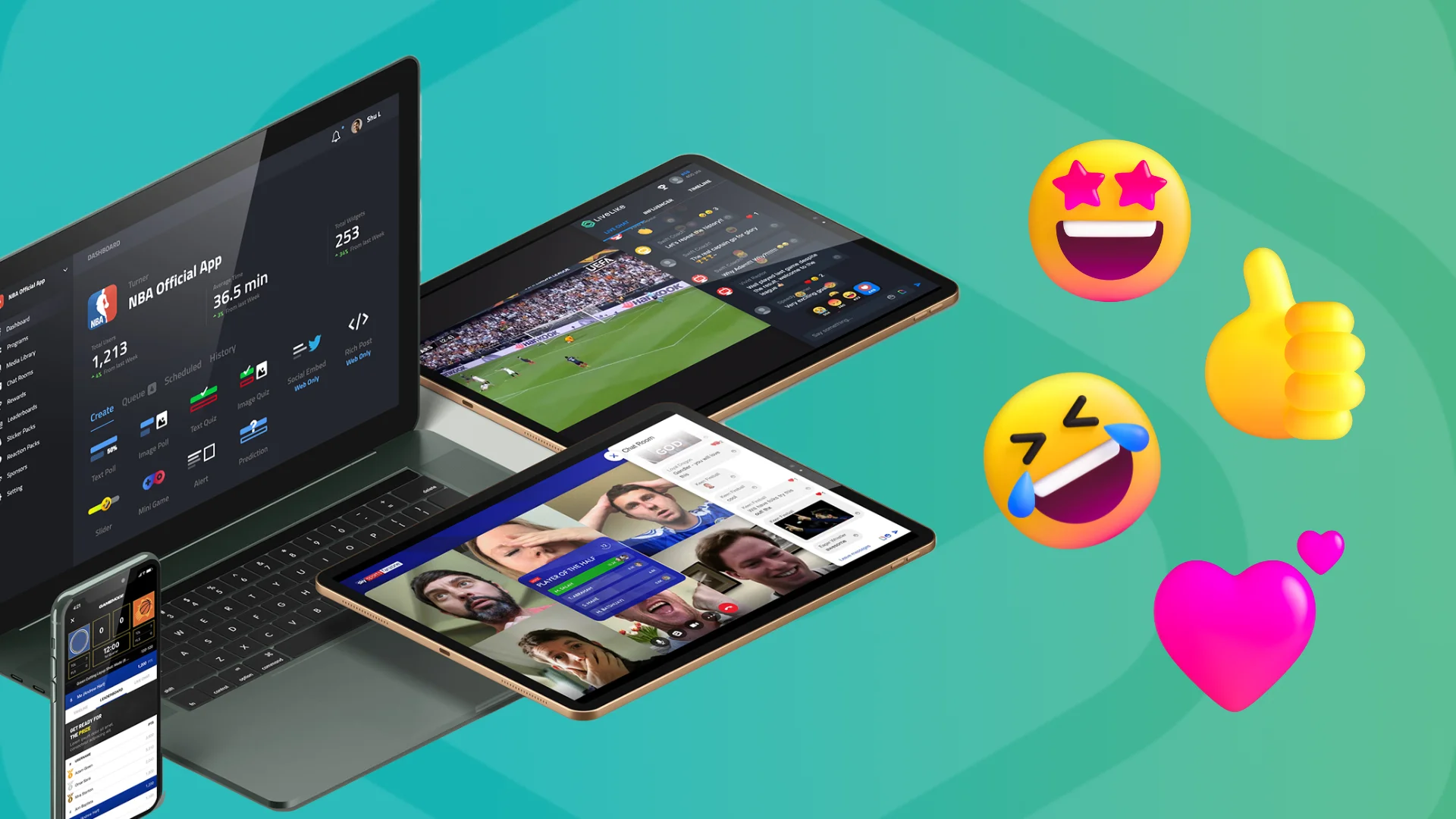
Ever since the introduction of Facebook reactions in 2016—which feature reaction buttons like “love”, “haha”, “wow”, “sad”, and “angry”—many other brands and companies have followed suit with the same formats.
In 2019, LinkedIn announced the launch of LinkedIn Reactions, in which users can mark posts as “funny”, “insightful” or “curious”, and take a stance on whether they “love”, “like” or “celebrate” them. In 2020, Instagram added a feature that allows users to react to DMs and stories with emojis. And now in 2022, we can leave emoji reactions on iMessage, Slack, Zoom, Snapchat, and almost every other online platform.
We even see icon reactions being used in the real world; in many mall, restaurant or airport bathrooms, visitors can find emoji feedback machines, where they can rate their experience based on restroom cleanliness.
As a part of the LiveLike audience engagement suite, we prioritize making this type of self expression a given on your platform in order to show your audience you care about their opinions, and give them a way to share their thoughts with the rest of the community.
In this article, we’re breaking down the top four reasons why social media reactions work successfully to increase user engagement on your platform.
1. It Allows Your Users to Express Themselves
The depth and range of human emotion is far too wide and complex to narrow down to a simple “like” button. People want to be able to express themselves and share their opinions as often and with as few limitations as possible, whether they’re in the real world or interacting online.
In other words, it isn’t enough to give something a thumbs up or down, people want to be able to cheer on posts or experiences they support and appreciate, show dismay or rage to the ones they disagree with, and question the ones they don’t understand.
Don’t just take it from us; let the stats speak for themselves. In the first year following the launch of Facebook Reactions, users shared 300 billion Reactions, adding up to more than 800 million a day.
When users are given a broader range of emotions to react with, they are also more likely to feel comfortable engaging with content, as it takes less than a second and they know their reaction is less likely to be misconstrued. For example, previously users only had the option to use the traditional “like” button if they wanted to engage with a post, regardless of if they actually liked the content or not.
With reactions, they are no longer limited or at risk of being misunderstood, and can engage freely in a way that may lead to richer, more intelligible discussion.
2. It Shows Your Customers You Care About Their Input
The difference between a passive user and a loyal fan is often determined by simply letting them know you value their opinion and want to know what they think.
By giving your users more options to express their thoughts or feelings on your platform, you are telling them that you care about what they think about your content, and are going to use that information to give them a better experience. When the option to react to posts isn’t there, it subconsciously lets your users know you are not a people-first platform.
Not only does this ability to express themselves give your fans more freedom, it also results in the collection of valuable user data regarding the content on your platform. While they feel heard and perhaps engage in more meaningful discussion about the different reactions given, you can start to discover what content resonates the most with your audience.
3. It Enables Conversation Between Users in the Community
With Live Chats being one of our major LiveLike solutions, we’re all about giving users the ability to communicate, and fostering productive or engaging conversation between fans. Doing so not only works to establish a sense of community and belonging for your users, but also boosts engagement rates on your platform, and gives you key insight into user opinions about your product, service, or platform experience. While live chats are a more obvious way to enable conversation, reactions are an equally strong force in getting people talking.
Take, for example, this post by Learn Basics, that makes great use of the LinkedIn Reactions format and saw over 15,000 reactions and 500+ comments:
By using reactions strategically and pairing it with a relevant poll question, this post successfully catches the attention of its viewers, engages them in sharing what is likely an opinion they feel passionately about, and entices them to start a conversation either arguing others’ message reactions or advocating for their own.
As well as being an effective way to start debates or discussions in the comment section, reactions also offer an extremely low effort option to interact with a post. Not everyone is comfortable leaving comments on social media, and not everyone has the time to craft the perfect response. Reactions are a quick, easy second option that still allow users to participate in the discussion and give their two cents, which in turn goes towards boosting your overall platform engagement.
4. It Creates Opportunities for Increased Brand Recognition
At its core, reactions were created to expand the limits of how users could express themselves online; but even still, the reaction options found on platforms like Facebook, Instagram, and LinkedIn remain limited to around 4-5 emotion-based emojis.
That’s why, as a part of the LiveLike suite, we’ve pushed the boundaries even further by introducing the ability to react with custom brand reactions through build-your-own-bespoke UI. You can use the suite to introduce brand-specific emojis and GIFs that fans can use to respond to chat messages, sentences in a blog, images, or even moments in a live event.
Whether you’re in sports, music, edtech, or fintech, using brand and industry-specific reactions that are personalized to your niche target audience helps to make your fans feel special and to create a sense of community, all while helping to define your brand voice.
What’s more, launching brand-specific reactions—like the ability to react to something with an image of your company logo or a GIF of a player on your sports team—essentially works as a free way to have your own users spread the word about your brand, and build up your brand recognition.
At the end of the day, your users are looking to feel heard, share their thoughts and opinions with others, and connect with likeminded people in their community. With stock UI to use OOTB or build-your-own-bespoke UI to get added customization, the LiveLike Live Chats solution has everything you need to introduce fun, effective reaction formats for your fans to meet these needs.
Currently, LiveLike powers three different types of live chats—Public, Private, and Influencer—that all integrate reaction capabilities to engage users. Start boosting user engagement on your platform with social media reactions with the help of the LiveLike engagement suite.
Still not sure if gamification can be applied to your business platform? Get in touch today to learn more about how gaming elements can enhance your user experience.
How to Own the Next Gen Experience
Today on The Future of Fandom, we deep dive into the next gen experience — and how to own it. on this episode we take a look at StockX and how it stays ahead of the curve, and even ahead of its partners, in this realm of consumer connection via their Chief Marketing Officer, Deena Bahri.
StockX is known for sneakers, streetwear, accessories, collectibles, and everything in between. It’s also been able to harness hype and build an ocean of fans drop by drop. Today, Deena chats about how they stay close to next gen consumers in the physical, digital, and “phygital” worlds.
We also talk about Own It, StockX’s next brand platform that they hope will layer another critical element of the next gen consumer into their own experience: the desire, and the need, to belong as an individual.
Deena’s been on the cutting edge for years, and over the next half hour, you’ll see why. So let’s collab for a little while and predict the future with StockX and Deena Bahri.
Connect with Deena Bahri on LinkedIn: https://www.linkedin.com/in/deenabahri/
Read more about StockX: https://stockx.com/
Read more about Own It: https://stockx.com/lp/own-it-2022/
Full episode here:
FULL TRANSCRIPT BELOW
Adam Conner (01:26):
Deena, how are you? Thank you so much for chatting with me.
Deena Bahri (01:29):
Hi, Adam. Good to be here. Thank you for having me.
Adam Conner (01:32):
And chatting with you again, by the way listeners. It’s not been on this podcast stream, but I have interviewed Deena before in a similar vein, specifically how to harness hype, which we will talk a little bit about today I think. I think that it is certainly relevant to this idea of fandom. And we’ll get to that. We’ll get to the other F word here, which is future. But the first thing that I want to do, I’m guessing most people who listen to this know what StockX is. If they don’t, where the hell have they been? What is StockX Deena?
Deena Bahri (02:01):
Hmm. I hope everybody knows, but just in case, StockX is the leading global platform for trading and consuming current culture. You may be saying to yourself, what is current culture? It’s everything from sneakers to apparel, to electronics, trading cards, collectables, art prints, Lego, anything that represents what the consumer is talking about, thinking about right now.
Adam Conner (02:29):
Now in terms of that current culture, of course ever changing, but the way in which it was interacted with digitally and in eCommerce has changed a lot, progressed, evolved, let’s say over the last several years from the first days of direct to consumer where people were starting to take advantage of their own relationships with brands that weren’t necessarily tied to a specific retailer, to the time when you began at StockX to today, to this interview. From that heyday, to your first day, to today, what have you seen change the most about the way that consumers engage digitally and what has stayed the same?
Deena Bahri (03:11):
I’m thinking of three things that have changed. The first I would say is the pace. Just things are going faster and faster. A symbol of the influence of technology, I guess, and the amount of conversion 15 years ago, when I started in direct to consumer, there were pretty much the early adopters in e-commerce. Maybe some people were converting from offline to online consumption, but it was a smaller more separate ven diagram. And I think it’s converging more, more and more. You have more consumers who maybe don’t fit the traditional eCommerce consumer profile becoming eCommerce consumers. And I would say that is also contributing to the change of pace. And then you have just so much convergence, right? There were, I think, brighter lines between it’s called, one example might be entertainment and fashion, or sport and music.
Deena Bahri (04:10):
These were more separate quadrants of culture I think that are now converging more and more and crossing over. I guess the last thing that has changed is just the nature of the dialogue between brands and consumers, which, going back in time was a one way dialogue. Obviously the advent of social channels has created faster, more frequent conversation. But I think in the very recent times, the emergence of newer platforms has allowed for true two way conversation. And I think that’s really, again, fundamentally changed the relationship between the consumer and a brand.
Adam Conner (04:50):
Completely new ways to interact, truly with this well new generation of people, a next generation of consumers, which requires a next gen experience. Now you’ve been at the forefront of that over the last several years with StockX. Thank you for telling me what’s changed over time. When it comes to the today, the most recent part of that last analysis, when decoding what that experience should look and feel like, from an elemental basis, from its foundation to its frills. Let’s just say, if I were to create a wardrobe on StockX from the shoes I got to wear everywhere, to the watch that I can wear maybe, what are those parts that are essential? And what’s the cherry on top right now, again, in your experience, for that next gen experience?
Deena Bahri (05:43):
I think what’s essential for the NextGen consumer experience, I think truly an omnichannel experience. It’s a word we’ve talked about for a long time in e-commerce and in retail. And I think increasingly that is table stakes, right? A consumer who has an experience or an interaction with the brand online, wants to have a connected experience with your brand offline. I think the other piece of it is really being distributed with your brand presence in the channels where the consumer lives, and the marketing channels where the consumer lives. And that means really showing up well natively and consistently in social channels and in each social channel where your consumer is living and breathing and consuming content. We talked again for a long time about having a consistent brand presence in your touch points. But I think today more than ever, the consumer expects to be greeted where they are with a familiar voice and presence from you, the brand. And that’s something we’re certainly working on all the time.
Adam Conner (06:52):
Yeah. What are some of the recent ways in which you’ve leaned into that? Meet people where they are is certainly something I’ve heard about a lot, meeting the demands of the newest generation of consumers, for sure. They’re more demanding than most in terms of sounding and in terms of feeling like they want to belong, like they are of value, well, a valued customer and in turn that makes them a fan. Are there any specific examples recently that you’ve built up to meet that demand?
Deena Bahri (07:17):
Yeah. I think last time we spoke about discord, and that’s an example we go back to often because it is a channel that has emerged over the last 12, 18 months as a place that we as a brand must be, and a place that we can engage with our consumers in a very rich way. And I think launching that, continually testing our presence in that channel, expanding our presence in that channel with different content types and engagement platforms. I think also some of these emerging streaming platforms like Twitch, where again, a year ago or 18 months ago, we tested, we gingerly put our toes in the water. And then now, fast forward to today, we have a team of marketers and creatives in Amsterdam activating our brand at TwitchCon as part of our partnership. I think it’s about being on the right channels, but also being there in the right ways.
Adam Conner (08:11):
Yeah. I think that’s the first time I’ve heard. And it’s a nice moment for me just in my years of interviewing marketers, but learning about this world, it’s the first time a brand and you’ve done it now twice to say, “We need to get into Discord.” I really haven’t heard that and I can more readily understand activations with Twitch. I think live streaming has a long way to go, even though live commerce is sort of sputtering, at least in the US. That’s certainly something I can grasp.
Deena Bahri (08:37):
Mm.
Adam Conner (08:38):
But the Discord thing, I’m going to remember that, when Discord, it becomes an essential brand channel maybe a couple years down the road in terms of the way that you interact, and then remember that you said it first and you said it twice before anybody, which was very notable.
Adam Conner (08:51):
Let’s talk about some ways in which you create magnetic experiences and maybe Discord eventually will be one of those where you feel really, really tightly tied to, as a consumer, to StockX. I’m reminded of other players out there right now, I think who are navigating this digital ecosystem really well.
Adam Conner (09:12):
The first one that comes to mind is Nike and sneakers, just because of the inherently shareable experiences that they allow people to publish as soon as they get, or don’t get a new drop of shoes. In fact, also on this show, a gentleman by the name of Rob Petrozzo. I don’t know if you’ve met him, but he co-founded a platform called Rally, and basically said that he borrowed a lot of those things for his platform because it was so inherently shareable. And because it was a great way to connect people. Now, marketplaces, I think in general, have an ability to do that more so than their brand counterparts. The people who would supply that marketplace. Nike sneakers, I think is a bit of an outlier, but I’m curious how you pull those brand partners along for the ride, because I’m guessing that they’re not thinking about it or are as connected to do it as you are. Do you know what I mean by that?
Deena Bahri (10:02):
Yeah. Yeah. It’s a topic that comes up a lot in our conversations, in our direct brand conversations, because they don’t understand this consumer. I’m generalizing of course, but…
Adam Conner (10:13):
Sure. Yeah.
Deena Bahri (10:14):
By and large, they don’t understand this consumer as well as we do. And they don’t understand how to reach them and how to be relevant to them. And I think they do recognize the need obviously to show up in the right channels, in the right ways, with the right product. But they are often struggling with the path. And I think it’s a place when we do develop these partnerships, it’s a great opportunity because we can bring that. They bring the product, we bring the connection with the consumer. And one of our strong desires every time we partner with a brand, or a personality, or an entity of any kind, we try to make it feel authentic and be fully integrated. Right? We don’t like to do these surface level partnerships, but we try to build multiple layers where there’s content integration. There’s hopefully some unique product involved. There’s a tailored or targeted marketing campaign. There maybe is an event. It becomes more of like an immersive 360 experience with that brand partner for the consumer.
Adam Conner (11:19):
List something that’s a branch of that. And I don’t want to tiptoe, but I want to make sure I ask the question carefully, which is that it seems obvious to me and to you, and thank you for noting that individual brands are behind when it comes to that consumer connection. Obviously they ultimately want to get there. Do you foresee a time in which they will ever get there to the extent that a traditional marketplace has it? Because if you are going to build genuine fans, my guess is that most people want to do it directly. That’s why DTC rose 15 years ago, as you said, when you were part of the first adoption of it. Do you see brands accelerating even towards you or do you think you’re accelerating away from them even as you grow?
Deena Bahri (11:58):
Maybe I’m biased.
Adam Conner (11:59):
Okay. Fair enough.
“I think we’re accelerating. I think it’s true what you’ve said about brands wanting to establish that direct connection with consumers. And I also think sometimes they do that with blinders on without really seeing what the consumer wants. And they’re perhaps not asking themselves the question of, “Does my consumer really want to have to create credentials and sign up for loyalty with me and the 10 other brands they interact with,” as an example, right? I think when you’re interacting with a marketplace is one of the great benefits is you can engage with lots of your brands, your beloved brands, and when you’re interacting directly with one of those brands, obviously there’s tons of value. But I think there is a cost to the consumer to have to give their data, develop that deep relationship in the way that serves the individual brand’s goals.”
— Deena Bahri (11:59)
Deena Bahri (12:50):
There is a trade off there. I think we are accelerating because we are today in line with the way the consumer wants to consume, right? Which is in this eclectic, hybridized fashion, right? We use the word multihyphenate a lot. And we use the word intersection a lot. I think people don’t want to look head to toe, one brand. They don’t have one single passion point. They are complex and their interests are complex. And at a place like StockX, they can serve that complexity in one single place.
Adam Conner (13:22):
Yeah, that makes sense to me. And that was my inkling as well. That marketplaces are generally going to continue to accelerate away. And that brands will always be a bit myopic in the way that they want to attract consumers because it’s consumers [inaudible 00:13:35], it’s consumers that consume my thing, right? Whereas on StockX, or on any marketplace that can consume a bunch of stuff. And the way that you connect with consumers is your, I don’t know about secret sauce, because it’s sauce that’s out there, and other people have their other ways. It reminds me, I had a conversation with Rakuten and Dana Marino, who’s their CMO, another person I should introduce you to, anyway. And they do it through rewards, but everybody’s got their thing. And regardless of what that thing is, yeah, I think they’re getting away from brands. We’ll see. But that’s what I…
“Well, I do want to add one thing though, because I think there is one element in which brands have been super successful at reaching the consumer, and it comes to life on our platform a lot. I think it’s worth talking about, and this is collaborations. I think this has been a trend with our consumer for quite some time now. And we see more acceleration with brands collaborating with, let’s say an incumbent luxury brand collaborating with a musician or an athlete, or with a brand that’s adjacent, but not in their direct space. We’re seeing this with Gucci North Face, or any number of the Crocs collaborations. And I think this is one of the smartest ways I’ve seen some of these brands reach outside of their comfort zone to connect with consumers. And I’d love to see more of that. I think it speaks to, again, being focused on the customer and the way they consume rather than being focused on the singular brand goals.”
— Deena Bahri (14:03)
Adam Conner (15:04):
I’m right there with you. I think that’s a great point. Borrowing fandoms is a subtopic that we’ve explored on this show and it hasn’t been with product to product. Actually it started with getting warranties on product. We had another interview here with a gentleman who runs a company called Extend that does extended warranties. Anyway, he described a flywheel of that where consumers will ultimately want, in his case, it was extended warranties from a singular source. But in your case is they love the idea of those collabs. They’re new, they’re fresh, they’re things that brands probably aren’t thinking about all day, but that somebody like you can and can demonstrate how successful that it is, gets the people going, gets them excited.
Adam Conner (15:41):
This is actually where I want to bleed into the last conversation that I have with you. Because as we talk about fandom, we talk about fans and turning consumers into fans. You got to talk about the hype that comes along with any new drop, any new collab, anything like that, especially since StockX has grown to be a platform for more than just one thing, one category. You can get a whole ton of stuff on StockX. Listeners, you should be going to StockX.com right now, while you’re listening to this, because you have your hands free, but given the volatile nature of some of these things and I’m talking mostly digital goods and collectibles over the last couple of months, let’s say, we’re doing this around the middle of 22. What can you, and what can brands take away from the hype cycles that dominated their growth to retain engagement from those hyped up consumers once some of those fads start to wane?
“Well, we talked about the pace of change, and I think brands that want to stay relevant need to stay on pace, right? Launching one really great product or collaboration today will sustain you for a little while. But to stay in the foreground for the consumer, you as a brand have to continue moving alongside them. And I think you really need a roadmap of continued drops, continued moments. It doesn’t have to be drops depending on what business you’re in, but continued moments to engage the consumer in an accelerating or crescendoing story, right? And it could be building on the original moment or it can be a rotating cadence of stories. But I think the consumer’s appetite for interaction and for consuming stories is large. And you have to be willing to try to satiate that with a strong cadence of content, moments and engagement.”
— Deena Bahri (16:35)
Deena Bahri (17:37):
I think focusing on passion points, for us, that’s been super successful, right? Really understanding our consumer. We talk often about how much we listen to the customer. We study the customer, we do a broad array of insights work, qualitative, quantitative to really understand our consumer. And then we use that to fuel our decisions. And I think the results are showing that the consumer appreciates being heard and being observed in that way.
Adam Conner (18:06):
Well, that ties back to what NextGen consumers want. They want to feel like they belong. They want to feel individually valued and they want that individuality to shine. They want to be empowered in that search for it and in that embodiment of it, once they do. How relevant and timely then it must be for your newest initiative, “Own It,” which is very aptly named, and successfully, I believe, tackles this search and this destination, that’s a very broad way to sell it. Could you please describe what “Own It” is for StockX and what you plan to do with?
Deena Bahri (18:45):
Yeah, absolutely. Just this week we launched “Own It” as our new brand platform, and if you’re watching, you’ll see it perhaps on a digital media channel on television, you’ll see it on [inaudible 00:19:00] home, at TwitchCon, we’re going to be activating it all over the world, then all over the customer journey in order to celebrate individuality, self-expression, and the confidence that comes with really knowing who you are and putting it out there for the world to see. We talk about as our purpose at StockX, our purpose is really to empower consumers everywhere to participate in culture through their passion points, and “Own It” is an ode to that.
Adam Conner (19:28):
I was just reading a couple days ago. In fact, listeners, you’re going to be listening to this probably on Monday the 18th, which means this is brand new. You’ll be able to see it for yourself and the way that you’ll be activating this “Own It” platform will be in a number of ways, including one which is described by a word that I first heard by an expert and a consultant in the Gen Z world. It’s a guy named Ziad Ahmed. I don’t know if you’ve ever met him, which is “phygital.” Let’s go back to Discord for a second. This is the way that you are embodying it. I’m curious, in your perspective, what are the ways in which the physical and the digital will continue to bleed together, especially in the lens of this next gen consumer connection and experience?
“Yeah, I think it’s a fun word. And we started using the word phygital, actually when we launched our digital trading platform in January for basically tokens of physical products. And we said, this is a phygital item, meaning you own a physical item, but you have a digital token that you can trade to represent your ownership. And I think that is a great way to explain phygital. It’s the crossover between something that you interact with digitally and something you interact with physically. In our marketing world that might mean you engage with our brand campaign online, and then you happen to be at TwitchCon and you interact with the brand there in person, or you participate in an “Own It” themed panel on Discord, and then you go to one of our retail locations to pick up a piece of merchandise that ties back to the campaign. It’s again, that crossover between the digital and the physical, which goes back to a theme we talked about earlier, which is showing up in a consistent omnichannel way for the consumer.”
— Deena Bahri (20:14)
Adam Conner (21:22):
Right. Yeah, I can’t wait to see how that manifests, especially at TwitchCon and I’m not going to be in Amsterdam, but I’ll read about it plenty. Because I do follow that world, especially in the world of livestream, in a real world Discord experience. Never seen it. Can I use the word hype? Yeah. I’m pretty hyped to see actually how it’s going to roll out.
Adam Conner (21:40):
Okay. Let me touch on the other F word we like to talk about here, which is future as we close, and excuse the multiple word plays here. I’d like to know what you’re putting stock into next or what your “X” factor is for the future. I want to know what is next for you, for StockX? Maybe this is even what is nobody thinking about yet that they should, when it comes to this, again, we could say consumer connection experience, this broad stuff that we’ve been talking about over the last 20 minutes. I’m just curious. Is there some crazy, wacky, wild idea that is just the roots are there, but hasn’t proliferated. You seem to be on the cutting edge of pretty much every other way that consumers have connected over the last couple years. You might as well be able to tell me about the next ones.
Deena Bahri (22:25):
I wish I had that crystal ball.
Adam Conner (22:26):
Yeah, me too.
“There are a few things that we believe are going to be really strong themes for the future. And some of them are themes you might have heard from me last time we spoke Adam, alt investing, something we talk about a lot, the idea of digital or phygital assets. Having a lot of value, being highly valued by our consumer, and being a viable investment vehicle. And that’s something we’re going to continue to spend time on.”
— Deena Bahri (22:27)
Deena Bahri (22:52):
We talked about convergence and used collaborations as one example, collaborations between say luxury and street brands, for example. I think that’s going to continue to happen and this hybridization of themes coming together. I think we’re going to see that happen more and more. And then, maybe as my last prediction here, something that we’re starting to think about a lot. And certainly personally I’m thinking about a lot is the value of experiences, and how I think this consumer and this time in life, as we’re hopefully coming out of a pandemic, there’s a high premium on experience. And we’re thinking a lot about how do we help the consumer engage in that?
Adam Conner (23:41):
Yeah, that’s an area where I’m specifically super interested just because it’s been a few years since people have either been comfortable for it, and thus, a couple years, and since it’s been heavily invested in, and what’s old will be new again, almost in that way, but of course the tech will have evolved in a great way and a great deal since.
Adam Conner (23:59):
Thank you for telling me all of this. This has been a wonderfully enlightening, again, and listeners obviously now you know what StockX is. You should go over there and see what they are doing. Check out this “Own It” thing and just follow along. Because if the last few years of experience have taught me anything, it’s that these folks will continue to be at the cutting edge which means that you should be too.
Adam Conner (24:23):
Deena, thank you so much for joining me on the show, for peering into the future with me. We’ll keep looking for that crystal ball, but for now I’m very appreciative.
Deena Bahri (24:29):
Thanks, Adam.
Adam Conner (24:33):
Thanks again to Deena Bahri from StockX for joining us. Calling it now, as I did on the show, Discord will be a place more brands flock to in the coming years, maybe sooner. And thanks to you, the listener of course, for exploring the Future of Fandom with us. I’d encourage you to stay connected so here’s what you do: go to livelike.com/podcast and subscribe to the Future of Fandom wherever you listen. We are also on social @LiveLike on LinkedIn, and on Twitter @LiveLikeInc. Adam Conner (25:08): I look forward to predicting the future again with you real soon. And until then, I’m Adam Conner saying so long and thanks for being a fan.
This week on our Get to Know LiveLike series, we’re excited to highlight Software Development Engineer and Tester Intern Shruti Aggarwal.
Shruti has been passionate about software development since she was younger, and thrives off of any opportunity to improve her skills, grow her knowledge, and further expertise when it comes to programming. She has a love for coding languages and is always looking to learn more from her peers. After being introduced to the world of coding in high school, Shruti knew she wanted to find an SDE role and since found her way to the LiveLike team.
We’re happy to introduce you to Shruti and give you a chance to hear about her passion for coding, her daily responsibilities as an intern at LiveLike, and so much more. We’re proud to have someone like Shruti on our team, and excited to get to share a bit about her!
Tell us a little bit about your career path. How did you get into engineering?
My love for coding began when I first chose computer science in Grade 11 and that was the moment I decided I wanted to be a software developer. When I was first introduced to the concepts of programming languages, I was so excited to learn how different and powerful each of them are, learning first about the amazing power of C++.
After graduating, I continued with my journey in coding by entering into a postgraduate degree program to earn my Master’s of Computer Applications (MCA). I was a bright student but as soon as I got into college, I realized I had a lot more to learn in the coding space. I started participating in technical activities like research paper presentations, projects and more, conducting full, in-depth research on programming topics.
During my postgrad, I worked really hard to learn other languages along with my program course subjects, and completed some really strong projects on my own and with my peers. I also used to spend time helping out other classmates who were eager to learn more about coding, which helped me to strengthen my own knowledge at the same time. I sat for placements in my MCA and eventually landed where I am today, living my dream to be part of a technical field and learn more every day.
Can you describe what an SDET intern does and what your typical workday looks like?
As an SDET intern, my workday is not often very typical and can greatly vary from day to day. Generally, I start by going through my messages and emails, and checking in with my teammates. Then, I check some of the JIRA tickets which are either related to my language domain or to that of my team. After that, I spend several hours learning more about the LiveLike product, and reading more on the technical documentation of the Company, other task-related documents and my domain-specific learnings.
As a Software Development Engineer and Tester, I perform multiple kinds of testing throughout the day like sanity and regression, and on the development side I perform integration testing of the features, which gives me a better understanding about iOS language.
Did you always want to work in an SDE role?
Yes! It has always been my passion to work in the technical field as an SDE. When I first started learning about computers, I knew that I wanted to build something unique and helpful that would add to the betterment of the world. Since then, I have worked hard to get to the place I’m at today, and though I was unsure at times about the career journey I was taking, I am certain about the destination it led me to.
What have you learned about LiveLike (as both a business and a team) since you joined?
As an intern, you not only get to know the ins and outs of the product you’re working with but also the company. Since this is my first job out of my postgrad, I can say that being a part of LiveLike as a first career experience is no less than a blessing. As a startup, the opportunities at LiveLike are endless, and the company culture provides a profound example of how teams should work together. The people and the culture here not only work to foster the creation of a strong product, but it also has made me a better person both professionally and personally.
Someone once said that having a good manager feels like having a good friend, and I am lucky to have Vijay Rawat and Shivender Singh as my seniors. Even in terms of iOS skills, my knowledge zone has expanded and all the credit goes to iOS developers-Mike Moloksher, Ljupcho Nastevski, and Jelzon Monzon who are highly skilled and help me become a better developer each day. Everyone here believes in growing as a team and helps each other in the best possible way whenever the opportunity presents itself.
Company culture aside, when I first got to know about the LiveLike product, I was astonished by the sheer creativity of it. It’s clear that the team at LiveLike is constantly working to make the product more optimized and present it to the world in the best possible manner.
Is there anything else you’d want to share with aspiring engineers?
Dear aspiring engineers, do not lose hope and remember that you will get to learn more in this field than any other. If you ever feel like giving up just remember your “WHY”. You don’t have to be perfect in everything, just be unbeatable in one domain. Do not get overwhelmed and do not compare your first day looking at someone’s 657th day of practicing. Just keep going and keep working on your skills. The world is full of help, you just have to ask for it.
Love yourself, take really good of yourself in every manner and be gentle towards yourself and to the people around you. And remind yourself everyday that “practice beats talent”.
Thank you, Shruti!
The first-ever NFT was minted in 2014, and just seven years later, in February of 2022, the market cap of Art Blocks NFT projects available on the Ethereum blockchain and listed on OpenSea was worth roughly 828 million US dollars.
Nowadays, NFTs seem to be everywhere and can take many forms including art pieces, collectibles, domain names, event tickets, video-game items, virtual land, memes, and more. Despite their abundance, however, NFTs are still often poorly understood by people who don’t work directly in the NFT space, and who find themselves asking the same question: “What is the point of an NFT?”
This is a tough question to answer as the NFT market is still at a very early stage and is set to evolve significantly over the next few years. But one thing is for sure, the popularity of NFTs and the global NFT market will only continue to rise if, firstly, the access to NFTs is simplified as much as possible so it can be accepted by global audiences; and secondly, if there are more identifiable utilities associated with NFTs to help sustain and reinforce the market over time.
Before diving in to this crucial conversation around NFT utility, check out our NFT announcement video:
So, What Do We Mean By Bringing Utility to an NFT?
When you’re planning on investing in an NFT, you’re likely not doing so simply because you find that specific NFT—whether it’s a piece of art, an event ticket, or a domain name—particularly beautiful or impressive or extraordinary. Of course, that can play a major role in your decision, but it’s probably not the sole appeal. Instead, you’re likely also investing in an NFT to be a part of a community.
The appeal of being part of an NFT community, and what’s often responsible for incentivizing NFT buyers in general, is the exciting, redeemable perks that come with it. In short, minting an NFT with utility gives you access to a community where you’re then granted admission to enjoy exclusive benefits that can be digital as well as physical.
Take Crypto Baristas as an example: The “fun, caffeine-inspired NFTs whose purchase supports real-life coffee initiatives”. Crypto Baristas have launched a small collection of NFTs with the goal of opening the world’s first NFT-funded café in New York, supporting coffee supply chains, doubling down on sustainability, and improving the livelihoods of coffee-growing communities.
Holders of Crypto Baristas NFTs receive caffeinated perks for life at all future brand café spaces, exclusive coffees from Coffee Bros., and discounts on Crypto Baristas merchandise. As you can see, the investment in a Crypto Baristas NFT has a double utility here; not only do you get advantages like free coffee, you also contribute to a project that matters and makes a difference (and bonus appeal if you’re a caffeine lover!).
Measuring the Value of NFTs
At the start of the NFT craze, the value of NFTs was mainly measured by their scarcity and the reputation of the people behind their creation. The understanding was that if the founding team members seemed skilled and resolute, the public reputation was thriving and majorly positive, and the actual products were so exclusive and obscure, then the launch was sure to be a success.
This is how things typically went in terms of selling NFTs in the earlier days—specifically more artistic NFT projects that would be coveted by a niche group of people who held interest in either the space of NFTs or art collection. The more famous you were or the more hype you built around your project, the better chances you had at success, and you’d better not screw up your pre-launch reputation or the value of your NFT project may diminish.
Of course, these types of artistic NFT projects that target buyers who understand the ins and outs of NFTs will still exist as the NFT space evolves. But the reality is that in order to democratize NFTs and have them exist in the mainstream, reputation and scarcity won’t be enough to make people realize the value they will acquire over time and invest in them.
Should Every NFT Have Utility?
While some projects rely on utility as a key driver for people to purchase them, the short answer is no. Why not? Because it depends on what kind of NFT you’re looking to purchase or mint.
If you are going to mint a digital artwork or a meme, it is best to think of it as if you were buying a physical painting or drawing, where the appeal is not necessarily its use. And similarly to purchasing a physical piece of art, NFT artwork will come with a public certificate of authenticity and ownership despite being issued by the blockchain in which the artwork or meme is stored.
On the contrary, and for some other categories of NFTs such as collectibles or gaming items, the added utility can help to empower an NFTs’ value and increase its demand even further.
Why Utility is Becoming More Important in the NFT Space
Simply put, utility NFTs are growing in importance because scarcity, reputation, proof of ownership, and certificates of authenticity are no longer enough incentive. People want to invest in an NFT because of its long-term value, not its bragging rights.
Buyers are starting to ask: What can I achieve with my NFT? What am I getting out of this? How is this purchase benefitting me?
This is where the utility layer can provide answers and strengthen the value of NFTs, ultimately helping to democratize NFTs. We are already seeing a lot of opportunities and use cases arising in the gaming industry with utility NFTs: In some cases, holders of utility NFTs are able to use their NFT to gain access to exclusive items in multiple games; in others, a holder’s avatar is able to wear NFT fashion items. And with more and more integration of utility in these industries, it is becoming a crucial factor of staying competitive in the NFT space in general.
So, How Can LiveLive Help Bring Utility to Your NFT?
The NFT space has opened up a whole new world of opportunity for consumer interaction, brand storytelling, and engagement through digital goods. Since our Audience Engagement Suite was created to reinforce connections with users through interactive features and to reward fan behaviors with points and badges, it was natural for us to further investigate how we could use the power of NFTs to further drive engagement.
We truly see our platform as a gateway for Plug and Play utility for NFTs. It’s no longer only about collecting items in your wallet or being part of a community; it‘s about creating additional ways to incentivize all NFT holders with advantages and gated experiences within digital platforms. Our main goal now is to combine NFTs with our loyalty and rewards features to make them even more attractive and useful.
Through the LiveLike CMS and our Proof of Interaction API, you’ll be able to link NFTs with any specific rewards and experiences of your choice. For example, the Golden State Warriors listed their first NFT collection last year and have planned a new drop this month, as a build up to the 2022 playoff season.
The GSW roadmap includes both digital prizes (ex. Ticket Stub NFTs) and physical prizes (signed jerseys) for every round victory. Using our API solution could enable them to extend the scope of utility for their NFT holders, offering them new experiences such as virtual one-on-one discussions with players, Ask Me Anything sessions with the coaches, access to private group chats, significant discounts on merch and ticketing, access to premium content, emojis, stickers, and more.
Expanding the NFT utility layer using our Audience Engagement Suite will help organizations to increase the reach of their collections and seamlessly onboard more and more non-crypto native users. It could also help them bring more value to their NFT collections, reinforcing the appeal and subsequently the demand for them.
Want to learn more about how LiveLike can help you bring utility to your NFTs?
This week on our Get to Know LiveLike series, we’re happy to be highlighting Sales Development Representative Nick Thomas.
Nick has always been passionate about building strong relationships in his working life, and providing the best customer experiences possible, no matter the position or industry he’s in. After being introduced to the world of sales by a friend, he knew he wanted to move into the SDR role and found his way to LiveLike.
We’re happy to introduce you to Nick and give you a chance to hear about his career journey, his day to day life as an SDR, and more. We’re proud to have someone like Nick on our team, and excited to get to share a bit about him!
Tell us a little bit about your career path. How did you get into sales?
I got into sales through a friend of mine who I worked with at a nonprofit called Tulsa Responds where I worked as a client navigator. My friend told me about a program called Satellite in which they train you to become a sales development representative and help you to find your first sales position.
At the time, I was looking to change career paths and after researching what an SDR is and what they typically do, I was immediately interested. I signed up for the Satellite program and totally immersed myself in the world of software sales. It was super fun learning about what it takes to become a successful SDR, and it helped me develop a newfound passion for sales that eventually led me to LiveLike.
Can you describe what a Sales Development Representative does and what your typical workday looks like?
A sales development representative is someone who conducts outbound prospecting and research for new clients who may be interested in the product the SDR’s company is selling.
A typical workday for me includes researching potential new clients, writing cadences to various industries, conducting outbound prospecting through multiple email campaigns, and monitoring those email campaigns for any promising responses. I also do organizational tasks such as preparing meetings for our business development team and providing upkeep through our client database system HubSpot.
Did you always want to work in a sales role?
I knew that I wanted to work in a role where I could build relationships with clients, but it was only last year when I determined that sales was the right path for me. I’ve always loved talking to and meeting new people, and have previously enjoyed working in customer service roles.
Once I had done some research and learned more about what it means to be a sales development representative, it became clear to me that it was the exact kind of role I’ve been looking for—one that combines passion for a company or product with meeting and building relationships with clients.
What have you learned about LiveLike (as both a business and a team) since you joined?
Since joining the LiveLike team, I’ve learned so much about the LiveLike platform itself as I’ve explored new and exciting ways to pitch our product to new industries. It’s been really cool getting to learn more about how our product can be implemented to meet the needs of all different types of companies.
When I first started, it felt a little bit like I’d be on my own island being the only SDR on the team, but so many teammates across all the different departments have been really supportive and inviting during my time so far with the company. I can definitely say I don’t feel like I’m on my own island and that I love the community feel that the LiveLike team brings me.
Is there anything else you’d want to share with aspiring sales representatives?
I would say the best advice I can give to an aspiring sales rep is to always be respectfully persistent, treat clients like human beings not robots, and think of creative ways to reach people!
.svg)
.png)