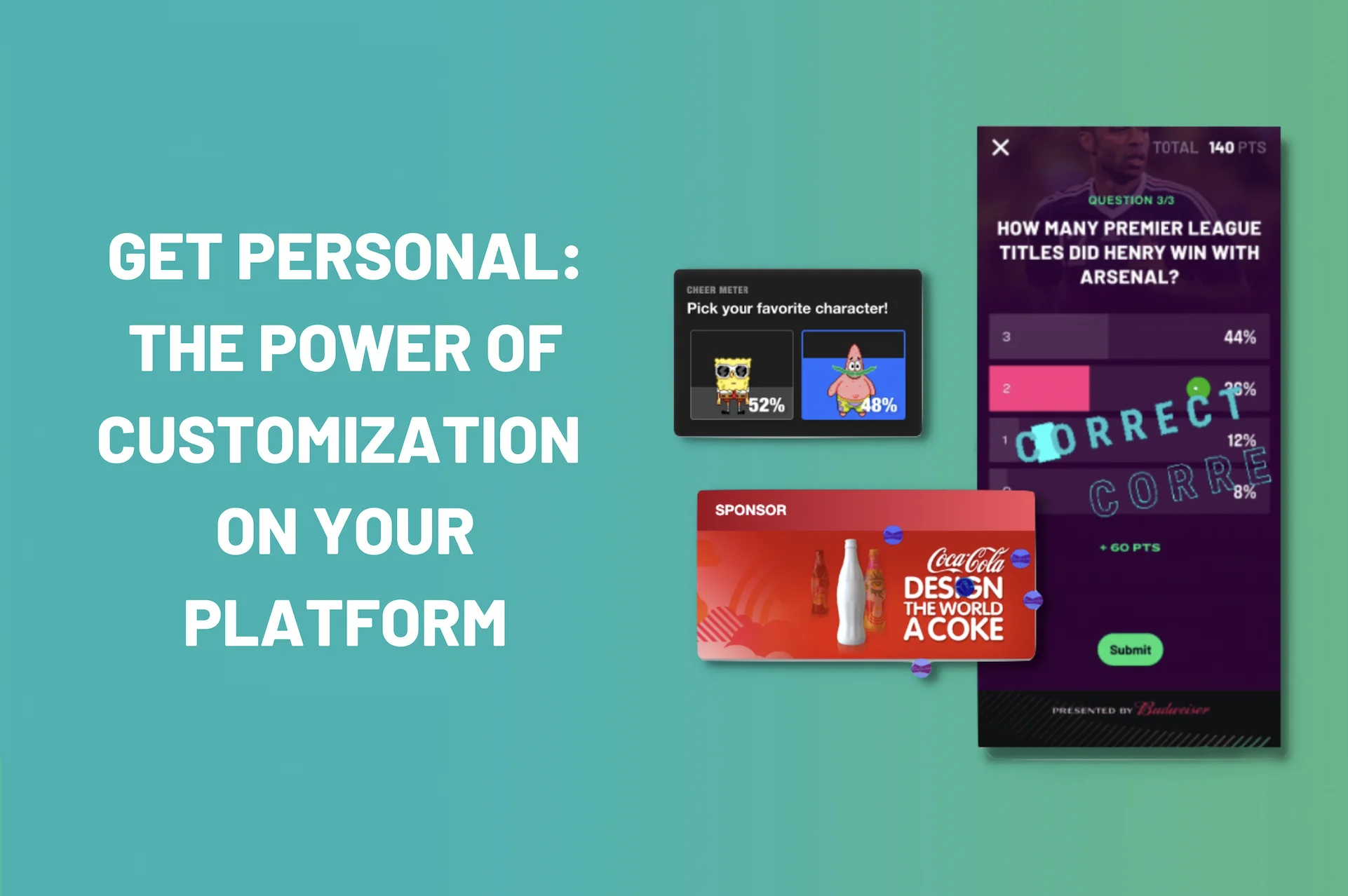
Customization has become a crucial aspect in today’s market, where the ability to personalize the user experience can mean the difference between success and mediocrity for a business. By offering a platform with a wide range of customization options, you empower your clients to create a truly unique experience that resonates with their target audience and sets them apart from the competition.
From interactive features to loyalty programs and beyond, giving your clients the tools they need to tailor their offering to their specific user needs is a surefire way to drive fan engagement and satisfaction. In fact, 71% of consumers expect a personalized digital experience when they go online, and 76% get frustrated when they don’t find it.
In other words, customization is KEY; that’s why the LiveLike engagement suite offers a wide range of customization options, from branded interactive widgets and live chats to customizable loyalty rewards programs and web3/NFT solutions. With these tools, you can create a truly unique and personalized experience that sets your platform apart from the rest and keeps your audience engaged and coming back for more.
In this article, we’re breaking down the main reasons why customization is so crucial for the success of your digital platform.
First Thing's First: Why is Non-Customizability a Problem?
Before we dive into the benefits of customizing your platform, let’s talk about the potential drawbacks of not prioritizing it.
Non-customizability can present a number of issues for platforms, including:
Lack of User Engagement
In 2023, people crave authentic brand experiences, including feeling like it was made specifically to meet their needs and certain user expectations. About 76% of consumers are more likely to consider purchasing from brands that offer this kind of personalization.
Because of this, a one-size-fits-all approach to a platform’s features and functionality can lead to a lack of fan engagement. Without the ability to personalize their user journey or feel as though the experience was made for them, users are likely to lose interest more quickly in a brand and seek alternative solutions that are more customized.
Limited Platform Differentiation
In a crowded market, non-customizability can limit a platform’s ability to differentiate itself from the competition. Without customization, a platform can be perceived as just another generic offering that fails to address the unique needs and preferences of its users.
For example, consider two platforms offering event management services. The first platform provides a one-size-fits-all solution that is not customizable, and the second provides a range of customization options like personalized branding, custom event pages, and unique agenda-building tools. Which platform do you think event planners are going to choose?
The answer is clear: the second platform, with its customizability, is much more likely to be chosen as it offers a unique and tailored experience for each event planner’s specific needs.
Missed Monetization Opportunities
Customization options not only enhance the user experience, but they can also provide monetization opportunities for a platform. The ability to offer premium features or services to users who are willing to pay for them can result in significant revenue streams for a platform. This is because users are often willing to pay for a premium experience that is tailored to their specific needs and preferences.
For example, consider a platform that provides custom branding options. The platform could offer basic branding options for free, while offering premium options such as custom logo design or personalized event pages for a fee, a monetization opportunity that would not have been possible without the customization options the platform offers.
So, What Are the Benefits of Customization on a Platform?
Besides avoiding these downfalls, customizing your platform also offers a multitude of benefits, including increased user satisfaction, better user adoption, and heightened customer retention. By providing a tailored experience, customization can reduce acquisition costs by as much as 50%, lift revenues by 5-15%, and increase marketing spend efficiency by 10-30%.
Whether it’s through offering customizable dashboards and profiles, user-generated content, configurable settings, a variety of platform themes and skins, third-party integrations, or AI-powered recommendations to adhere to your individual users’ interests and behavior, customization is a key factor in delivering a platform that truly empowers users and drives success.
So, why not make customization a priority and reap the rewards of a more engaged and loyal user base?
Let’s get into the major benefits of customization:
Increased User Satisfaction & Engagement
As we’ve mentioned, customization allows users to personalize their experience, leading to higher user satisfaction and engagement levels. By allowing users to personalize their experience, they are more likely to be satisfied with the platform, continue spending more time on it, and interact with more content and features. This added customization also boosts brand loyalty, as users are more likely to feel a stronger connection and ownership over their experience.
Increased User Retention
A platform that is able to provide a personalized experience is more likely to retain users over time, as they feel that their needs and preferences are being addressed and met. When users can tailor the platform, they are more likely to remain loyal and continue using a platform. This increased user retention can lead to increased revenue, customer loyalty, and long-term success for the platform.
Access to Crucial User Data
When users are given the ability to customize their experience on a platform, they are more likely to engage with it and form a deeper connection with the brand. By personalizing various aspects of the platform, such as their profile, preferences, and settings, users are providing valuable information about themselves to the company. This information can then be analyzed to gain insights into the preferences, habits, and needs of the user base as a whole.
For example, a company offering a personalized music streaming service may collect data on the genres and artists that individual users listen to most frequently. This data can then be used to improve the platform’s recommendation engine, ensuring that users are being served music they are more likely to enjoy. Additionally, the company may use the data to identify new music trends and adjust its content offerings accordingly, providing users with a better and more relevant music experience.
At LiveLike, we understand that customization provides a personalized and unique experience for each and every end-user; that’s why it remains such a critical aspect of the LiveLike engagement solution. Every individual has different needs and preferences, and offering customization capabilities allows our clients to cater to those differences and create a truly tailored platform experience.
With customization, we’re able to offer platforms the ability to meet the specific requirements and goals of each fan and user, resulting in increased satisfaction, engagement, and overall growth. In short, customization is a key factor in delivering a platform that truly empowers users to achieve their objectives and drive their success.
Want to learn how LiveLike can help you customize your platform experience for users? Contact us today.
Personalize Interactive Digital Experiences to Maximize Engagement and Conversion With the mParticle LiveLike Integration
Standing out in the post-covid era is harder than ever before. Consumer attention spans continue to plummet, and the rate of new content creation is accelerating. In the modern digital landscape, personalization, context, and engagement are the best currency.
mParticle’s integration with LiveLike enables brands to bring the 360° customer view available in mParticle into LiveLike, the most complete digital experience platform, in order to deliver contextual and immersive customer experiences. The integration enables data-driven teams to maximize fan engagement, increase retention rates, and open new monetization opportunities.
mParticle and LiveLike
LiveLike is a digital engagement platform that transforms digital users into engaged fans through customized, interactive experiences. Interactive Widgets, Live Chats, and Rewards programs can be fully customized to meet a brand’s digital product objectives.
mParticle is an AI Customer Data Platform that helps brands such as Starbucks, NBCUniversal, Spotify and Airbnb turn customer data into insights, and insights into action. By collecting data from across sources in real time, creating a 360° customer view, and streaming data to downstream tools through 300+ productized integrations, mParticle enables teams to deliver real-time, personalized experiences that are consistent across channels.
By connecting data from mParticle to LiveLike, Product, Marketing, Commerce, and CX teams are able to use the most relevant data to inform and optimize immersive digital experiences.
How It Works
- Data is collected via native SDKs, or sent to mParticle via RETL, S2S API, or flat file uploads
- mParticle associates the events to a profile and adds the profile to any relevant audience
- Event Integration: data collected or ingested by mParticle can be forwarded to LiveLike in real-time
- LiveLike’s engagement and interaction experiences are informed by data from mParticle
- Feed integration: loyalty, rewards, engagement, and other zero-party data can be fed back to mParticle, and can be made available to other platforms
Benefits
Built on the three pillars of interactivity, community, and loyalty, LiveLike’s 360° solution brings fan engagement to owned and operated platforms, allowing them to avoid dependency on third-party ad and gaming platforms. The LiveLike engagement suite is modular and fully customizable to meet the needs of a diverse range of business needs and product goals, and can be easily integrated via Web Embed Codes, SDKs (iOS, Android, Web), and APIs.
Use the 360° Customer Profile in mParticle to Inform Experiences in LiveLike
Rich first-party data stored in mParticle can now be used to target and personalize experiences delivered via LiveLike’s engagement suite. This data can inform polls, quizzes, alerts, promotions and more, helping brands to reduce churn and improve monetization.
For example, consider a platform that provides custom branding options. The platform could offer basic branding options for free, while offering premium options such as custom logo design or personalized event pages for a fee, a monetization opportunity that would not have been possible without the customization options the platform offers.
Build a First-Party Data Asset
The mParticle LiveLike integration can ingest data via LiveLike engagement widgets, allowing companies to develop and own a new proprietary set of customer data. Companies can use this data to gain a deeper understanding of their customers and to target their audience more effectively through the mParticle platform.
Coordination With Other Channels, Teams, Tools, and Use Cases
Loyalty and reward programs brands manage in LiveLike can be easily coordinated with programs run in other platforms integrated with mParticle. LiveLike and mParticle customers benefit from mParticle’s existing integration layer—making it possible to connect data from other tools to inform experiences in LiveLike, and making data from LiveLike available in other systems. This allows for even more reach, better customer engagement, and increased revenue.
We are beyond excited to announce this new partnership, combining two incredibly powerful market-leading companies.
To learn more about how to get started with mParticle and LiveLike, schedule a custom demo here.
As a growth marketing manager, you’re on the front lines when it comes to expanding the reach and impact of your company’s products or services. The competition for user retention is intense, and the business environment is constantly changing, making it a challenging and demanding role.
Despite this, if you’re up to the task of consistently experimenting, adapting, and making data-driven decisions to create the best possible user experience, your efforts are almost guaranteed to pay off in terms of driving user acquisition and referral growth.
That being said, it’s always good to get a little help!
In this article, we explore the objectives and KPIs you should have in mind when prioritizing user acquisition on your platform. We also provide some solutions for meeting these objectives and discuss how the LiveLike engagement suite can help growth marketing managers to achieve their retention goals. By following the strategies outlined in this article, growth marketing managers and business owners alike will be able to turn the challenge of user acquisition into a powerful opportunity to drive more revenue.
Goals & KPIs for Driving More Acquisition on Your Platform
The objectives and KPIs for a growth marketing manager can vary depending on the specific goals and targets of the organization. For example, a startup might be more inclined to focus on acquiring new customers, while a more mature business that has already garnered initial brand awareness might be more focused on customer retention and brand loyalty.
For any business, however, growth marketing managers should have a deep understanding of their target audience and be able to develop and implement strategies that align with their organization’s goals to drive business growth. Some common objectives and KPIs include:
OBJECTIVES
- Increase User Acquisition: Drive more traffic to the company’s website or app to increase the number of new users.
- Improve User Activation: Ensure that new users have a positive first experience and take desired actions, such as making a purchase, completing a tutorial, or signing up for a service.
- Boost User Retention: Keep users engaged and coming back to the company’s product or service through personalized experiences, incentives, and effective communication.
- Drive Revenue Growth: Maximize conversion rates, upsell opportunities, and customer lifetime value to increase revenue.
- Foster Referral Growth: Encourage current users to refer friends and family, effectively expanding the company’s reach without spending additional resources on user acquisition.
KPIs
- Acquisition Rate: Number of new users acquired over a specific period of time, typically measured as a percentage of the target number of new users.
- Activation Rate: Percentage of new users who take desired actions, such as making a purchase or signing up for a service.
- Retention Rate: Percentage of users who continue to engage with the company’s product or service over a specific period of time.
- Conversion Rate: Percentage of users who complete a desired action, such as making a purchase or filling out a form.
- Average Order Value (AOV): Average amount spent by a customer in a single transaction.
- Customer Lifetime Value (CLV): Estimated total amount a user will spend over their lifetime as a customer.
- Referral Rate: Number of new users acquired through referrals over a specific period of time, typically measured as a percentage of the total number of new users.
8 Tips to Supercharging Your Growth Marketing Efforts
Now, having knowledge of the best metrics to measure your retention is important, but only if you are going to take the necessary steps to improve them. That’s why it is crucial for growth marketing managers to implement effective strategies with these metrics in mind to drive growth via their digital platforms.
We compiled a list of the top tips and strategies we recommend for maximizing your growth marketing efforts and improving your retention metrics. These include:
1. Personalization
Did you know that 80% of consumers are more likely to buy from a company that provides a personalized experience? That’s why it’s so crucial to make sure the experience on your platform is tailored to your users’ unique needs and preferences.
Whether it’s adapting your platform to different user preferences such as language, time zone, or device type, using your customer data to create personalized blog posts, or offering different promotions to different users based on their demographic information, personalization can work to build stronger relationships with your users and increase their engagement on your platform.
2. A/B Testing
Otherwise known as ‘split testing’ A/B testing essentially means creating two versions of something—copy, images, CTAs, etc—and testing them with different groups of users to see which version performs better. By gaining this information, a growth marketing manager is able to make much stronger data-driven decisions when it comes to improving their platform user experience. By continuously testing different platform elements, they are able to identify areas for improvement and enhance the user experience to drive growth and increase conversions.
3. Paid Advertising
Paid or pay-per-click (PPC) advertising can be an extremely valuable strategy it comes to acquiring new users and driving traffic to your platform. In fact, PPC can generate over twice the number of visitors compared to SEO, with a stunning 200% ROI rate when used effectively. It’s no wonder it’s so crucial for growth marketing managers to prioritize!
Paid advertising can come in the form of search engine ads, social media ads, and display ads, and involves using targeted campaigns to reach relevant users that are likely interested in the products or services you are offering. By creating these targeted campaigns, paid advertising can be a great and cost-effective way to reach large audiences quickly and efficiently in the hopes of acquiring new users.
4. Content Marketing
We’ve all heard the saying: content is king. And it only becomes more important as the markets get more and more saturated. Content marketing involves creating and sharing valuable, relevant, and engaging content that will provide value to your target audience.
This content can take the form of blog posts, videos, social media posts, or even podcast episodes, depending on the type of audience you are trying to reach. The idea behind this is that by consistently publishing valuable content, your users will engage more frequently with your platform and be more likely to share your content with others, driving more organic traffic. By doing this, you’re able to reach new customers without breaking the bank and use your marketing budget for other areas of growth promotion.
5. Referral Marketing
This leads us to the topic of referral marketing. When users are loving your platform—whether it’s because of the content you put out, the experience you provide, or the actual products and services you offer—they are more likely to spread the word.
While great content and a quality product are both key, referral marketing can be achieved by offering incentives or making the referral process more engaging. By gamifying your referral process and making it more interactive via points, badges, leaderboards, or discounts works to incentivize users to recommend your brand to others and results in customer acquisition and brand awareness.
6. Email Marketing
Did you know that in 2022, the number of email users worldwide was 4.3 billion? Email is an easy, cost-effective way to reach the most amount of people at once, and with such strong ROI opportunities, it’s no surprise that it’s a favourite content distribution method for most growth marketing managers. Use email marketing to build and maintain relationships with your users by sending regular, personalized communications to inform them about your company updates.
Make sure to segment your audience based on their behaviors and interests, using customer data and A/B testing to craft messages that are relevant and engaging for your target recipients. By taking the time to nurture these relationships, you’ll ultimately be able to direct more conversions for your business, boost brand loyalty, and encourage desired actions from users.
7. Search Engine Optimization
It’s no secret how effective SEO can be in terms of driving organic traffic to your platform. If you want to boost growth through SEO, it’s important to do some keyword research and make sure you’re using best practices for on-page optimization. This means creating great content that includes the keywords you want to target, using meta tags, adding descriptions to images and videos, and making sure your website is easy for search engines to understand.
And don’t forget the importance of backlinks—getting links from other high-quality websites can give your platform a big boost in search results. By focusing on SEO, you can increase your visibility and reach a more engaged audience, which can lead to more growth and success for your platform.
8. User Onboarding
User onboarding is a critical component of any growth marketing strategy, as it prioritizes those users who are experiencing your brand for the first time. A streamlined, informative, and interactive onboarding process can greatly impact how a user feels about your brand, and ultimately increases the chances of them taking desired actions on your platform. By providing new users with a positive first impression, they are more likely to continue using your platform and engaging with your brand. A well-designed onboarding process can also reduce friction and minimize drop-off rates, ultimately leading to higher user retention and conversion rates.
Now that you’ve gone through all of our growth marketing tips, you might have noticed a pattern—each strategy involves some kind of interactivity. Almost every step to effectively deepening audience engagement on a digital platform involves how well you’re able to grab and hold your users’ attention, and build a sense of community around your brand.
It can seem daunting to find new and innovative ways to enhance the interactivity of your platform, but with the help of LiveLike’s engagement toolkit, it has never been easier. Our innovative tools, including interactive widgets, live chats, and loyalty and rewards programs, are designed to increase fan engagement and attract new customers to your platform. With LiveLike, infusing interactivity and community building strategies into your platform is a seamless and straightforward process created with growth marketing managers in mind.
Get in touch to learn more about growth marketing strategies or to find out how LiveLike can enhance your platform experience.
With LiveLike’s Cutting Edge Tech, FORTË Can Tap Into the Power of Community Support and Encouragement as Core to Its Innovative Fitness App
NEW YORK, FEBRUARY 6, 2023 – FORTË, a B2B, interactive video streaming platform for gyms, boutique studios, influencers, and sports leagues; powers top brands like UFC Gym, YMCA, Curves The Edge, 305 Fitness, Under Armour World Headquarters, and The NFL Players Association. FORTË is joining forces with LiveLike to elevate its platform even further. With this collaboration, FORTË is taking its fan and user experience to the next level with interactive and community-driven features from LiveLike to elevate their immersive digital fitness platform.
People prioritize community when it comes to working out, and with LiveLike’s customizable, interactive features, FORTË users will be able to encourage each other on their fitness journeys through gamification, earning rewards as they go. According to the U.S. Department of Health, 80% of adults aren’t meeting key fitness guidelines, and a Onepoll study showed that nearly half of Americans are intimidated by the idea of working out at a gym. Through this new partnership, FORTË is determined to break down those barriers and create a supportive and motivating virtual fitness environment. With LiveLike’s dynamic engagement suite, innovative companies like FORTË can focus on delivering a world-class product experience without sacrificing valuable time and resources on core engineering.
“Fitness is much less intimidating and more fun when we do it together. We are working with LiveLike to enable our clients to create deeper connections between their community and instructors, said Lauren Foundos, CEO, FORTË. “The engagement and rewards experiences they have provided to their partners, including many of the top sports organizations in the world, global gym chains, boutique studios, and influencers, will apply nicely to further enhance our interactive digital experience. By partnering with LiveLike, we will continue to push the limits, innovate, and always ensure that we deliver the best community-driven experience for our clients and their members.”
“The best partners are those who, like FORTË, have an inspiring vision that drives us to push the limits of our technology and keep innovating,” said Miheer Walavalkar, CEO and co-founder of LiveLike. “We love working with entrepreneurs like Lauren. Her energy is infectious, and our teams are both incredibly motivated to expand the limits of our imaginations, making this a win-win partnership that I am very excited about.”
Get in touch today to learn more about how LiveLike and FORTË can help you engage users on your platform.
The best way to tackle the new year is to look forward and prepare for what’s to come. As we settle into 2023, it’s important to stay focused on what we can expect for the year ahead in terms of fan engagement, sports and media, digital community, Web3, and beyond.
To kick things off and inspire your own predictions, we’ve gathered some of the major forecasts from those at the forefront of it all—our very own LiveLike leadership team. Here are the top industry predictions from LiveLike for the year 2023:
“2023 will be the year of community…entertainment and sports streamers (as well as publishers and other companies) will significantly increase their investments in engagement in order to focus on what sets their brand or content apart; lower churn by giving users incentive to stay; and find creative ways to monetize fandom through consumer loyalty. They will do this by tapping into innovative tech that will ultimately enable the industry to finally move from Web2 to Web3.”
— Miheer Walavalkar, CEO
“2023 will begin a new era of value-driven innovation. Tech layoffs cause a lot of talent that has been ‘playing it safe’ in big companies to take chances on big ideas. This is happening at the same time as a prevalent confluence of new technologies mature—like Web3 and AI/ML—that enable such innovations. In line with this, I predict we’ll see restricted budgets forcing teams to find creative solutions to do more with less.”
— Lawrence Chan, CFO
“Since sports organizations are moving away from having digital platforms to leveraging and creating strategies for fans on those proprietary platforms, 2023 will be the year of fan engagement. The mechanics work effectively for organizations looking to acquire and leverage zero-party data. LiveLike has built the backbone to be able to leverage the power of gamification and loyalty programs throughout its partners’ ecosystems and is, therefore, ideally positioned to play an important role in this transition.”
— Samuel Westberg, CCO
“More brands, publishers, and content creators will take ownership of their digital experiences in 2023. They will partner with companies who can help them match the capabilities of their owned-and-operated properties to the rising expectations of fans, allowing them to build stronger communities and more directly monetize fandom at a pace they control.”
— Justin Poliey, Director of Engineering
“Get ready for an explosion of channel partnerships and joint go-to-market strategies in the B2B tech space in 2023. As companies navigate tighter marketing budgets, they will turn to revenue operations to maximize efficiency and success—and the numbers don’t lie. According to Forrester, channel sales represent over 75% of world trade.
In other words, it’s time to buckle up and get ready for an exciting year of collaboration and strategic partnerships that drive growth and success in the industry. Who better to drive these joint GTM motions than your in-house marketing and brand experts? Even though budgets are tight, sales need marketing now more than ever to drive successful revenue operations.”
— Hurriyeh Iftikhar, VP of Marketing
“2023 will be the year of incentives. When you look towards both the media and sports industry, you see bundling, consolidations, M&A, and content rights shifting. In other industries, like fitness and fintech, there is a plethora of apps and content available to users. Trusting that that content alone will engage users and guarantee their loyalty isn’t the case anymore.
This is causing brands and platforms to realize they need to do more to convince their users to earn their time. LiveLike’s rewards and loyalty ecosystem has proven to increase retention rates, frequency in user returns, and session lengths, all of which ultimately drive revenue through subscriptions, advertising, and sponsorships. Incentivize your users with rewards for their loyalty this year.”
— Vishal Parikh, CPO
Have questions about our forecast for 2023 or have predictions of your own? Get in touch to learn more about finding success for your business in the new year.
What is Wildmoka?
By now, you probably already know that interactivity is often the X-factor brands need to set their content apart. In fact, a stunning 88% of marketers say that interactive content alone can help brands to differentiate themselves from their competitors. What’s more, when it comes to video content specifically, around 43% of consumers prefer an interactive video experience as opposed to content from standard video platforms. These statistics alone are perfect examples of why our integration with Wildmoka has been so crucial to our clients. But, let’s not get ahead of ourselves here! You might be wondering: what is Wildmoka?
Wildmoka is the leading cloud-based platform for creating and publishing clips, reels or streaming live on social media and OTT platforms. Known by its clients and beyond as the “Digital Media Factory for Sports & News”, Wildmoka offers those in the industry the opportunity to democratize digital sports broadcasting with end-to-end video content creation services. Broadcasters are able to easily automate real-time video content to be hyper-distributed across their social channels and OTT platforms in order to enhance their viewing experience.
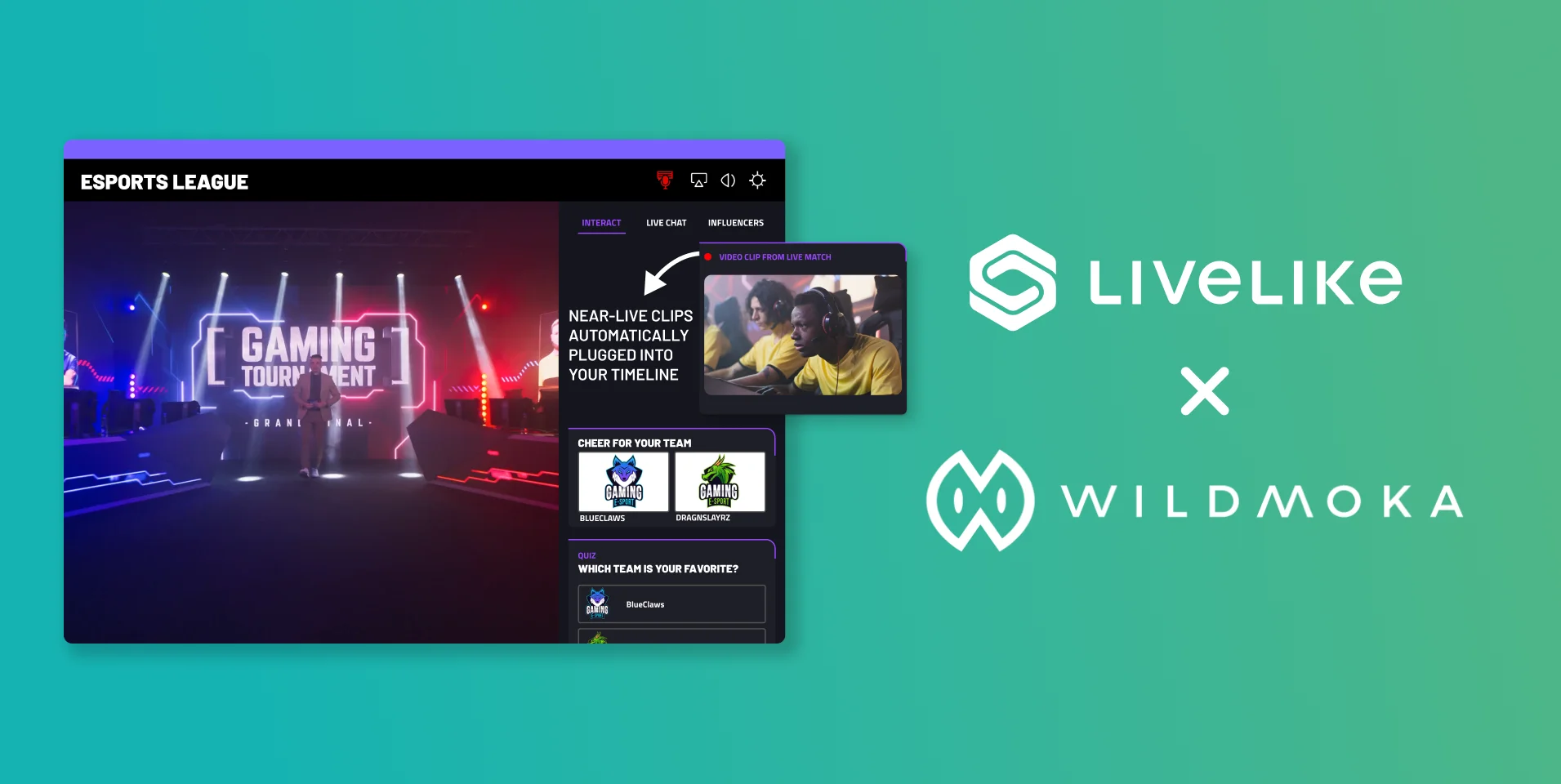
In 2022, Wildmoka partnered with LiveLike to harness the power of interactivity and boost this audience experience even further. With this additional access to our customized, best-in-class engagement tools—live chats, polls, quizzes—media companies can now differentiate themselves by not only being the first to publish near-live clips but also by delivering superior, interactive viewing experiences.
So, How Does it Work?
Prior to this partnership, the process for pushing alerts to a platform timeline involved manually creating, copy-pasting, and publishing the content, delaying the time it took to get the content in front of viewers. Thanks to this collaboration, publishers can now alert users as quickly and efficiently as possible with automated video alert widgets and do so in tandem with contextualized interactive widgets that engage users even further.
LiveLike has integrated the Wildmoka tool within its CMS to enable the automatic publication of video widgets in its timeline mode. In order to install the Wildmoka LiveLike plugin to power interactive, automated viewing experiences on your platform, check out this CMS tutorial video and corresponding instructions below. In this tutorial, you will learn how to harness the power of LiveLike and Wildmoka to master the following features:
- Create more content in seconds: live streams, near-live clips, reels (match summaries, best of players, and more)
- Hyper-distribute content to all digital channels (OTT and social media)
- Automate your entire digital content creation workflow
- In your program, click on ‘Automate’
- Next, click on ‘Wildmoka Video Alert’
- Enter your Wildmoka Match ID, a Widget Title, etc.
- Finally, ‘Start’ the automation
- Your new video widget will be published automatically (as soon as a clip on the match is created on Wildmoka)
“LiveLike enables Wildmoka customers to deliver superior viewing experiences and significantly boost user engagement rates. Wildmoka partners also benefit from having Wildmoka’s Digital Media Factory near-live clips automatically plugged into their timeline, facilitating the operators’ work and enhancing the end-user experience.”
Check out what automatic video widget publication can look like within a mobile application!
Get in touch to learn more about our Wildmoka integration or to find out more about LiveLike video features.
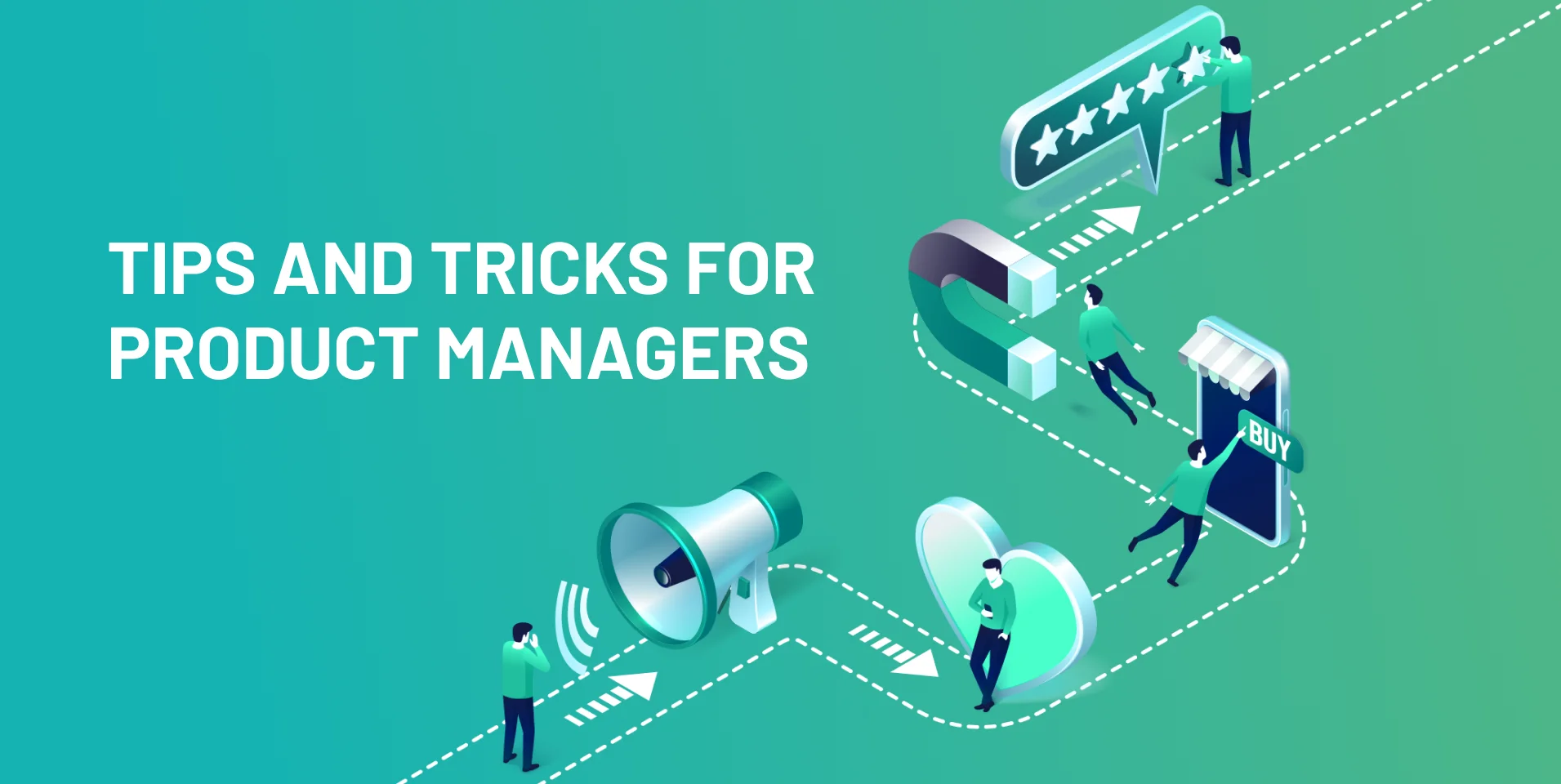
In today’s digital world, we are constantly being bombarded with new products and platforms vying for our attention. As a result, the competition for obtaining and retaining users on digital platforms is fierce. With so many options available, it can be challenging to stand out and convince users to choose your platform over others. Once convinced, it can be even more challenging to retain them for extended sessions and encourage them to consume more content.
As a product manager in charge of building and improving a digital platform, it is important to ensure your platform is attractive enough to maximize this user retention.
Think about it: retaining users means providing them with enough value on your platform that they are likely to continue using it and potentially even recommend it to others. This can lead to increased revenue and customer loyalty, both of which are essential for the long-term growth of your business.
In this article, we explore the objectives and KPIs a product manager should have in mind when prioritizing user retention on their digital platform. We also provide some solutions for meeting these objectives and discuss how the LiveLike engagement suite can help product managers achieve their retention goals. By following the strategies outlined in this article, product managers and business owners alike will be able to turn the challenge of retention into a powerful opportunity for their platforms.
Goals & KPIs For Improving Retention on Your Digital Platform
If you are a product manager in charge of your company’s digital platform, retention should be one of your key success factors. Of course, a lot of strategy goes into meeting and maintaining these retention goals, however once executed, these are some of the most effective ways to measure that success:
RETENTION RATE: The percentage of users who return to your platform over a given time period (e.g. after one month, after three months).
Continuously measuring and keeping track of your retention rate and adjusting your strategies accordingly will ensure your users continue to find value in your platform and feel motivated to return.
FREQUENCY OF USER SESSIONS: The number of times users engage with your platform over a given time period (e.g. daily, weekly).
Increasing the frequency of user sessions helps to ensure users are getting recurrent value from your platform and are motivated to return often.
DURATION OF USER SESSIONS: The amount of time users spend on your platform during each session.
Increasing the duration of user sessions can help to ensure users are getting a deeper and more immersive experience on the platform, which can ultimately help to drive total retention.
NUMBER OF INTERACTIONS PER USER: The number of clicks, page views, and other actions taken by users on the platform.
Increasing the number of interactions taken by users can help to ensure users are engaging with the platform and finding value in it.
CHURN RATES: The percentage of users who stop using the platform over a given time period.
Decreasing the churn rate can help improve retention by reducing the number of users who leave the platform.
CUSTOMER LIFETIME VALUE: The estimated amount of revenue that a user will generate over the course of their time on the platform.
Though not directly related to improving retention rates, measuring the lifetime value of users is a great metric to determine how your platform is generating money. Evaluating lifetime values can help to assess your user retention efforts and adjust these strategies to set your business up for success.
By combining the use of these metrics, you will enable you to precisely evaluate how effectively you are retaining your users and how engaged they are with your platforms.
Tips & Strategies to Improve Retention on Your Digital Platform
Of course, having a valuable and compelling offering within the market, first and foremost, is key for boosting customer retention on a platform. That said, loyal customers and high retention rates are not guaranteed no matter what product or service you provide, especially without an effective strategy for your platform experience. To target the previously mentioned metrics and improve user retention rates on your platform, there are a number of methods and solutions that a product manager can consider:
- Personalizing the User Experience can help to increase retention by making the platform feel more relevant and tailored to its individual users. This might involve using zero or first-party data and other technologies to tailor content recommendations or offer personalized incentives and rewards.
- A Well-Designed Onboarding Process can help increase retention by making it easy for new users to understand how to use your platform and get the most possible value from it. This might involve using tutorials, tooltips, or other guidance methods to help new users navigate the platform and learn about its features.
- Gamifying Your Platform with points, badges or leaderboards can help drive retention by making your platform more rewarding and motivating to use. This might involve offering loyalty programs, discounts, or tangible (real) rewards.
- Introducing Social Features on your platform, such as the ability for users to follow, chat and connect with one another can help increase retention by fostering a sense of community and making the platform more social and interactive.
- Pushing Interactivity through mini-game modules such as quizzes, polls, sliders, and predictions can drive retention by making the platform more exciting, motivating, and appealing to your end users.
- Providing Excellent Customer Support can increase retention by addressing user issues and concerns in a timely and helpful manner. In fact, 89% of companies say that excellent customer service plays a huge role in customer retention. This might involve offering multiple channels for support (e.g. email, chat, phone) and providing prompt, helpful responses to user inquiries.
- Continuously Improving a platform can help keep users engaged and motivated to return. This might involve adding new exciting features or functionalities, fixing bugs, or frequently improving the user experience.
How Can LiveLike Help You Achieve This?
At LiveLike, we provide brands and organizations with the tools needed to make their user experience more engaging and interactive, significantly affecting the performance of their platforms. With an extensive suite of interactive tools, informative widgets, live chat capabilities, and loyalty rewards programs, our customizable features empower brands to put their audience first and set their platforms up for success in terms of boosting retention.
Here are just some of the ways LiveLike can help to engage your users and keep them coming back for more:
- Personalizing the Experience thanks to zero-party data captured using LiveLike’s interactive features (live chat and reaction analysis, polls, sentiment sliders, etc.)
- Pushing Interactivity with LiveLike widgets (polls, quizzes, cheer meters, emoji sliders, AMAs)
- Pushing Interactivity with LiveLike widgets (polls, quizzes, cheer meters, emoji sliders, AMAs)
- Gamifying the Experience using the LiveLike loyalty rewards engine (points, badges, leaderboards)
- Introducing Social Features with LiveLike chats (public, private, influencer) combined with our two upcoming products (activity feeds and social graphs)
- Onboarding Your Customers with the LiveLike Quests feature
- Onboarding Your Customers with the LiveLike Quests feature
When implementing and iterating these features and more with LiveLike, the possibilities for boosting retention on your platform are endless; it’s just a matter of applying the right strategies to meet your objectives.
Get in touch to learn more about improving user retention or to find out how LiveLike can make it possible.
If you’re reading this, you’ve probably already been exposed to the world of search engine optimization (SEO) and understand the wonders it can do for your business.
In its simplest form, SEO is the process of improving your website—in terms of user experience, technical health, design, content, and navigability—in order for it to rank higher on search results pages. The higher your site ranks on those pages, the more credible it is deemed and the more likely users are to visit it. This exposure results in more clicks and organic traffic to your site, which in turn builds a site’s SEO score even further. All in all, the objective of improving your SEO ranking is to build trust in the eyes of your potential customers and search engines; and trust leads to results.
This year, we made a huge push to improve our website in order to enhance our experience for users, boost our overall SEO ranking and get the word out about our amazing product. We’re proud to say these efforts paid off and we were able to greatly improve our website SEO through both front and back-end optimization. Here’s a brief summary of the different changes we made and some ways that you can similarly optimize your site to rank higher on popular search engines.
So, How Did We Enhance Our SEO Ranking in 2022?
Optimizing Existing Website Content
The best place to start when improving your site ranking is with the website content you already have. If you have any existing content—no matter its length, type, or substance—it can always be improved, and positively add to your SEO efforts rather than detract. Here are the enhancements we made to ensure our existing website content was optimized for search engines.
Keyword Research: We started by conducting thorough and strategic keyword research, making sure to explore search volumes for all potential LiveLike use cases as well as all the geographic areas we target. Compiling the best and most relevant keywords allowed us to refine our existing content and update it according to more current user search engine habits.
During this stage, we made sure to integrate keywords thoughtfully and organically so as to avoid keyword stuffing. Keyword stuffing is the act of over-optimizing your content by using too many of the same keywords on an individual page. This over-optimization can be easily recognized by search engines, which will sometimes limit crawlers to your website or penalize your content and put it at risk of losing traffic.
While there are risks with keyword stuffing, integrating relevant, researched keywords into your content is a great way to improve your SEO and increase site traffic.
Metadata Management: Once you’ve compiled a list of relevant keywords, you’ll need to make sure your metadata similarly aligns. In its simplest form, metadata is data that describes other data and gives users information about the page they’re looking at.
Enhancing metadata involves optimizing meta titles and meta descriptions, by integrating keywords naturally so they correlate with what people are searching, as well as researching and maintaining optimal title and description length.
If meta titles and descriptions are not manually created by you, search engines will automatically generate them by taking the first text on each individual page. This can often do the trick if you happen to have an informative and relevant introductory paragraph, but puts you at an easily avoidable risk of losing SEO points.
Image Optimization: When optimizing for SEO, people often forget about images—but images are content too. Image optimization on your website can help to create better user experiences, faster page load times, and other ranking opportunities. When strategizing our image SEO optimization for 2022, we prioritized these major steps:
- Creating descriptive, keyword-rich labels for your image filenames, alt tags, and title tags.
- Replacing generic stock imagery with custom, LiveLike-specific visuals
- Compressing all images so as not to increase our page load speed
- Assigning eye-catching featured images for all unique pages to appear on search engine results pages
- Ensuring all images were mobile-friendly and suitable for social media platform sharing
Publishing Consistent, Link-Worthy Content
Now that you’ve optimized your existing content, it’s time to shift your SEO efforts to the future content that will be published on your site. It’s important to keep your content fresh by publishing consistently to stay up-to-date on any news in your industry, changes in your product, or shifting expectations from your users.
As well as maintaining consistency, we strived to publish a variety of different types of content this year, to satisfy our wide range of users. Since we work with clients from many different industries, there is no one specific audience persona that we are able to target. Because of this, it makes the most sense to put out content that appeals to a larger scope of users.
This year, we included videos, long-form articles, and mini-blogs, and focused on putting out unique content for EdTech, Fintech, Sports, E-Commerce, Entertainment, product updates, feature spotlights, and more.
One of the best things you can do for content SEO is to publish content that makes your website link-worthy. Links are one of the most important ranking factors of search engines, and search engines like Google will look at the quantity of quality inbound links you have to your web pages when they crawl them. The higher quality links your webpages have, the higher they will rank on search engine results.
This can, of course, be a challenging step, and requires you to put yourself in the minds of potential link-sharers. Just because you put out an amazing piece of content, doesn’t mean it will be deemed link-worthy by its viewers. Take some time to think about what kind of articles or content your community is likely to share, and brainstorm content pieces accordingly.
You may also benefit from collaborating with other businesses to co-support one another when publishing a piece, or spotlighting another company in the hopes that they share it with their networks.
Make Sure Your Website is User-Friendly
The next best thing you can do for your website once your existing content is newly optimized is to start brainstorming ways to make it more user-friendly. Simply put, if your website is hard to navigate, boring to look at, or causes frustration, users will be more likely to leave it and turn to your competitors.
For us, this involved taking the following key steps:
- Creating a website design that puts users first
- Keeping design simple with color combinations that reflect the LiveLike brand
- Using accessible, consistent, and on-brand language and tone
- Avoiding large chunks of text and breaking them up with visuals or headers
- Prioritizing mobile compatibility
Create an Interactive User Experience
For this step, we started by putting ourselves into the minds of both our clients and potential website visitors. And since we’re in the business of fan engagement, we felt it was only fitting to use this skillset to our advantage and integrate engaging tools to improve the user experience.
This involved adding interactive widgets—polls, trivia quizzes, AMAs—within our content to engage our readers and break up any lengthy text. Not only did this work to create a more fun, personable environment, but it also made our content more approachable and readable.
Provide Relevant, Specific CTAs
As mentioned above, we made sure our site pages had easily recognizable CTAs that users might be interested in depending on the page content they are interacting with. Having relevant, specific CTAs on your site can help users with decision fatigue by giving them direction on what they can do next. They can also work to create a sense of urgency that may help increase conversions.
Improve Your Site Health Score
The site health score of a website is determined by the amount of errors and warnings that are found on a site’s pages when they are crawled. In other words, it is a measure of the technological health of a website that takes into account its speed, structure, security, and technical SEO. And since these errors and warnings can include duplicate metadata, long page load speed, duplicate content, and low page word count, addressing the previous steps we’ve discussed can help to reduce these errors and improve your overall site health score.
This year, we worked hard to eliminate all errors and warnings on our site where possible, and successfully improved our site health score by 28%. Here are just a few ways we did this:
- Using XML sitemaps
- Standardizing URLs
- Using unique meta descriptions
- Optimizing all page title tags
- Adding image alt text
- Fixing 404 errors
- Adding internal links
- Using HTTPS
- Improving site speed
- Prioritizing mobile design
- Strategizing CTA placement and content
While we’ve worked hard over the past year to prioritize our SEO efforts and have realized success as a result, our work is not done! SEO optimization for a website is an ongoing process, and as you increase the amount and frequency of your website content publication, you will inevitably go through changing periods of higher and lower SEO success. It is crucial to stay on top of your SEO efforts by conducting regular site audits and optimizing all new content being published on your website.
Want to know more about search engine optimization or content optimization solutions? Let’s chat!
How to Light a Fire Under Next-Gen Consumers
Today on The Future of Fandom, we present the finale for our 2022 run of episodes—and hey, what good is a finale without a little Firework show?
On this episode, we explore how Firework envisions the future of truly connected, community-based, live commerce in partnership with their Chief Business Officer, Jason Holland.
Jason thinks like a modern content creator; from a long form, he builds for the short. Discarding the text and display of the past, he sees live and short-form video as the way forward—the only way forward. Since he joined Firework two and a half years ago, the business has taken off like a rocket and exploded onto the scene, boosted by partnerships with major retailers and tech titans in their ranks, and we’ll explain more about that in our discussion. Today, we’ll also discuss how next-gen consumers are embracing live commerce, the future of commerce in Web3, and Jason’s vision for an optimal community-driven experience where every voice has a voice.
Jason is more forward-thinking than most, and will more than likely have a hand in the future of the way you shop. So, let’s finish the year with a bang and predict the future with Firework and Jason Holland.
Connect with Jason Holland on LinkedIn: https://www.linkedin.com/in/jasonholland/
Read more about Firework: https://firework.com/
Full episode here:
FULL TRANSCRIPT BELOW
Adam Connor (01:43):
Jason, thank you so much for speaking with me, first off.
Jason Holland (01:46):
Adam, thank you for having me. Couldn’t be more excited to be here.
Adam Conner (01:50):
You came to Firework about two and a half years ago, in June of ’20. We’ll talk about all the circumstances and maybe benefits to a virtual commerce solution about that in just a second. The first thing I’ve got to ask is that I know you had been introduced to Firework in May of 2020. That in my opinion, because I’ve never moved to a job really that fast, is you must have seen something that just lit a fire under you that was absolutely unstoppable, that in part made this move happen. Would you mind telling me the story of how you joined, and then we’ll talk about Firework as a biz?
Jason Holland (02:28):
Yeah, I’m happy to go into it, and you’re spot-on. It was an interesting circumstance where I was working with a business that I had been with over two tours of duty in the publishing space called Evolve Media. I was with the business in its infancy when we founded the company from 2004 to about 2010, took about a seven-year break and came back to the business as its chief operating officer in 2017. So, I’d been with the company for about three and a half years, and was introduced to Firework as a function of a strategic partnership that I did between the Evolve business and its publishing portfolio and the shoppable video commerce and livestream infrastructure that Firework has.
(03:12):
When I met Vincent, Jerry and the founders and executive leadership at Firework and saw what they were building relative to what is such a burgeoning, but I think arguably nascent space in video commerce, and what’s happening, especially in Western markets, in the US, UK, and in how retailers, brands, publishers and agencies are looking to adopt the technology and trying to figure out the best way to do it, I couldn’t turn down the opportunity to join. So, I joined Firework in June of 2020. I’ve been here for about two and a half years, and work as the company’s chief business officer.
Adam Conner (03:50):
Folks, I would encourage you as we speak here to just go fire up Firework on your browser just to see what they’re all about and to see the incredible growth that they’ve not only experienced, but the endorsements they’ve had in terms of their funding. This is really going crazy, and right before we started you told me this is a seven-day thing. Now, for those who haven’t yet navigated to the browser — Yes, I’m still talking to you, listener — Could you tell us and help them out? What is Firework in a nutshell?
Jason Holland (04:20):
Yeah, happy to walk you through it. Firework is very much a video commerce infrastructure and operating system that enables retailers, direct consumer brands, consumer packaged goods businesses, publishing, and in the co-alignment with media buying agencies and holding companies to create a connected open web infra that is all built on shoppable video, live commerce and what will be the future of video commerce. As we think about short, 30-second swipeable, shoppable video and the experiences that digital consumers have got historically in the walled gardens, whether it’s an Instagram, a TikTok, et cetera, Firework’s thesis was, “Look, we have got to enable digital consumers and content consumption folks to be able to tap those experiences onto actual retail websites as well as direct-to-consumer brand websites.”
(05:18):
As we watch those KPIs from an engagement perspective, conversion, et cetera, click-through rate really applied to owned assets like an Albertsons, who is an early-stage grocery retail partner of Firework, and a Fresh Market, and what has been executions with Walmart and Sam’s Club, et cetera, the engagement and conversion that we see relative to digital consumers having these ecosystems on an owned asset are 10X what any other digital mechanism drives. That’s a really exciting component of the business.
(06:00):
Just walking through a quick timeline in history of the company, the business is pretty young. We were formed about four and a half years ago. Our co-founders, Jerry Luk and Vincent Yang, are both serial entrepreneurs. Jerry was the founder and creator of LinkedIn and LinkedIn Mobile with Reid Hoffman, was an early-stage employee, was one of the first 35 employees at LinkedIn, and he partnered with Vincent, who’s a former investment banker and ran components of JPMorgan and Summit’s investment banking divisions to bring all this to life. When I think about the engineering, tech, dev and fundraising horsepower that the business has got, it’s incredible.
(06:42):
And then when I think about the executives that we have started to bring into the business as the company has scaled from other top-tier global technology companies, it casts a really bright light on what I think is the future of Firework in sitting as the base video commerce infrastructure for all of open-web digital consumer connectivity.
Adam Conner (07:06):
Well, listeners, you get right there a list of titans which have helped to build Firework to date. You I hope can clearly see, especially since we talked a little bit about live commerce on this show before, how the future of Firework is likely very closely aligned with the future of fandom generally. A little plug for the title.
(07:27):
So, you join in the middle of 20, and if I’m doing my math correctly, that’s roughly two years into its founding. Now, of course we were in a time, especially in the US, where anything virtual-connected, anything digital content, even podcasts, saw a monster, monster lift. And in the midst of all that, you have day one. Can you describe what you remember most about 2020, how it affected live commerce as an industry, and what has stuck around now that we are looking at it at the end of 2022?
Jason Holland (08:10):
Yeah. I think it’s the investment that major brands and even small and mid-sized direct consumer businesses were making in their digital ecosystem, in how do we tap into a richer connectivity to our consumer base in shifting away from display images and what has historically been a text-based environment on the open web and websites, in really saying, “How do we deploy a more human high-touch experience?” That obviously nets out in short video, shoppable video, livestream and live commerce. And in the middle of the pandemic, that’s where the business really started to catch fire as these companies were looking to upgrade the ways in which they connect to their consumers.
(08:57):
So, it was exciting at the onset. The last two and a half years have been among the most intense, fascinating of my professional life. So much of that is just a result of not only the company’s scale and the amazing partners that we’ve got, but also the market at large as especially Western markets look to adopt live commerce and shoppable video and upgrade their digital consumer experiences. The only footnote I’ll put on that is Firework has been so fortunate from the standpoint of institutional knowledge and IP that we’ve got, all the way through our CTO, Rick Zeng, who was the founder and creator of Taobao and Taobao Live, which is the live commerce infrastructure powering all of Alibaba’s live commerce and the roughly 400 billion in econ GMV that they run through that in China. He is the founder and creator of our shoppable video and live commerce technology.
(09:54):
So, the institutional knowledge the business retains on how to blend, what I always tell people is the best of what China has done through the lens of Alibaba and live commerce with the best that the walled gardens have brought from a swipeable short video perspective, enabling it with shoppability and then bringing it to a connected infrastructure on the open web is what really makes the company powerful.
Adam Conner (10:19):
I’m so glad you said that, and I should hardly be surprised that you have somebody who is so central to live commerce’s growth in Eastern markets. That’s what I’ve heard all the way back between… 2019 was the first time I really started to learn about it from the brick-and-mortar retail perspective. A gentleman who I interviewed who was doing tours called retail store tours had taken a lot of his inspiration for what was to come from Eastern markets, and that was just in a brick-and-mortar context. We already knew that digital live commerce was brewing, and in fact, well on its way there already. So, the fact that you have that IP in the bank is just wonderful.
(10:59):
As far as this year is concerned, what is the latest and greatest in live commerce? I ask this because consumers may have remembered just at the beginning of October, TikTok mentioned, and I’m sure this is something they’ve probably also pursued in Eastern markets first, that they were going to dip their toes into live commerce solutions here in Western markets, in the US. Of course, if you’re on Instagram, you’ll have seen shoppable links, things like that. But I’d like to know from your perspective, since you’re in it seven days a week, what’s the newest, latest, greatest that we might not have heard of?
Jason Holland (11:36):
Happy to share there. I think it’s important to start as we think about walled garden social apps and the open web and defining in Western markets like the US, that 96% of digital consumer transaction still takes place on the open web. It’s not taking place in a social app. That’s where when we think about shopping in digital consumer bases on an Albertsons or a Fresh Market, a Walmart, et cetera, it’s really those ecosystems where we have got to place huge investments in upgrading the shopping experience, because that’s where the vast majority of the transaction is still taking place.
(12:19):
I think that’s where Firework said, “If we can build an infrastructure that any of these businesses, no matter how large or small, can tap into, and also harness the thesis that Alibaba has tapped so well around taking in-store sales associates and creating a brick-and-mortar experience where you’ve got a greeter as you walk into a Walmart, et cetera, and flipping that into the digital world so that we’re personalizing it and creating something that feels like you’re in the store as close as you possibly can in a digital environment. That’s really where the business takes off, and when I think about what China’s done so well from a content perspective is it’s not celebrities primarily that are driving the live commerce and shoppable video growth in China, it’s folks that are passionate about the products, it’s loyal consumers, it’s folks that work in brick-and-mortar stores that are turning the camera around and using the software to talk about the products and the services that they’re promoting.
(13:22):
That’s been a huge thesis of Firework as well, is how do we start getting livestream and video into the hands of the people that interact with products and that love the products the most every day? That’s where if we look at the shift away from A-list celebrity and some of the inauthenticity that especially younger audiences see in products that are promoted by celebrities, it really becomes an interesting component of our business as we work to build content in creator portals that are unlike anything that Western markets and retailers have been able to tap into before.
Adam Conner (14:00):
That’s an especially good point with regard to how the everyday person now can be what we’ve seen, I think between probably 2017 and today, go from influencer to micro to nano to pico, to all of these prefixes, which eventually just boils down to just a person and their ability through innovative solutions like this push a purchase, which maybe we didn’t think about five, 10 years ago.
(14:25):
In terms of the actual content experience tied to shopping, what are some of the ways in which you encourage interaction in the moment? What are some of the ways in which you measure that? What are some of the ways in which you’re seeing that the newest consumers and fans of today want to do it? Because other than, and maybe this is just my elder Millennial perspective, I see the video, perhaps I like it, comment on it or something like that. Then I swipe to a shopping experience, and the two are still separate for me. Now, I could have a video that I’m watching, a livestream video, and I could have a button, it might pop down a widget, something like that. But that’s my ancient 30-year-old brain talking. How have you noticed that Gen Z, Gen Alpha, if they’re tiptoeing around it, how have you seen that they are interacting live with this connected content commerce experience?
“That’s a great question. I think it’s a combination of interconnectivity in the ability to participate in something that’s live, whether it’s commenting, whether it’s interacting in a video capacity with hosts, et cetera, and it’s also the ability to create their own content. When I think about passionate shoppers and loyal customers and communities of shopper and fandom, frankly, that partners of Firework are building across the retail ecosystem and direct-to-consumer brands, CPGs, it really becomes the fact that video commerce is the future and it’s the connectivity that shoppers have got in passionate fans of brands, that it just doesn’t exist in display images and text anymore. Everything has got to either be live or short video.”
— Jason Holland (15:15)
(16:09):
And to your point around the blend of those two, I think that’s where Firework has done a good job of being able to then take a live stream, whether it’s 30 minutes, 45 minutes, et cetera, and cut all of those highlight reels down into short shoppable video so that you’ve got swipeable segments that bring the best of the best from those livestream segments into something that can live in perpetuity on a retailer’s website that becomes really powerful.
(16:36):
And then when I think about, again, content creators and just the future of fandom relative to brands, it’s the ability for those e-communities and the shoppers to actually participate in creating the content themselves that becomes really exciting. When I think about next year, that’s where we’ve got a ton of exciting stuff that we’re launching with several global partners, retail partners, et cetera, where they will leverage the ability for their shopper base and their most passionate, loyal fans to participate in creating the content in conjunction with them, which I think is awesome.
Adam Conner (17:17):
You are preaching to the choir there. You’re kind of preaching to another preacher, maybe a deacon or something like that, but you’re preaching,
Jason Holland (17:26):
I think you see it too, which is really exciting, because again, as the ecosystem grows, and I would say most of our conversations with our business partners start with, “We’re trying to figure this out. We’ve got to remit. This is on our strategic roadmap, it’s being deployed now. Investments have been set aside to build into video commerce infrastructure. How do you advise that we do it?” And when I think about the deep discussions that we have with engineering, tech, product, development, retail media, merchandising teams, et cetera, Firework is really the only full-funnel video commerce architecture that embraces full livestream and live commerce capabilities, full shoppable video, full one-click-to-buy, and then a distributed open web storefront across retailers, brands, publishers.
(18:18):
And it’s the connected network effect of bringing an entire open web together, which when we think about the open web, it’s still a hundred times bigger ultimately than all the walled gardens combined. Think about all of the shoppers that are on Albertsons, Kroger, Walmart, Target, Macy’s, Nordstrom, all the brands that are selling their products within those stores, et cetera, and to have one video commerce infra that supports all of that and then cross-pollinates that content in a contextually relevant way becomes really powerful for shoppers and the retailers.
Adam Conner (18:54):
I can see it. I clearly see it. It’s clear that you can too, and listeners, this is why we do this show, because this is coming. And it may start and sputter here and there because, hey, we haven’t seen it before, but this is where it’s going. It’s all about creating that community at the end of the day from the long-form that you cut down to the clips — I can definitely relate to that because I do podcasts all day — To the feeling that you are truly contributing to something and that something is contributing to the world.
(19:26):
That is the root of two things that I have seen which come together nicely here. The first is how next-gen consumers and just young people operate, behave and work. And secondly, it is one of the many premises of Web3, which is still a pretty cloudy thing in a lot of folks’ minds, but the point is that things, life should start with community. Would you mind expanding on that a little bit? When you think about the open web current experience today and then look forward to this Web3 world, and maybe I’m not even describing that correctly, but just a world separate from today where this kind of thing has been fully adopted, where does Firework play? Where does live commerce sit?
“The word that comes to mind is ‘connected,”‘and that’s where when I think about, regardless of if you take the open web again and you think about any content that you’re consuming in a video capacity being contextually relevant and available from a live-streaming and shoppable video point of view, anywhere you’re at on the internet, that is a connected infrastructure that very much feeds into what I believe is the thesis of Web3.”
— Jason Holland (20:17)
(20:45):
And it’s the ability to take any shopper or any fan, et cetera that is interested in a brand or its content, and to be able to create and contribute to the content that they’re most passionate about. It’s the ability to view it and engage with it and shop with it anywhere they’re at on the open web, whether it’s a publishing ecosystem, thinking about our partners like Condé Nast and Hearst and Accelerate360, which is Us magazine, et cetera, and the ability for all of our retail partners, again, whether it’s an Albertsons, a Fresh Market, et cetera, to be able to interconnect all of that short video and livestream into contextually-relevant publishing ecosystems. And then from a retail media perspective, allow P&G and Unilever and Olaplex, et cetera, to then bring their content into the same connected infrastructure.
(21:41):
There’s nothing that exists like that right now, where all of this from a short video, livestream and video commerce perspective is proliferating and living across a connected infrastructure. So, when I think about network effect and what has really driven Firework’s scale from an investment perspective, it’s the fact that there’s no video commerce infrastructure that is connecting the entire open web, which again is massive relative to walled gardens. And I think that’s where people forget; you look at Instagram and TikTok, and it’s the digital consumer experience that they’ve made so popular from a swiping perspective, et cetera, that just hasn’t been made available to open-web audiences previously. That’s I think where the business is really excited.
Adam Conner (22:27):
The other thing that immediately comes to my mind, you say “connected,” I think about something which is imminently measurable, trackable, where you can finally start to see the true ROI of some of these. I don’t care if it’s a celebrity campaign or an influencer campaign or what, but it’s hard to say, “Hey, I got a million likes on this celebrity post or an influencer post,” that that drives sale.
Jason Holland (22:51):
To truly drive.
Adam Conner (22:52):
“Oh, well it drove these clicks,” and sure, there’s a funnel you can follow and there’s stuff, but it’s not as direct. And that for years, I haven’t seen it so much in the retail side, but I’ve definitely seen it in worlds where first-party data is hard to come by, especially the CPG world. How many years ago was it that Unilever and Keith Weed came out and said, “Influencer fraud is rampant. We need to figure out some better way.” They have got to be drooling over that future, and while it’s not here today, might not be here just tomorrow, it is coming, and that’s, again, very cool that you’re at the cutting edge of that. It’s kind of making me jealous sitting here in the host chair, honestly.
(23:28):
It makes me wonder, even if we don’t see that maybe utopian future in the world of connected commerce in a live context yet, what do you see for ’23? I mean, what’s the reasonable next couple of milestones where you see this starting to mold, even if not resembling that description you just gave us.
Jason Holland (23:47):
It’s a great, great topic. I think it all starts with retailers, brands and their shoppers, especially retailers and brands, wanting to own the connectivity to the communities and loyal fans and shoppers that, again, 96% of them are shopping on the owned website and assets of the retailer and the brand, and they don’t want to pay any of the Google tax associated with converting a platform they don’t own, which is TikTok, Instagram, et cetera. They also want to own the first-party data, and they want to own the conversion metrics and everything that Firework can offer back to them when you are communicating through video commerce in an ecosystem that you actually own.
“So, I think that becomes a really important piece of what will 2023 hold, and this is all a function of the discussions that we’ve had throughout 2022, is everyone is investing in video commerce now and they’re trying to figure out where does this slot into, not only our digital consumer connectivity roadmap and how we’re doing that in Q1 and Q2 of next year, but it also ties into brick-and-mortar and how are we using the shopper video content and the video commerce that we’ve got in our digital assets to power into our stores as well. Whether it’s QR coding on shelves, which is something that we’re doing with some of our biggest retail partners in Japan, such that if an in-store sales associate isn’t right there walking with you and you want to learn about a particular product, you swipe your phone over the QR code, and your immediately into livestream and shoppable video experiences showing you how to cook with the product, recipes to use with the product, how to use this particular home and garden product, et cetera.”
— Jason Holland (24:32)
(25:36):
And that’s where, when I think about the democratization of content and the ability to bring all of these experiences that used to live solely on TV into your digital ecosystem, and create DIY and home improvement shows through livestream and shoppable video that are all driven by experts in the categories and shoppers, it starts to put forth an entirely new content consumption experience that we’ve never had.
Adam Conner (26:10):
It’s true. You think about this a lot. I think about it in the traditional television, how do I combine the best of that, seeing somebody cook with the thing, use the home and garden product, whatever. Can I get that right here in my hand while I’m going down the aisle? That would be wonderful. There’s a couple of steps to get there, but I’m glad that it’s at least in the ether for ’23.
(26:34):
What are you most personally excited about for the next year in retail and commerce generally? I’m just curious, because obviously with a tinge to Firework, that was the last question, is what do you see for next year, but what’s on the fringes of even your imagination for like, “You know what? I just heard about _____. I think it’s really cool.” Do you have anything like that that you’ve seen recently that…?
“I think it all loops back to content and the way that we look at producing it, and it will become an even more prolific shift from professionally-produced, highly-curated content that is really expensive to produce, and that will start converting into in-store sales associates that are doing a fashion show that is far more authentic and real, especially through the lens of younger consumers, that isn’t super high-polished and scripted and has blemishes within it, et cetera, that we don’t edit out. I think that’s a really exciting piece.”
— Jason Holland (26:55)
(27:33):
And then it’s also going to trickle into fashion shows being hosted with fans and communities of people at their houses with their friends, and big massive retailers getting comfortable with the fact that it’s totally okay, and there’s this content ecosystem of passionate folks out there that are fully capable of using Firework’s tech to produce something that they’ve never been able to tap into before in their homes, et cetera. Then of course, it’s the ability to make it all shoppable and overlay a deep conversion layer that allows those brands and retailers to make a true frictionless payment and seamless experience, all the way through what I see as upper-funnel entertainment to lower-funnel conversion in one infrastructure. That’s really what Firework is trying to build from a video commerce capacity.
Adam Conner (28:25):
And hey, anything that helps to democratize that production process a little bit more is good in my book, because I don’t have a degree in visual effects, stuff like that. And even in the early days-
Jason Holland (28:34):
You don’t need it anymore.
Adam Conner (28:35):
Exactly. Even in 2013, ’14, Vine, which had very limited production capability, most of the stuff you saw was very quick and dirty that were some of the most popular, but even then you had the Zach Kings of the world and people who had amazing editing abilities still rise to the top because there was high gloss. That sheen is starting to wear. And of course there’s still a corner for that, but especially when it comes to then on top of it you’re throwing a brand in, people are already going to be a little bit skeptical of, “Well, what is this? Am I being sold to? Blah, blah, blah,” the fact that it’s… And brands frankly, and if brands are listening, you’re going to have to trade off the high gloss –
Jason Holland (29:15):
Authenticity and “real” is just as important now as brand safety, right?
Adam Conner (29:19):
Totally, totally.
Jason Holland (29:20):
And I think the benefit of what Firework’s built is that you don’t have to sacrifice brand safety protocols in the ability to monitor and edit livestream, buffer it, delay it, and still have the ability to edit out something that you don’t want. And then the ability to take that software and literally create short, swipeable video that fits a narrative becomes really exciting. That’s where it’s not just a video commerce technology for shoppable video and live commerce that we built, it’s a full video creation and editing CMS that anyone can use. It happens to be a B2B platform first, but ultimately I think the future state vision is that as shoppers and passionistas and fans of brands start to engage more directly with those brands, they’ll be using the Firework software to create their own video content just as much.
Adam Conner (30:16):
I hope that you’re right, for your sake and for ours who are just looking for a better shopping experience. Then, and I round out with this sometimes, I’ll do it here, although it might seem obvious, I ask people to fill out a blank. The blank is, “I can tell you for sure that the future of fandom will not include blank.” Is it eventually disconnection, high-production gloss? What is it in your head that you see us definitely moving away from?
“I do not think it will include text display and image-based anything. The future is video: it is live video, it is short video, it’s the ability for any audience to create and participate in the future of what a brand wants to do. So, I don’t think it will include what historically most websites have looked like, and that’s where Firework’s growth, as we bring the technology in, our ability to completely reinvent and re-architect a digital consumer experience to be all livestream and shoppable video first, and then connect it again across the entire open web in contextually-relevant ecosystems, that’s a really exciting future.”
— Jason Holland (30:40)
Adam Conner (31:24):
Agreed. Well, thank you for discussing that future with me here. Jason, it was wonderful to have you, and good luck-
Jason Holland (31:30):
Adam, it’s great to be here. I’m grateful.
Adam Conner (31:32):
… with ’23. For us all, to the future.
Jason Holland (31:36):
To the future. We couldn’t be more excited. I think Firework couldn’t be more grateful to sit in a space that is as explosive as it is right now and sit at the forefront of that. So, super grateful for the time, and thanks so much for having me.
Adam Conner (31:52):
I’ve noticed, and I think we can all admit, live commerce has started and sputtered slightly in the US this year, but while we’re currently far behind our Eastern market counterparts, I think Jason will be one reason we do a lot of catching up in 2023.
(32:09):
Thanks to Jason Holland from Firework for coming on the show, and to you, the listener, whether today is the first time you’re tuning in or if you’ve listened since we kicked off roughly a year ago, allow me in closing to offer my heartfelt thanks for predicting the future of fandom with us. These stories are a true honor to produce, and I can’t wait to see the stories that we tell next year.
(32:32):
With that, we’ll be back in 2023, and until then, please do stay subscribed wherever you listen, and connect with us on LinkedIn @LiveLike, or on Twitter @LiveLikeInc. For the final time in 2022, this is Adam Conner saying so long and thanks for being a fan.
What is Sceenic?
One of the most popular features of the LiveLike toolkit is Watch Parties, an interactive co-viewing experience that allows our clients to connect users privately, publicly or with their favourite influencers. And part of what makes LiveLike Watch Parties possible and so easy to use is our integration with Sceenic and their Watch Together video solution.
Sceenic offers solutions to create interactive video experiences and to power co-viewing capabilities on any video, OTT, IPTV, or STB platform. With their Watch Together white-label software solution, LiveLike clients are able to transform user video features on their platform and engage users using different video room functionalities.
These can include powering watch parties during a live event, allowing group video calling capabilities, introducing interactive video room-based features like live chats, quizzes, and polls, and more. With the LiveLike x Sceenic integration, your users will be able to chat in real-time synchronized video conversations while watching any content inside their favorite platforms.
The advantage of using our SDK is that we remove the typical complexities of video calling integration that are unavoidable when using a video calling service provider. For example, with LiveLike, our team of experts will set up your authentication server for you rather than having you go through the process of figuring it out on your own. Video calling integration can be complicated and time-consuming: two attributes we work to omit from the process!
So, How Does it Work?
In order to install the Sceenic LiveLike plugin to power co-viewing experience on your platform, check out the documentation guides below.
Within these guides, you’ll find information about how to implement LiveLike Watch Parties on your platform, and master the following features:
- Creating a video room
- Joining a video room
- Rendering participant videos
- Leaving a video room
- Muting/unmuting local participant audio
- Showing/hiding local participant video
Get in touch to learn more about our Sceenic integration or to find out more about LiveLike Watch Parties.
The market leaders of interactive fan engagement, LiveLike and Ease Live, today announced a new partnership which will combine the full strength of their platforms—from delivering interactive experiences at scale to building community features with loyalty and rewards features. The combined offering will be a supercharged 360° experience for fans seeking to dive deeper into their favorite live content.
This new strategic partnership creates a market-leading offering that leverages powerful interactive experiences to increase fan engagement with a renowned loyalty and rewards platform that encourages more audience participation. The partnership provides sports teams, leagues, and content rights owners with the perfect tools to build, nurture, and monetize fandom—all with a rapid time-to-market and distribution across a range of devices.
Ease Live provides state-of-the-art interactive overlays on top of live video streams that provide users with personalized access to polls, trivia, live games stats and more. These interactive features are accessible across web, mobile and connected devices.
With this partnership, LiveLike will enhance the Ease Live experience with fully powered live chats and a rewards and loyalty engine that allows customers to collect first-party data on audience engagements.
This results in an immersive and personalized experience that further engages the fans. Fans become more active participants in the live event with the interactive elements on the live stream than the traditional passive lean-back viewing experience. They remain longer and engaged during the live game or match. With LiveLike, fans are also rewarded for their activity with advanced loyalty programs and offers.
Combining immersive and engaging elements not only brings fans closer to their best-loved teams and sports, but also rewards them for increased participation and provides a sense of community. All of this creates additional opportunities for revenue generation through the use of brand-sponsored features, predictive betting, gamification and interactive advertisement.
What Does This Mean For Clients?
- Diverse and Robust Feature Set: The LiveLike and Ease Live partnership provides an all-in-one solution, from interactivity, engagement, and community to a fully-integrated in-house gamification engine. The flexibility of the two platforms allows customers to deploy new features instantly through our cloud capabilities without having to go to the app stores. This enables rapid time-to-market and new revenue realization.
- Ease of Deployment: The integration of LiveLike loyalty systems and LiveLike widgets to the Ease Live platform provides a turn-key solution that is unmatched in the industry. The partnership enables seamless backend integrations and fully customizable front-end implementation.
- Unparalleled Market Traction: Trusted by top-tier leagues and content providers, the combined roster of products and outstanding services is the secret sauce for their unrivalled success. Already deployed worldwide, Ease Live and LiveLike distribute content to millions of end users.
The ability for us to AB test the integration of the LiveLike module to fans versus a segment of fans that just got our typical race day experience, we saw a double-digit increase in engagement around the fans that specifically had the LiveLike modules.
Tim Clark
Chief Digital Officer, NASCAR
The big KPIs for a lot of the rights holders is all about how do we get more audience, how do we get that audience to watch longer. The more interactivity you give fans, the longer they watch, and the more monetization opportunities it generates. It’s all about storytelling in the moment and creating interactive opportunities while watching games. To do this, timing is an essential part. The Ease Live platform is unique in its ability to synchronize graphics, data and even watch parties.
Chris Wagner
Managing Partner, OTT Advisors
- Continuous innovation: Through this collaboration, both companies focus on their strengths and continue to evolve, listen, adapt, and deliver the best in fan engagement for years to come.
Get in touch today to learn more about how LiveLike and Ease Live can help you engage users on your platform.
Serving a World-Class Next-Gen Fan Experience
Today on the Future of Fandom, we serve up an open conversation about tennis, exploring how the US Tennis Association (USTA) is crafting brand love (get it?) for next-gen fans in partnership with their Chief Brand Officer Amy Choyne.
Amy has been a lifelong tennis fan; she’s attended the US Open ever since she was four, and in 2016, after various tenures stewarding brands across fashion and retail, she got the chance to serve at the helm of the sport she’s loved ever since she could hold a racket. A little over six years later, Amy reflects on that time with us today and speaks about how fan engagement has evolved and what she’s excited about moving forward.
We also touch on topics like the growing intersection between elite athletes and social voices, the difference between sports fans and fans of other industries, and just a little bit about pickleball.
So, let’s predict the future with USTA and Amy Choyne.
Connect with Amy on LinkedIn: https://www.linkedin.com/in/amy-choyne-571593/
Read more about USTA: https://www.linkedin.com/company/usta/
FULL TRANSCRIPT BELOW
Adam Conner:
Amy, how are you? Thank you so much for joining me and having this conversation.
Amy Choyne:
Thanks for having me.
Adam Conner:
So first things first, we are in a moment of reflection for tennis as a sport, being in a bit of a planning set for 2023. We’ve just come out of an electric season, a bunch of new things have happened, new entrance, new stars, and maybe people that you’ve known for a long, long time, but that the general public might not have. Just give me a picture of what this season of the sport has meant for you and USTA a and what you’re most excited about coming out of that.
Amy Choyne:
Well this year, 2023, has been a tremendous year for the USTA and the US Open. It is the second year after the pandemic when we let fans back in. We had a very strong attendance, probably the strongest ever. And every single night and day session in Arthur Ashe was actually sold out, which is a first. It was an all time high for food and beverage, for merchandise, for attendance. The energy at Arthur Ashe Stadium and on site at the NTC was unlike anything I’ve ever seen. I can’t say it was all because of us. We had a lot of stars aligned. We obviously had this Serena effect as we call it, in that she had her swan song and performed incredible. It was also a moment of time where we felt a little bit of a torch being kind of passed down with Frances Tiafoe and Carlos Alcaraz coming up and all of these great new players, and people were really excited to see all that energy.
Adam Conner:
I bet. And I have seen that in other sports that I have followed from childhood. Tennis is a little newer to me, but I have an aunt and uncle who are really into it. So it’s been sort of in my world, but I’ve never played, unfortunately. I play tennis and it turns more into the home run derby.
Amy Choyne:
There’s still time.
Adam Conner:
There’s still, of course, still time. My wife plays. She seems to enjoy it. I feel like she would kick my butt. So I have not challenged her yet at this cause that would be more of a comedy session than anything else. But I want to ask this because you’ve had so many milestone moments this year culminating in things like the US Open and now you get to reflect and move forward to next year. I just want to ask because your journey to USTA was not necessarily via working in a whole bunch of other sports, which is typically what I see.
Once you get into sports, you stay in there, but you have experience from fashion, from retail. What is different in transitioning to sports marketing in comparison or running a sports brand, being a steward of a sports brand, as compared to those other industries? Because well, you’re a little unique in terms of the interviewing experience. I haven’t seen many people make that type of change after so long in that world. I’m just curious, what inspired you to move into that world and what’s different about the fans from let’s say the devoted customers of a retailer, or a fashion icon?
Amy Choyne:
It’s a great question. First and foremost, let me say that I’ve been going to the US Open since I was four. I come from a tennis family, and I am a tennis player. However, I don’t play with a lot of people in the office because they are really tennis players. But it’s not a prerequisite to actually work at the USTA.
Adam Conner:
That wasn’t part of the interview that you’d have to play the rest of the executive team. Okay, got it.
Amy Choyne:
No, you don’t have to play the rest of the executive team, but I think in all jobs, and particularly if you work in sports, to have a passion for that sport is particularly important. Especially for the USTA in that we are a non-for-profit, and our mission is to promote tennis in America. So you really have to feel passionate about that. So my job is twofold, and one is to ensure that the customer experience at the US Open is the best in class and we are constantly getting new tennis fans into the funnel, as well as delighting people that have been with us for a very long time, as well as getting more people to participate in the sport. Coming from retail, as I think we all know, retailers know so much about our shopping behaviors. I could tell you right now, even now, it’s scary in that my entire Facebook feed is selling me exactly what I just spoke about two seconds ago. But-
Adam Conner:
Isn’t that scary. Oh, they’re listening folks. They’re listening.
Amy Choyne:
And from a retail perspective, we know so much about customers’ spending habits, what they don’t like. Marketing nowadays is all about personalization and all about this customer experience. So when the USTA was looking to evolve the conversation with fans and prospective players, they wanted someone outside of the tennis industry. So that called within the retail and thankfully I got the job because it’s a fantastic place to work. The conversation with fans and players is a little different than selling a lipstick or a luxury purse, but you’re selling an experience when you think about the US Open. If you’re selling a great seat down on Courtside and a hospitality package with some bells and whistles on it, it’s no different than selling a trunk show to someone that is obsessed with the designer to get that extra special kind of touch point. So there are similarities. That said, the product obviously is so different for sure.
Adam Conner:
I have to ask, did it feel like a dream come true after all of those years of attending the US Open as a spectator to then have the chance to read that brand, which you so loved over the years? Does it feel any different from the other side of the experience? Just personally, before managing all of the bells and whistles, I’m just curious. I just remember the first time that I went to a real baseball game for instance, after playing Little League and being just overcome. Now you had had that stadium wow moment ever since childhood, but I’m just curious, personally, how did it feel to finally be there as an operator rather than a viewer?
Amy Choyne:
I could say to this day, after six and a half years I still get chills walking into Arthur Ashe Stadium and walking on the court and actually having an office there. It doesn’t get old. It is a privilege, as we like to say, to be a steward of the brand and to be able to work on it. So there really is nothing like it. And to be able to add to the experience and grow the brand.
Adam Conner:
Now in those six and a half years, the ways in which customers engaging with retail fans, engaging with sports have of course changed and evolved. Some trends pulled forward due to global macroeconomic and geopolitical events and some just organically. I’m curious given your background in retail and my background actually before I ever got on any microphone was in retail analytics. So I’m well aware of the deep amount of research that goes into consumer behavior. I’m curious in your tenure serving as the steward of the USTA, how has the fans engagement with the sport evolved over that time? And then I’ll move forward to the most recent US Open as a point in time, but I’m curious about the spread.
Amy Choyne:
No, absolutely. I think that people always connected with specific players and followed specific players, and we have kind of noticed that in the way people look at our content both on our website as well as on our app. We’ve tried to evolve all of our channels with that in mind. So for example, with our app, you can have a different experience if you are at the tennis center or if you are using the app at home, and you could follow different players. And we have ensured that the content can be searchable by players and information like that. We have an international audience that has evolved over the years and we make sure that we are talking to the broad spectrum of people.
“Then social media is particularly a great avenue for us. We’ve had about 1 billion engagements this last US Open, which is remarkable, and that’s only over a two week time frame. We have found great success in something like Instagram Reels in which we have this unique content in which we co-collaborate with the players, or an influencer for that matter. And it really increases our lift and engagement with the audience and allows us to really have these authentic conversations with these people who are either tennis stars or tennis enthusiasts and giving a different point of view.”
— Amy Choyne
Amy Choyne:
We’ve also activated YouTube for highlights because people love highlights. Unlike other tennis entities out there, we actually report on tennis throughout the year. We have an always on strategy. So for example, if you’re watching Roland Garros, and there is a head to head on television, we actually play on YouTube the last time they played possibly at the US Open. Or will give stats on different social media, just to educate it. So we know that fans want statistics, want education, and we always bring that back to the US Open. So I think that people want more and more and are kind of experienced content on all different channels.
Adam Conner:
I’ve seen that come to light, especially in sports gambling actually, where the casinos of your would just literally be a sports book where you would go and bet on a line. Nowadays, and we’ve had it here on this podcast, we had an example of it earlier this year where people led with that sort of information first, that content first. You hook people that way and then sure you push them down the final, maybe they do something. In this case, that always-on source is probably something that they craved you. I’m sure you did plenty of research on that. And that, as I’m sure you also know, is how you stay relevant throughout the year when maybe for example right now in a period of reflection, you can look back but these other channels are a great way of doing that. Then when you’re in the action they have so many different ways of engaging.
Did you see anything new or different or unexpected from the fans at this particular US Open as compared to what you’d seen before? What’s been new in terms of a cutting age behavior or observation that you noticed now that you’re on the other side of it?
Amy Choyne:
I’m always amazed that the amount of Honey Deuces people actually have. The behavior is tried and true at the US Open. I mean there’s nothing like being at the US Open, the energy, and the crowd if you’re on site. The crowd really, I wouldn’t say carries the player, but I can’t imagine. The remarkable thing when Serena was playing is if you were playing against Serena at the US Open, I kept feeling, oh my God, I can’t imagine being the person on the other side of the net because the crowd was so bringing Serena with them. So that isn’t changed, but it was so enhanced this year. And it always amazes me that kind of crowd experience because there’s nothing like it and that energy.
Then on our social media where fans can engage, they have opinions and they speak to each other. We moderate it just to make sure that people aren’t saying terrible things. That being said, I mean there’s crazy conversations that happen and debates. Obviously people were very passionate about Novak playing or not playing, had nothing to do with the US Open because that was a sure country decision on the vaccination. But fans are passionate, have opinions, and they’re not shy to let their voices be heard whether it’s in the social universe or in the stadium itself.
Adam Conner:
My guess is that you are there to enable and empower that conversation. Of course moderate it in its various colors. But what I have found is that this newest generation of fan of any type of sport is just as concerned about what happens on the court as what happens off the court. And we just had a great conversation with US Soccer last week where they mimic the same. I’m curious what you have seen over the past, let’s say year or two, to back that observation up that the next gen fan is equally caring about those two sides and then how you’ve thoughtfully stepped in. Of course, you moderate and curate an online brand presence for that where passionate fans talk. But I’m curious what else you’ve seen.
Amy Choyne:
When we came back after the pandemic, it was definitely during a time of unrest, and we definitely saw that. We did it mindfully. We had no fans in the stadium. We used kind of that platform to allow us to speak out on different things. There was a lot of unrest that was happening in the world at the time. We supported all of that during the pandemic. During 2020, we had something called Champion to Champion where we partnered with tennis players and paired them up with first responders or people in the education area where they had conversations where one champion would honor another champion. We actually put that on ESPN and on all of our channels at the coin toss. And it really showed that not only the USTA is being present in what’s going on in the world, but all of our players as well.
We’ve also found that players and a lot of them, the younger players like a Coco Gauff or Frances Tiafoe, really have shown their voice both on the court or off the court. Or Naomi Osaka, with Black Lives Matter. And I think they’ve grown up on these social platforms and they’re not shy of speaking up and standing behind what is important to them. And we want to partner with them to make sure that their voices are heard.
Adam Conner:
Sure. It creates a question in my mind of not necessarily two audiences, but of two validations for listening to somebody in any sports community, but tennis included. On the one side, raw on court performance, best in the world. You want to hear their perspectives, what they’re doing just because they are elite and they’re at the top of their game. Then there’s another side which often intersects this, the middle of this Venn diagram is quite large. But the other circle, let’s say, are the top socially minded players out there who have exceptionally strong voices and are seen as the foremost thinkers out there. Outside of what they do on the court, you have the privilege of facilitating both sides and that very large middle of the Venn diagram. I’m curious how you thoughtfully facilitate both in light of passionate fans who sometimes care about one way more than the other. And to a select view, some of those might be opposed. I’m curious how you navigate through it all.
Amy Choyne:
It’s an interesting question. It’s something that we debate all the time with our board. Where should the USTA stand on all of these social issues and some of the unrest that’s happening in the country? Generally speaking, we stay away from politics, because as the national governing body of tennis, I don’t think that we have the privilege of taking that stance and we stay very neutral. That being said, I don’t think that any organization in modern day can not comment on certain things that are happening in the world. And diversity, inclusion and belonging continues to be incredibly important for the USTA.
“We have a platform called Be Open, which we launched in 2019, in which we say that if you keep an open mind, great things can happen on or off the court. And in doing so, we have put out a tremendous amount of content that supports that and shown how tennis has been that bridge throughout the years with starting with Billie Jean King and Equal Pay, and the USTA having equal pay as a tournament, to us being a diverse sport with Arthur Ashe and Serena and Venus and Frances and Naomi and Coco and how the organization is giving back through our foundation in our NJTLs. Which was started by Arthur Ashe, and trying to diversify tennis by bringing it to low areas that are under-resourced across the country.”
— Amy Choyne
Amy Choyne:
So we try to use our platform to educate on that and to bring that conversation up. We always have naysayers and there’s always trolls on social media that say that we should just focus on tennis, but I don’t think that any modern day brand can stay away from it.
Adam Conner:
Yeah, I think that voice is thankfully getting a little quieter. It’s becoming a little bit more accepted to do it. I would associate that a lot of the time with a troll type environment. I agree, as somebody who is the steward of a brand that caters to all sorts of people and causes, you can’t both support it on the content front, evolve in the way that you engage with fans and not have a perspective. Cause the fans who are predominantly passionate want that. At a certain point you have to serve the fan, and that means sometimes you just have to take a stand, and these are important. So with that, because this is something which to me, I mean I’ve seen it over the last several years, obviously I’m sure that you have even between in the six and a half years that you’ve been with the sport, I got to talk about next year between years six and a half and years, seven and a half. I want to know what you’re most excited about.
I want to know about your thoughts on the future of the sport, the future of the ways in which fans engage. Because even in the world of tennis, even though again, I’m not in every day, every tournament watcher. We can level with that. But even within other sports I have seen the role of technology on the field evolve in crazy ways. I remember the first time, and I don’t even remember when it was, but I think it was recently, the first time I saw a line call where the ball’s either in or out and I had never even hardly even seen that before. I was like, okay, so this is much more… I see it more in soccer, that’s because I follow soccer a little bit more. But that has to equate to the ways in which you are engaging fans on platform, whether it be live down to the minute experiences, that commentary that you had talked about all year round, that always-on educational resource. This is a very big question, but because this is the Future of Fandom, I got to round out with this, what are you most excited about when it comes to that future?
Amy Choyne:
I mean I think you’re totally on the point that that technology is actually Hawkeye and actually our line judges are no longer human. It’s an exciting time for technology and I think on the analytical front, our player development team is working with many people, IBM being one of them, who’s been doing some wonderful things with AI and Watson of what can really be seen for a fan who’s really interested in the analytics and the strategy and the stats and how to engage in it. And as you said, I think that the betting world will be super excited about it as well from a fandom perspective. I think that we’ll see a lot there. As I said earlier, I think the torch has been kind of sent down. So all of these new players, the fans are going to get to know and see how they’re playing, get to know their personalities, see what they’re all about from a platform standpoint.
Unlocking User Engagement: A Guide to Boosting Interactivity With Quests
by LiveLike | LiveLike Blogs
Audio Player
00:00
Use Up/Down Arrow keys to increase or decrease volume.
Captivating and retaining customer in today’s fiercely competitive landscape is an ongoing challenge for businesses, and brands are constantly seeking innovative ways to hold the attention of their users. One particularly popular method that has emerged to tackle this issue is the use of quests. Quests, also known as challenges, adventures, journeys, and more, involve a series of tasks that users must complete to achieve a specific goal to then unlock certain rewards.
Quests are a powerful tool for engaging users and can be implemented across entire ecosystems with various platforms, whether it’s a digital environment like a mobile application or website, or even a physical location such as a stadium or store. They provide a unique opportunity to drive user engagement while simultaneously accomplishing your business objectives.
Here at LiveLike, we’ve developed a cutting-edge quest feature that allows you to effortlessly create and publish quests for your users on any platform. In this article, we’ll delve into the exciting possibilities of using quests in a business environment and explore concrete applications in the sports and entertainment industry and beyond.
“I think the future of tennis in that way is incredibly bright. I also think, and I have to plug it because I am for non-for-profit, that the future is incredibly bright for recreational play, and actually fans getting out there and picking up a racket because we’ve had a 29% lift since 2019. I think it was a little help of Covid because it’s a safe sport. But when I first got hired, they’re like, “How do you make tennis cool again?” I can’t take credit for it, but I think it is in the zeitgeist now again, and I think it is going back into the golden age where people want not only to come to the US Open for that on ground experience, but are consuming it on the web, maybe even in web3 eventually, because our fellow brands of the AO has done some incredibly fun stuff with that. I think there’s a lot to be done in that area.”
— Amy Choyne
Unlocking User Engagement: A Guide to Boosting Interactivity With Quests
by LiveLike | LiveLike Blogs
Audio Player
00:00
Use Up/Down Arrow keys to increase or decrease volume.
Captivating and retaining customer in today’s fiercely competitive landscape is an ongoing challenge for businesses, and brands are constantly seeking innovative ways to hold the attention of their users. One particularly popular method that has emerged to tackle this issue is the use of quests. Quests, also known as challenges, adventures, journeys, and more, involve a series of tasks that users must complete to achieve a specific goal to then unlock certain rewards.
Quests are a powerful tool for engaging users and can be implemented across entire ecosystems with various platforms, whether it’s a digital environment like a mobile application or website, or even a physical location such as a stadium or store. They provide a unique opportunity to drive user engagement while simultaneously accomplishing your business objectives.
Here at LiveLike, we’ve developed a cutting-edge quest feature that allows you to effortlessly create and publish quests for your users on any platform. In this article, we’ll delve into the exciting possibilities of using quests in a business environment and explore concrete applications in the sports and entertainment industry and beyond.
Adam Conner:
I’m going to round out with a couple rapid fire questions cause a couple things just came to mind, but I think we can cover them quickly. Number one, you go back to being a not-for-profit. Obviously, that is much different from being in the for-profit retailer, fashion industry. Does that allow for more investment back into the sport and the experience? I’m just curious what that shift meant for you as a brand steward when you made that change back in 16.
Amy Choyne:
Well, first and foremost, I smile every day that I don’t have to worry about Black Friday. From a retail perspective, that is always a challenging day to prepare for. The US Open, we like to call the bake sale. Even though we’re a not-for-profit, we are an incredibly profitable one in which everything that we make at the US Open goes back into the sport and to the grassroots. And we have 17 sections across the country that are partners in getting tennis and participation into the field. So while we’re a non-for-profit, is privilege to be one that can support the growth.
Adam Conner:
How about another one, do you see pickleball as a friendly competition, a threat or just a tide that’s lifting all boats?
“Well, pickleball, padel, paddle tennis, tennis, they’re all racket sports. And at the end of the day, we’re a health and wellness company, and getting people out there and participating in racket sports is good for the industry and it’s good for humanity, if I can go that far. The one thing I could say about pickleball, which we are trying to do, is to work with them on blended lines. So when you go to a park, a public park, or even a private facility, we are able to share our kind of infrastructure. So there is a way in which we can all work together.”
— Amy Choyne
Adam Conner:
One player that fans should have their eye on for next year, sort of like the Alcaraz of this year. Who should people know is on the come up?
“It is an incredible time for tennis, especially American tennis. When you think about the Americans coming up, you have Coco Gauff, you have Jessica Pegula, you have Frances Tiafoe, you have Taylor Fritz. I’m betting on the Americans. Watch them. They are really strong right now.”
— Amy Choyne
Adam Conner:
Love it, love it. Last one, it’s a fill in the blank. I do this with a couple guests and I’d just like to get your take. Finish this sentence for me. I can tell you for sure that the future of fandom will not include ______.
Amy Choyne:
For sure? I could tell you for possibly sure, I don’t see the future of fandom really in tennis NFTs. We haven’t kind of cracked that nugget yet. So I am cautiously looking at how to engage in that space.
Adam Conner:
Well we’ll all look forward to seeing it. That’s come with varied levels of interest and excitement, especially through ’21 and ’22. What I can say for sure is that A, this has been a fantastic conversation. I now know a lot more about how you run the sport. And B, I think we can all get excited about what’s to come in ’23 and going forward. For sharing a little bit of that perspective with me, there’s been a lot of love. Can I say that? Is that a good tennis way to get to wordplay out of here? Amy, thank you so much for joining us.
Amy Choyne:
Thank you very much.
Adam Conner:
Thanks again to Amy Choyne from USTA for joining us. I gotta say, this conversation made me think a lot about the future of American athletes relative to the world, and it seems like tennis will be a particularly good opportunity for us to shine and of course thrill fans along the way.
And thanks to you, of course, the listener for exploring the future of fandom with us. I’d encourage you to stay connected obviously. So subscribe to us wherever you listen to your podcasts or (how about and/or?) you can also find all of our content livelike.com/podcast and on LinkedIn @LiveLike and on Twitter @LiveLikeInc.
I look forward to predicting the future again with you real soon. And until then, I’m Adam Conner saying so long and thanks for being a fan.
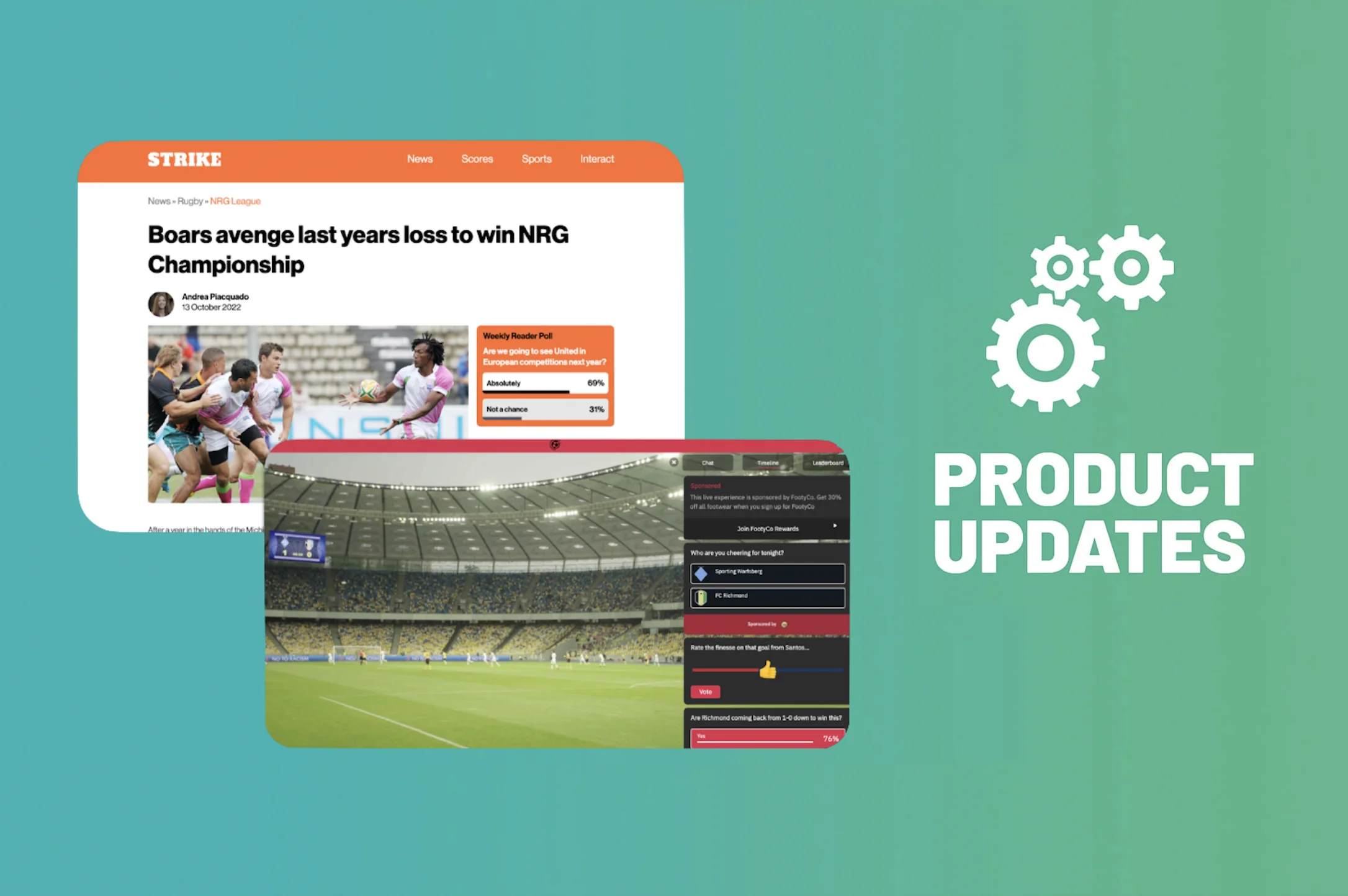
It’s the moment you’ve been waiting for: It’s time for our monthly product update! We have an exciting round-up of updates to share with you from October 2022! We are pleased to announce that we have officially launched our demo environment page, LiveLike Play, improved our chat moderation capabilities, simplified our leaderboard process, and more.
Introducing LiveLike Play!
The biggest request we get from potential partners is for a chance to actually test out our tools. That’s why we’ve introduced LiveLike Play, a section of our website that features demo examples of different environments powered by LiveLike! Visitors can now explore the live working demos, giving them a great way to visualize our tools in action and get a feel for how LiveLike can enhance their platform.
Global Shadow Muting in Live Chats
Now through our CMS, chat moderators can shadow mute users in all chat rooms for a dedicated application. On the front-end side, a shadow-muted user will still see their own messages, but they will be the only one who can. We have added this feature to reduce disturbances and potential harassment of users in public chat rooms.
Simplified Leaderboard Search Process
One of our major goals in constantly developing the LiveLike CMS is to make our processes as simplified and streamlined as possible. With this new update, integrators can now easily view what leaderboards a specific user is ranked on. This allows clients to build a more competitive experience on their platform and showcase compelling user profile screens.
Easy Access to User Widget Interaction History
Integrators can now also access a user’s past widget interaction history, and filter that history by widget type to show subsets such as past poll votes or predictions made. This new feature allows clients to learn more about their users and shift their platforms to adhere to certain fan behaviors.
If you want to learn more about LiveLike and what we are doing, feel free to contact us here. We would be delighted to learn more about your needs and expectations!
Making a Pitch for Fans at the World Cup and Beyond
Today on The Future of Fandom, we get out on the pitch ahead of the World Cup with US Soccer to think through their approach to a domestic football fandom, basing the frenzy of international action coming up this winter. And we get to do it with the help of their Chief Commercial Officer David Wright.
Did you know that there is more soccer content consumed in the US than any other country around the world? As David can tell you directly, the sport has seen explosive growth over his roughly 20 years of experience with it—and its rise is only continuing to ascend.
You’ll learn how that’s impacted David’s tactics and approach to the newest generation of fans, the ways in which they innovate, and their plans for 2023 and onward. We also touch on how US Soccer has led the charge in equitable pay and treatment between its men’s and women’s teams and how it can hopefully serve as a model for other sports. So let’s kick it off—finally, that wordplay makes sense!—and predict the future with US Soccer and David Wright.
Connect with David Wright on LinkedIn: https://www.linkedin.com/in/daveawright/
Read more about US Soccer: https://www.ussoccer.com/
FULL TRANSCRIPT BELOW
Adam Conner (01:28):
David, how are you? Thank you for joining me.
David Wright (01:34):
Adam, I’m doing great. Thanks for having me.
Adam Conner (01:36):
I’m a big soccer fan over the last 10 to 12 years, and I tell you where it really started. It began with the World Cup 2010 South Africa. I’d really never even watched a game, but it was the summer after I graduated high school. I wasn’t doing anything. I was down on the beach and in between going to the pool and the beach and back and forth, I watched that first game and watched as people went nuts as Tshabalala scored the opening goal for South Africa and then continued to watch as Landon Donovan put one past Algeria to send us through. And from that moment I was hooked and in large part, in fact exclusively due to US Soccer. So first off before we get started, thanks for serving at the helm and serving as the steward of that brand, which I love.
David Wright (02:24):
Adam, I love that story. And I would be lying if I didn’t say that I’ve actually heard a lot of similar comments from folks as they talk about their entry point to the sport and on the cusp of another World Cup. The beautiful thing about the global game is it’s just that, I mean, it serves as a communal moment and in many cases, and you’re a great example, it sucks people in and we’re delighted to have you as a fan. So thank you.
Adam Conner (02:51):
Well, it’s a real energy. It captures the world and obviously by extension the US during these times. What’s different now that we’re doing it in a different part of the year? Does that change anything about the World Cup planning? Because, listeners, obviously we are in the mid fall here. In a little while, we’re going to be kicking off in the winter (which is something we have not done for a World Cup, at least in my memory ever). I don’t think we’ve ever done it. Does that change the way you plan?
David Wright (03:19):
It’s interesting, Adam. It obviously is a first and with anything that happens for the first time, I think there’s a lot of lessons and key learnings along the way. I think where we stand and how we look at it, Qatar’s going to be an unbelievable moment for our sport globally, for all the obvious reasons. But as we think about it domestically, it’s going to be off the charts. And I point to, I mean just look at the US-England game the day after Thanksgiving. Some of the early reports of viewership are record breaking. It’s predicted to be the most watched game in the history of soccer in this country.
(04:00):
But then when you fast forward, the other interesting part is let’s not forget about the Women’s World Cup a mere six or seven months later. So now you’ve got a condensed window where the global spotlight is on the sport and US Soccer in particular, men’s and women’s national teams are front and center and I think poised to do some really great things. So from where we sit, we love it and it’s a countdown to the first match here in a couple weeks.
Adam Conner (04:27):
I’m looking forward to it. I’m planning on not doing a whole lot of anything there for those few weeks except being glued to the television as most people are or try to get out somewhere and take a look. But your experiences with soccer as a sport extend far before the first time I ever sat down to watch a game. And because of that, you have this incredible tenure of memory with regard to the way that fans have developed for the sport, a fitting tenure for this show, of course, as we look to the future of that fandom.
(05:01):
But before I get to that, let’s start between your beginnings in soccer and then your brief chapter away from the sport. What did you learn in those first, let’s call, I think it was like 15, 16 years, about the way that a US Soccer fan and not US Soccer, not of the Federation, but in this case of Major League Soccer, which is where you were, how did they develop, interact, engage, grow perhaps in relation to the way that people grow up with soccer internationally?
David Wright (05:37):
Yeah, it’s a great question and I think, let me start back to kind of my upbringing. I grew up playing the game and I grew up at a time when I was always the kid that was trying to stand tall and be proud that I played the game of soccer. And I was very fortunate to be able to play in college and fortunate to then go on and go to grad school and to be an assistant coach. And that ultimately brought me to MLS in the early stages of that league, which I think is really important and quite frankly was very important for my development. It was at a time where MLS was incredibly nascent and in the early 2000s, there wasn’t a week that went by where people were questioning the viability of the league, which is important to know because now you fast forward a generation later and no one’s questioning the viability of the league.
(06:27):
In fact, many would argue that MLS is one of the most prominent soccer leagues around the world as you think about just how it’s structured and the success from a business perspective. But in those early days of MLS, it was all about education and informing people that MLS existed, but then really trying to peel back the onion to try to create engagement opportunities. When you’ve got a league that at one point only had 10 franchises, didn’t have any history, that’s a big challenge to create meaningful fan engagement opportunities that bring people in with the passion that you described at the front end of the show.
(07:08):
And so that was really valuable for me to see. And I think one of the things that I learned among many is that there’s no lightning in a bottle switch, you know, you can’t make up history. And when you look at some of the other more established leagues around the world, I’ll use the obvious example in the Premier League, there are generations upon generations upon generations of fan bases that grow up and support a particular club in part because they’re their mother or father or grandfather or grandmother supported that club.
(07:41):
And we haven’t had that history. But guess what? It’s starting to change. And now we’ve got thriving professional leagues on both the men and the women’s side that are now starting to create their own path on their own history. And that’s really important. Which was then fascinating. To your point about my detour, I went to baseball and I specifically went to minor league baseball for a variety of reasons, not the least of which I wanted to prove to myself in the industry that I could help build something other than soccer. And it was about 180 degrees different, as you can imagine. You’ve got 115 year old established property that had still tremendous upside, but you didn’t have to worry about the education piece, you didn’t have to worry about the history. It was already there. But we had to think differently and we had to evolve. And that’s what we did over the five or six years that I was there.
(08:28):
And now back at US Soccer at such a seminal moment for our sport, we call this moment in time, we’re at the very beginning stages of this moment in time and fan engagement is through the roof. And in part because we have this generation of support specific to US Soccer, if you’re a fan of this sport, we truly believe we have an opportunity to meaningfully engage with you, which is pretty powerful and gets me pretty fired up every day as we think ahead.
Adam Conner (08:56):
To give the listener, maybe a newer fan of the sport, somebody maybe who caught onto a World Cup or some other league after 2010, you took that, can we call it sab-bat-ical? Because you went to baseball. Anyway, you had that break.
David Wright (09:11):
Yeah.
Adam Conner (09:11):
You come back. Can you give us a sense of the acceleration of the fanaticism of somebody who was a soccer fan between that time in 2015 and the time that you joined back to the sport five years later? Because I would think that it exploded. I mean, I saw soccer fandom really jump in two ways, one early to mid 2000s, largely through gaming because FIFA really rose to crazy prominence. And then the second was when NBC took the rights to the Premier League and people finally started seeing it somewhere other than some international channel if they weren’t watching the MLS already. So I’m curious, from your perspective, you take that gap, you come back, what’s different?
David Wright (09:52):
Yeah, there’s a lot that has evolved in a really short period of time. It’s almost like technology, right, you think back five or six years and how technology has evolved and will continue to evolve. I think soccer is on a trajectory unlike any other, and you referenced a couple of them. EA and the impact that that game has had on fandom, I can’t tell you how many millions of people are passionate about the sport of soccer and in many cases haven’t played physically. But their entry point was through gaming, and now they’re hooked and they’re diehard fans. I would again go back to some of the other foundational pieces that have seen massive acceleration. On the NWSL front, you know, think about the last number of years and how that league has really found its footing in once and for all. Finally, our country and corporate brands and media are starting to pay attention and truly get behind female sport.
(10:47):
And I think the NWSL from a team perspective and a league perspective is really helping to lead the way. MLS is now on a pace to 30 clubs. And let’s not forget USL, right? USL second division has dozens of clubs around the country. And so why is that all important? Because now you’ve got rubber meets the road in almost every single market and engagement on a 365 day basis that is really surrounding people with the sport of soccer. And then obviously the Premier League and other leagues that have really set their sights on the US as an opportunity. Adam, I’ll give you a little nugget. There is more soccer content consumed in the US than any other country around the world. So you think about that and everyone has that same reaction, but it speaks to the demand. And so when you look at some of the rights fees that are skyrocketing, we’ve got an incredible relationship that’ll kick off in January with More Media, Apple and the great relationship that they forged with MLS.
“You’ve got the NWSL rights that are coming up in ’23 and I think there’s a lot of optimism around the growth there. And then obviously Premier League and what NBC and the network has done with those rights, there’s a reason why soccer rights are exploding, because content consumption is on the rise and particularly in this market is unprecedented. And that really speaks to the demand. And I could go on and on about all the other metrics, but this thing is a rocket ship and it’s not slowing down, which is great. And oh, by the way, you’ve got a World Cup in ’26, you’ve got LA ’28, you’ve got maybe the prospects of another woman’s World Cup in ’31 on US soil. So this moment in time that I talk about is pretty special and is going to have a big impact on the sport.”
— David Wright (11:54)
Adam Conner (12:42):
You could just hear the energy in you talking about it. And I’m getting excited because not only the near term, but what it could mean going forward for my ability to watch and engage with those new commercial deals coming up. And by the way, I grew up in Baltimore where there really was not a soccer presence. There was a little bit of arena soccer like in-
David Wright (13:05):
Baltimore Blast-
Adam Conner (13:07):
The Baltimore… Great. Oh-
David Wright (13:10):
There you go-
Adam Conner (13:10):
Perfect. Nobody knows about the Baltimore Blast outside of Baltimore, but now I live in Pittsburgh, shout out the Riverhounds.
David Wright (13:18):
There you go.
Adam Conner (13:18):
USL team.
David Wright (13:18):
Yep.
Adam Conner (13:19):
Soccer’s everywhere. And that demand, that statistic was initially like what? I get it because it is exploding and we’ll get to the women’s game in a moment. By the way, listeners, if you’re interested in that, why don’t you stay tuned to early ’23. You might hear a little bit directly from the NWSL on that front, but let’s talk a little bit about the ways in which you are innovating right alongside the way that this fandom has exploded and accelerated. You come back in ’20, obviously there’s a lot going on in the world at that point, but we are getting back on track.
(13:59):
And in that time two things have happened. We have a brand new generation of fans who have come to social prominence in Gen Z and we have had this striking overarching sense of the need to belong in a community which goes right alongside the fanaticism that you might have historically associated just with watching something on the television and never being able to engage otherwise. As those two trends have started to rise and as Gen Z has started to mature into its own, what are some of the ways in which you’ve been engaging as a brand in different and new ways to capture and make sure that you are getting the 18 year old of today or maybe sooner that I was in 2010 when US Soccer first hooked me?
David Wright (14:45):
Yeah, it’s a great question and I think it really starts with our organization’s ethos and core values and what we represent and what we stand for. I mentioned earlier that we firmly believe that if you are passionate about the game of soccer, we have an authentic opportunity to engage with you. So this notion of inclusivity is critically important to our sport, but really is woven through everything we do. We talk a lot about diversity, equity, inclusion, and belonging. And those aren’t DEIB is not a four letter acronym. It’s real and guides everything that we do and in fact informs a lot of our business decisions. So if you look at how we position our property or our US Soccer as a brand, if you look at our actions, it supports this commitment to be a leader in the DEIB space.
(15:44):
And so why is that important? When you talk about Gen Z, you talk about this next generation of fan, at the core, it’s critically important. There’s a ton of research that supports that this generation significantly over indexed on supporting brands that they believe in, that resonate with them, that they feel they can relate to. And I think it starts with that. And then more tactically, we’ve really doubled down on our storytelling. So we have an unbelievable opportunity. Obviously everyone talks about our women’s national team and our men’s national team, but we’ve got 25 other national teams, not many people know that. And we’ve got all of these athletes from Para, to Futsal, to beach, they all have stories. And I think as we think to the future, our ability to tell those stories off the field is really, really powerful.
“I often look at our two kids. We’ve got a son who’s 19 and a daughter who’s 16, both play, but there as interested in what happens off the field as they are what happens inside the white lines. And so as a property, it’s a big area of focus for us and I think you’ll see us continue to double down on the content side of things. We also spend a lot of time really thinking about platforms and I’ll highlight… SheBelieves is an incredible platform. Obviously it’s got a competitive element, the ability to bring some of the top federations over to play against our women’s national team, but it’s so much more than that. It’s all about female empowerment and really showcasing the incredible feats of females on and off the field. And we’ve also seen that as an incredible means to engage with this next generation fan. So those are just a handful of things that as we think to the future, I think you’ll see us continue to really double down and lean into in our quest to truly engage with the masses.”
— David Wright (16:41)
Adam Conner (17:44):
And these masses, as you’ve said, have been values driven more than ever. Not only do they want to feel that they’re part of a community, they want to know that that community that they love also believes in the values that they do. It’s probably the best time then to bring up the fact that you are leading, I mean at the front of the pack when it comes to equity and pay equity and treatment. Now this is something that has been, well, it was deeply in the news and now we’ve come to the sort of exclamation point, which is that the equal pay CBA is here, men and women’s teams now have that equitable compensation treatment in the eyes of US Soccer. You’ve been there through all of that. What was it like in the trenches getting that done? And now that it is, how has that bolstered the message and the impact that you have again, both inside and outside of those white lines?
David Wright (18:47):
Yeah, first I give a ton of credit to our president, Cindy Parlow Cone, who really led the charge and also another individual that was behind the scenes, but equally as influential, Karen Leetzow, our chief legal officer. In short, Adam, it was tough. It was really tough, but actions matter. And to my point earlier about doing the right thing and creating positive change, I mean, what better example of an organization standing tall, leading and doing the right thing? But it wasn’t easy. There’s a reason why it had never been done before.
“Through the resolve and commitment of our leadership, the partnership with the Women’s National team PA, also the partnership with the men’s national team PA, very, very important to the overall partnership. The three entities were able to get together and figure it out. And I think what’s really, really powerful is the impact, not only is it having in the global space within soccer, but more broadly and how it’s impacting culture and other industries. We’ve already started to see that ripple effect. So again, a great example of doing the right thing, standing tall and as we look forward, something that we’re really proud to be paving the way and it’s going to be good for all.”
— David Wright (19:23)
Adam Conner (20:08):
And it’s strikingly important, especially now to have that. But any listener who maybe shares some of my entry into loving the sport can understand the impact that women’s soccer has had on that just as much as the men’s game. I mean, I started this off by talking about US Soccer’s triumph in 2010, that specific moment, it’ll be burned into my memory forever, but shortly beyond it, and I’m a little bit embarrassed to say it, but being surprised in 2011, watching the Women’s World Cup… not really even understand, “Okay, there’s a women’s World Cup. Okay, that makes sense.”
(20:52):
Again, I’m like a newish fan. I’m like, “All right,” see it on the television and watching the US just basically destroy almost everybody to then have them come back the next year, do it again in the Olympics and then just continue on this period of dominance. Man, I cannot think outside of Olympians, really many more female athletes in that time who were as revered and who came to prominence as much as those who starred for US Soccer. So I think that it’s a terribly important social moment, but a fitting validation of their performance and their shine over the last 10 or so years. And I hope that other sports follow as well.
(21:35):
Turning to the future then for both the men, the women, everything US Soccer, you’re on the verge of a pretty interesting change in the way that you can present that beginning in 2023. You’ll be managing your own commercial rights, which is something that is a new page that you’ve turned. In fact, shortly after the release of this podcast, folks, you should be listening to this on Monday, November 7th, if you are timely. On November the 9th, there will be a summit to talk a little bit about that. But I want to get a preview from you as we look ahead to it. What does that mean to you to have that power in ’23 with your own commercial rights, and what do you think that that will mean for the fan?
David Wright (22:12):
Yeah. Adam, I think it’s a great example of our ever evolving organization and we’ve had an incredible relationship with SoccerNet Marketing and SoccerNet Marketing has managed the rights for the better part of 20 years and really has given us the foundation that we’re now ready to build upon. But as is often the case with leading properties, the ability to manage the day in and day out decision making is really important. And I think as we look to the future again during this moment in time, what better time to take control of our business from a commercial standpoint? And so while it wasn’t an easy decision, it was the right decision, I think it was the right decision for the sport of soccer, it was the right decision for US Soccer. And I think we’re going to have tremendous success as we think about growth.
(23:02):
I mean, we are an NGB, national governing body, 501c3, which is really important to understand because every single dollar that is generated gets reinvested back into the business. So we are very, very focused on growing the business because we know that will provide resources for us to be able to compete at the highest level. And so on November 9th, we’ve got a commercial summit that will kind of serve to kick things off. And I think you’ll start to see us be very aggressive. I mentioned our Warner Brothers partnership that kicks off in January. We’ve got soon to be announced Spanish language relationship that is equally as important. But then we also have an incredible roster of corporate partners that are critically important to our success, not only from a financial standpoint, but how they activate, how they bring this property to life is really important.
“From a fan perspective, I think you’re going to see the US Soccer Federation continue to rise in prominence. I think you’ll see a lot more front and center engagement based on increased resource, more active partners, whether they be media partners or corporate partners. And that’s really good as we think about growth in the game. And it is absolutely a new chapter. It’s not going to come without as challenges as you would imagine, as is always the case when your business is evolving like ours, but one that we are incredibly bullish and excited for. And I think it’s going to be, again, really, really good for the sport and really good for US Soccer.”
— David Wright (23:58)
Adam Conner (24:36):
So stepping to one final question, and you know what, I’ll make this a pretty high flying one just because the title of this show is so broad. What do you foresee for the future of the way that any sport, whether it be a league or a franchise, can truly grow and win with these next gen viewers and next gen consumers?
David Wright (24:59):
Yeah. A couple of things, Adam. I think first, the properties that are winning the day are those that are at the core. They know who they are, they know what they represent, and they stick to that. As I often say, you can’t pick and choose when to do the right thing. You can’t pick and choose when you want to stand for this or when you want to stand for that. You got to be really consistent. And consistent meaning when it’s 75 and sunny or when it’s 42 and sleeting out.
(25:27):
And so first really looking inward and understand what do you stand for as a property? And then beyond that, how you are going to bring that to life? And I think what gets me so excited about US Soccer among many things is it’s really clear what we stand for and our partners have bought in. We know that our fans over index with our core values. So I think that’s really, really important for properties to understand who they are, what they represent, and then how they are going to bring it to life and stick to it.
Adam Conner (25:59):
Let me give you one bonus and then we’ll roll out of here. I’ve done this a couple times with guests, but it’s great because I think I’m going to like this better in a sport that I actually watch and follow. It’s a blank, the sentence ends with a blank. “I can tell you for sure that The Future of Fandom will not include ________. Could you take a stab at filling that blank for me?
David Wright (26:25):
Wow, I love that. Well, it depends on the timeline, but eventually The Future of Fandom will not include linear. So as you think about consumption and you think about the evolution of consumption, depending on who you talk to in the industry, that evolution is happening very quickly and how fans are engaging in and consuming content changes by the day. You’re starting to see properties have to really wrestle with, “Do I double down on linear that gives me today the broadest distribution, or do I lean into where the industry’s going, which is through a direct to consumer streaming platform?”
“Right now it’s a bit of a healthy mix. I mean, that’s how we approached it. We’ve got, as I mentioned, our great relationship and it is a healthy mix between linear and streaming, but there will come a day where it will be exclusively a DTC world. And when that is, I think remains to be seen, but properties need to prepare for that and evolve and try to stay ahead of the curve, those that evolve with consumption trends will win the day. Those that don’t evolve I think will find themselves struggling. So that’s what comes to mind with that. Great question, Adam.”
— David Wright (27:05)
Adam Conner (27:42):
Food for thought. Everyone think through that. The future might not be as far away as you think. For coming on and chatting about the beautiful game with me. Again, thanks for being the steward of the sport so far. I can’t wait to see what’s coming up this winter, and of course in ’23. David, very much appreciate your time.
David Wright (28:02):
Adam, it’s been a pleasure. Thank you.
Adam Conner (28:07):
World Cup time is almost here. Do me a favor. If you’ve never watched soccer before, give US Soccer a shot this winter. I think you’ll be pleasantly surprised by the energy and the entertainment and sooner or later you’ll be hooked. Thanks to David Wright for joining us and thanks to you, the listener for exploring yet again The Future of Fandom with us. I’d encourage you to stay connected, so subscribe to The Future of Fandom wherever you listen to your podcasts. Or you can also find all of our content livelike.com/podcast. You’ll get all of our episodes back to our launch earlier this year and across social, we’re also on LinkedIn @LiveLike and Twitter @LiveLikeInc.
(28:51):
I look forward to predicting the future again with you real soon. And until then, I’m Adam Conner saying so long and thanks for being a fan.
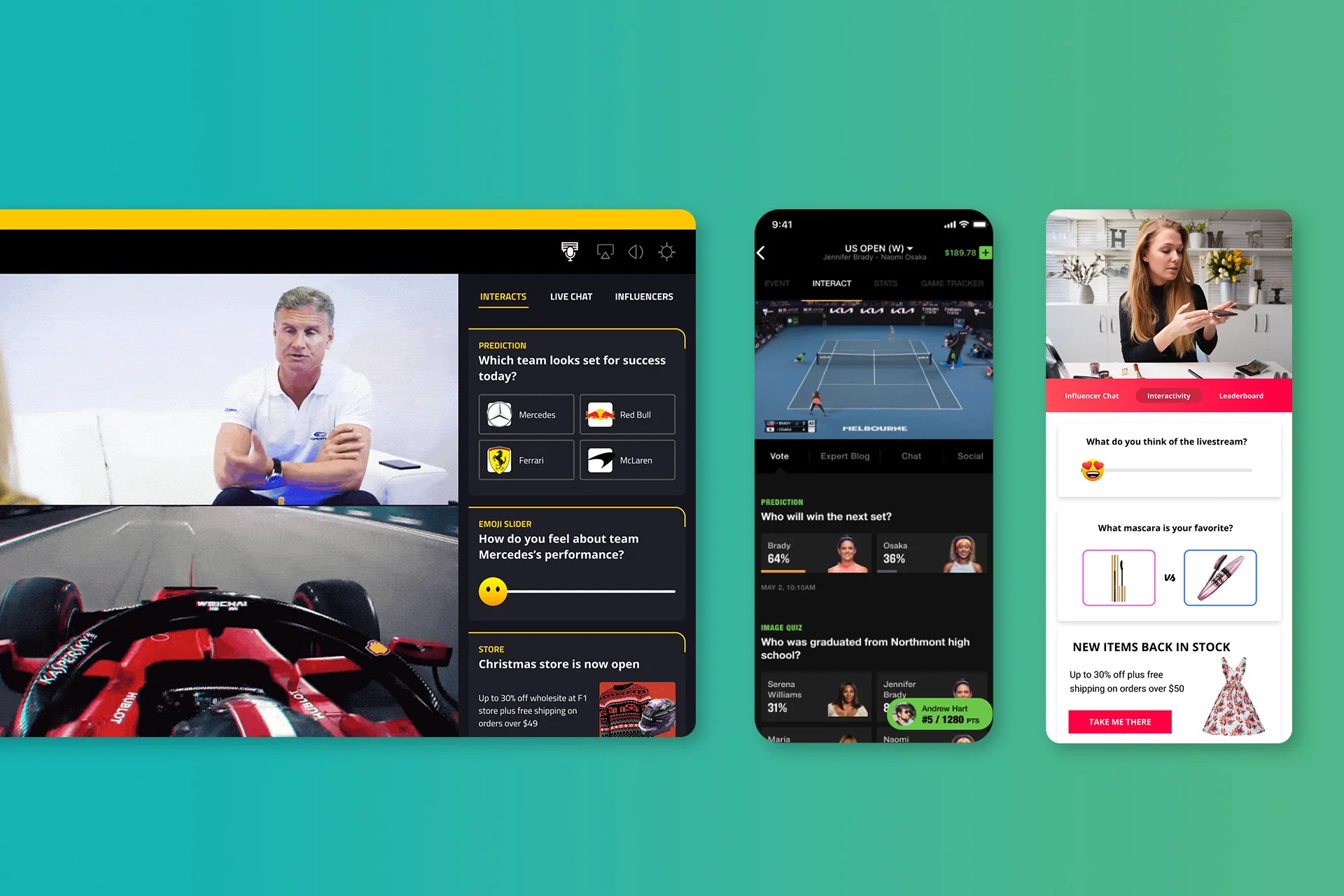
Where the concept of live streaming was once mind-blowing, today’s viewers are looking to take it a step further with something even more interactive. They’re no longer satisfied with being passive observers to live streamed content; they want to feel connected to other fans, make an impact on the action, and feel like their voices are being heard.
And it’s up to the creators and producers out there to respond to these new desires. To keep viewers entertained, broadcasters, rights-owners and streaming platform producers need to consider interactive live streaming capabilities in order to meet new audience expectations.
In this article, we’re looking at the three major reasons why interactive live streaming can greatly improve the audience experience, and keep 21st century fans engaged with digital content.
Create a Sense of Community: Live Chats and Watch Parties
Alongside gamification and interactivity, one of our three major pillars is community. Building a sense of community on your platform and making sure your users feel connected to one another is a surefire way to encourage their loyalty and foster a strong united fan base.
While many of our other tools help to build this idea of connection, live chats and watch parties are the two most effective community-building tools in the LiveLike engagement suite. Both of these tools work to add a social dimension to your platform that give users the interactivity they’re looking for.
Whether it’s to strike up conversation about a shared passion, share real-time thoughts and reactions to live events, or even engage in lively debates, live chats and watch parties allow for real-time connection between your users and give them the chance to learn, bond, or feel connected.
Live chats and watch parties can be used in many different ways on your platform. Here are just some examples:
- With public, private, and influencer chat options, you’re able to customize your user experience depending on the type of connection you are hoping to foster. Allow public chat for group bonding or debates, private chat for individual conversations, and influencer chat for VIP audience experiences. Currently, public chat is the most popular and common practice, existing on gaming platforms such as Twitch, YouTube and more.
- Gain more control over the chat tools on your platform by creating a restricted or “Influencer” chat session where only you or your guests can share insights, updates, stories, and more. You can even combine this with an “Ask Me Anything” Module to enable your audience to participate while maintaining moderation control.
- Enable users to create their chat groups to enjoy the same content simultaneously. Instead of discussing on Messenger, WhatsApp, or another chat application, users will remain on your platform for all their social needs. You can even go further with a “Watch Together” solution to let users create video chat rooms with our Watch Party feature. This has already been implemented by the biggest streaming services including Hulu, Netflix, and Amazon Prime Video.
Introduce Opportunities For Engagement: Interactivity Feed
As well as looking for opportunities for social interaction, users on your platform similarly long for moments of interactivity that go beyond traditional communication. In other words, not only do your users want to connect, they also want to play!
Creating moments where they can have a say in what happens during a live event, flaunt their industry knowledge, or challenge their peers to some friendly competition alongside the live stream is a great way to boost engagement on your platform. This can be done with the LiveLike suite through the introduction of an interactivity feed, a localized place on your platform where you can push interactive engagement modules such as polls, sliders, AMAs, cheer meters, quizzes, and more.
With so many different modules—or as we call them here at LiveLike: “widgets”—to choose from, the possibilities are endless depending on your platform goals:
- Gather Immediate Feedback: One of the most valuable things to learn about your users is what they think of the content you are providing. And what better way to find out than to ask them directly through subtle but engaging widgets integrated alongside the content they’re viewing? Pushing simple polls or sliders is a great way to avoid sending out tedious post-event surveys and works to engage users in a fun, intriguing way.
- Stir Up Some Friendly Competition: The whole appeal of interactive live streams is that they are uniting, entertaining, and generally more fun than a passive viewing experience. That means it’s up to you to make the experience as fun and entertaining as possible by engaging your users with ways to test their knowledge, flaunt their skills, or make some noise. With quizzes, predictions and cheer meters, users can easily engage in personal or communal competition and feel wholly invested in the content on your platform.
- Provide Exclusive Offers and Relevant Information: The strongest platforms out there are the ones that do it all, and give users no reason to look for help, entertainment, or information elsewhere. With our social embed feature, you’re able to offer exclusive promotions, discounts, or experiences and provide users with all the information they need through external social media postings.
Nurture Your Audience: Loyalty & Rewards Programs
Finally, your platform is only as strong as your fans are loyal. On top of community and interactivity, rewarding your users is undoubtedly the most powerful thing you can do to create brand loyalty and ensure platform longevity. By integrating loyalty rewards programs into your interactive live streaming experience, you can make sure your most devoted fans feel appreciated and come back to your platform for more.
- Points: Reward items like points, stars, etc. are low-hanging fruit that can be set up to be given to users automatically based on their activity on your live stream. With points, your audience members are more likely to engage with your content consistently as they feel incentivized to collect more. That being said, points alone are not enough; they need to be combined with other offers or “real” rewards to ensure user loyalty.
- Leaderboards: Leaderboards are a great way to extend your points system and build momentum for users to return to earn points in the first place. Users can compete against one another for spots on the leaderboard and feel motivated to end up as a top ranked player at the end of your live stream. But besides eternal glory, why should they care about finishing first? These kinds of victories must give way to bigger, or more interesting, and rewarding opportunities.
- Badges and NFTs: Badges and NFTs are another way to incentivize your fans to interact with your live stream content, and are becoming more relevant as we gain more of an understanding about the value of owning NFTs. These can be awarded when reaching a specific number of points or for having completed specific tasks while enjoying your live stream.
- Gifts, Exclusive Offers and Premium Experiences: Real-time VIP offers and loyalty rewards are the last piece of the puzzle and perhaps the most important to your interactive live stream user experience. This is because it concerns what your end-users are able to walk away with thanks to all the hard work they put in to earn those points, leaderboard rankings, and badges or NFTs. This last step must include the offering of real-rewards that your users can enjoy outside of your platform, such as discounted concert tickets, a chance to meet a celebrity, a free signed jersey, etc.
Implementing these loyalty mechanisms on top of your gamified live streaming experience will help you to increase user session lengths, reduce customer churn, and successfully monetize your platform.
In 2022, the competition for user attention is huge and only continuing to grow. It seems like everyone is fighting to acquire the top production companies, diversify their content portfolio, and generally offer the most amount of content out there compared to their many competitors. But in reality, the focus needs to return to the user experience on these livestreaming platforms, and to the new expectations of interactivity.
Broadcasters, rights-owners and streaming platform producers need to ask themselves: What can my fans do on my platform that they can’t on others? Or: What do they want to do that I’m not currently offering?
Interactive livestreaming is an amazing solution to making your platform stand out amongst the rest, and is becoming the norm as we move forward in the world of digital entertainment.
At LiveLike, we specialize in creating these unique interactive livestreaming experiences, and have proven our efficiency with renowned broadcasters around the world (Warner, Fox, Canal, Sky). With the use of our extensive engagement suite, we can help you to build these experiences and introduce interactivity seamlessly within your existing ecosystem.
.svg)
.png)