Where the concept of live streaming was once mind-blowing, today’s viewers are looking to take it a step further with something even more interactive. They’re no longer satisfied with being passive observers to live streamed content; they want to feel connected to other fans, make an impact on the action, and feel like their voices are being heard.
And it’s up to the creators and producers out there to respond to these new desires. To keep viewers entertained, broadcasters, rights-owners and streaming platform producers need to consider interactive live streaming capabilities in order to meet new audience expectations.
In this article, we’re looking at the three major reasons why interactive live streaming can greatly improve the audience experience, and keep 21st century fans engaged with digital content.
Create a Sense of Community: Live Chats and Watch Parties
Alongside gamification and interactivity, one of our three major pillars is community. Building a sense of community on your platform and making sure your users feel connected to one another is a surefire way to encourage their loyalty and foster a strong united fan base.
While many of our other tools help to build this idea of connection, live chats and watch parties are the two most effective community-building tools in the LiveLike engagement suite. Both of these tools work to add a social dimension to your platform that give users the interactivity they’re looking for.
Whether it’s to strike up conversation about a shared passion, share real-time thoughts and reactions to live events, or even engage in lively debates, live chats and watch parties allow for real-time connection between your users and give them the chance to learn, bond, or feel connected.
Live chats and watch parties can be used in many different ways on your platform. Here are just some examples:
With public, private, and influencer chat options, you’re able to customize your user experience depending on the type of connection you are hoping to foster. Allow public chat for group bonding or debates, private chat for individual conversations, and influencer chat for VIP audience experiences. Currently, public chat is the most popular and common practice, existing on gaming platforms such as Twitch, YouTube and more.
Gain more control over the chat tools on your platform by creating a restricted or “Influencer” chat session where only you or your guests can share insights, updates, stories, and more. You can even combine this with an “Ask Me Anything” Module to enable your audience to participate while maintaining moderation control.
Enable users to create their chat groups to enjoy the same content simultaneously. Instead of discussing on Messenger, WhatsApp, or another chat application, users will remain on your platform for all their social needs. You can even go further with a “Watch Together” solution to let users create video chat rooms with our Watch Party feature. This has already been implemented by the biggest streaming services including Hulu, Netflix, and Amazon Prime Video.
Introduce Opportunities For Engagement: Interactivity Feed
As well as looking for opportunities for social interaction, users on your platform similarly long for moments of interactivity that go beyond traditional communication. In other words, not only do your users want to connect, they also want to play!
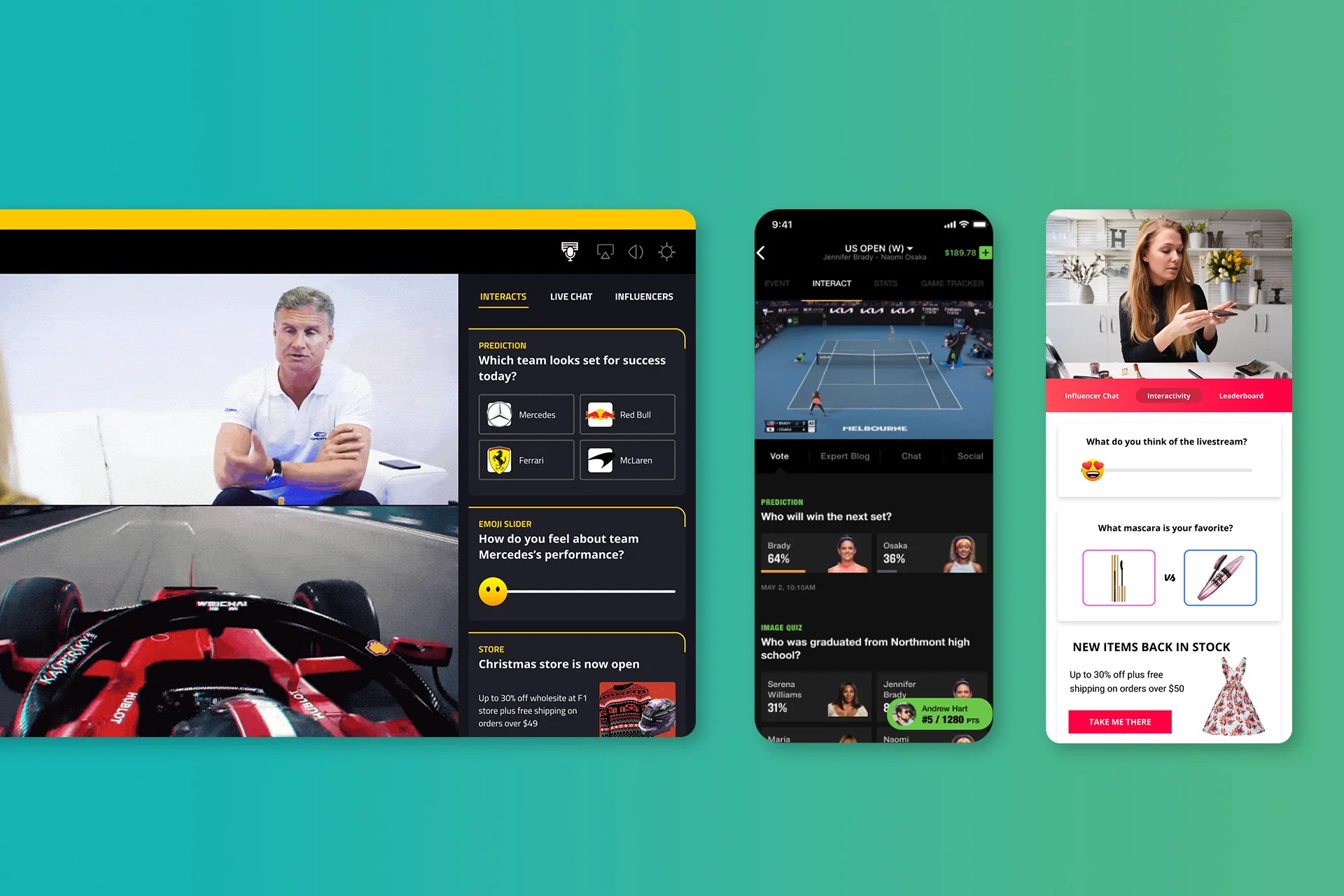
Creating moments where they can have a say in what happens during a live event, flaunt their industry knowledge, or challenge their peers to some friendly competition alongside the live stream is a great way to boost engagement on your platform. This can be done with the LiveLike suite through the introduction of an interactivity feed, a localized place on your platform where you can push interactive engagement modules such as polls, sliders, AMAs, cheer meters, quizzes, and more.
With so many different modules—or as we call them here at LiveLike: “widgets”—to choose from, the possibilities are endless depending on your platform goals:
Gather Immediate Feedback: One of the most valuable things to learn about your users is what they think of the content you are providing. And what better way to find out than to ask them directly through subtle but engaging widgets integrated alongside the content they’re viewing? Pushing simple polls or sliders is a great way to avoid sending out tedious post-event surveys and works to engage users in a fun, intriguing way.
Stir Up Some Friendly Competition: The whole appeal of interactive live streams is that they are uniting, entertaining, and generally more fun than a passive viewing experience. That means it’s up to you to make the experience as fun and entertaining as possible by engaging your users with ways to test their knowledge, flaunt their skills, or make some noise. With quizzes, predictions and cheer meters, users can easily engage in personal or communal competition and feel wholly invested in the content on your platform.
Provide Exclusive Offers and Relevant Information: The strongest platforms out there are the ones that do it all, and give users no reason to look for help, entertainment, or information elsewhere. With our social embed feature, you’re able to offer exclusive promotions, discounts, or experiences and provide users with all the information they need through external social media postings.
Nurture Your Audience: Loyalty & Rewards Programs
Finally, your platform is only as strong as your fans are loyal. On top of community and interactivity, rewarding your users is undoubtedly the most powerful thing you can do to create brand loyalty and ensure platform longevity. By integrating loyalty rewards programs into your interactive live streaming experience, you can make sure your most devoted fans feel appreciated and come back to your platform for more.
Points: Reward items like points, stars, etc. are low-hanging fruit that can be set up to be given to users automatically based on their activity on your live stream. With points, your audience members are more likely to engage with your content consistently as they feel incentivized to collect more. That being said, points alone are not enough; they need to be combined with other offers or “real” rewards to ensure user loyalty.
Leaderboards: Leaderboards are a great way to extend your points system and build momentum for users to return to earn points in the first place. Users can compete against one another for spots on the leaderboard and feel motivated to end up as a top ranked player at the end of your live stream. But besides eternal glory, why should they care about finishing first? These kinds of victories must give way to bigger, or more interesting, and rewarding opportunities.
Badges and NFTs: Badges and NFTs are another way to incentivize your fans to interact with your live stream content, and are becoming more relevant as we gain more of an understanding about the value of owning NFTs. These can be awarded when reaching a specific number of points or for having completed specific tasks while enjoying your live stream.
Gifts, Exclusive Offers and Premium Experiences: Real-time VIP offers and loyalty rewards are the last piece of the puzzle and perhaps the most important to your interactive live stream user experience. This is because it concerns what your end-users are able to walk away with thanks to all the hard work they put in to earn those points, leaderboard rankings, and badges or NFTs. This last step must include the offering of real-rewards that your users can enjoy outside of your platform, such as discounted concert tickets, a chance to meet a celebrity, a free signed jersey, etc.
Implementing these loyalty mechanisms on top of your gamified live streaming experience will help you to increase user session lengths, reduce customer churn, and successfully monetize your platform.
In 2022, the competition for user attention is huge and only continuing to grow. It seems like everyone is fighting to acquire the top production companies, diversify their content portfolio, and generally offer the most amount of content out there compared to their many competitors. But in reality, the focus needs to return to the user experience on these livestreaming platforms, and to the new expectations of interactivity.
Broadcasters, rights-owners and streaming platform producers need to ask themselves: What can my fans do on my platform that they can’t on others? Or: What do they want to do that I’m not currently offering?
Interactive livestreaming is an amazing solution to making your platform stand out amongst the rest, and is becoming the norm as we move forward in the world of digital entertainment.
At LiveLike, we specialize in creating these unique interactive livestreaming experiences, and have proven our efficiency with renowned broadcasters around the world (Warner, Fox, Canal, Sky). With the use of our extensive engagement suite, we can help you to build these experiences and introduce interactivity seamlessly within your existing ecosystem.
Share
Blog
Discover more articles
We dive deep into the world of Software-as-a-Service, exploring industry trends, product updates, best practices
NEW YORK, 10 September 2026 – Sports broadcasters and rights holders can now build and schedule live interactive content during a match from a single written instruction, with the video and images pulled automatically from their own media library. The capability comes from a partnership between fan engagement company LiveLike and sports media infrastructure company ScorePlay, announced today ahead of IBC in Amsterdam.
Until now, an exercise such as putting a player of the match poll in front of fans mid-game was manual work under time pressure. A producer had to open the content system, build the program, write the poll options, find and upload an image for each player, then schedule the post. Across a weekend of fixtures that work repeats every time, and the moments that would have made the best content pass while it is being done.
The partnership takes that handwork out. ScorePlay tags video, audio and stills as they are uploaded, identifying the player, the sponsor, the stadium and the fixture. Genie, LiveLike's AI orchestration layer, now reaches into that library directly through ScorePlay's API.
In practice, a producer types what they want. Genie identifies the fixture, requests the relevant assets from ScorePlay, assembles the interactive unit with the correct player imagery already in place, and schedules it to whichever surfaces the broadcaster is running. The producer approves it or moves on.
“Our goal at LiveLike is to use technology to help rights holders deliver unforgettable fan experiences in the moments that matter,” said Miheer Walavalkar, Chief Executive Officer and Co-Founder, LiveLike. “This partnership is the next chapter in that journey. What we have done with ScorePlay is to completely remove the friction between having the idea and getting it in front of fans.”
"Our customers have spent years getting their media properly organized and tagged," said Joshua Krakowsky, Head of Partnerships at ScorePlay. "What they want now is for that library to go to work. LiveLike is one of the first partners to build on our API in a way that puts a customer's own footage in front of fans while the game is still going."
The integration is listed on ScorePlay Connect, ScorePlay’s open platform for partner integrations that customers can access. Both companies are demonstrating it at IBC 2026 at the RAI Amsterdam, in Hall 1 on the ScorePlay booth, 11 to 14 September.
The LiveLike Audience Engagement Suite is a finalist in the region's leading broadcast technology awards, recognising the fan engagement platform's work with sports broadcasters and rights holders
New York, July 31 - LiveLike, the fan engagement platform used by sports broadcasters, streaming services and rights holders worldwide, has been shortlisted for Best in Sports at the BroadcastPro ME Manufacturer Awards 2026 for the LiveLike Audience Engagement Suite.
The awards recognise product innovation, engineering excellence and technology development across the broadcast ecosystem. Finalists were selected across 21 broadcast and satellite categories following industry-wide voting and review by an independent panel of experts. Winners will be announced on Tuesday 6 October 2026 at The Westin Dubai Mina Seyahi Beach Resort & Marina in Dubai, UAE.
The Audience Engagement Suite gives broadcasters and rights holders a way to build interactive experiences directly into their streams and owned platforms - predictions, quizzes, live chat, rewards, loyalty programmes and community hubs - without assembling separate point solutions for each one. Every interaction feeds a single evolving profile of the fan, which the platform then uses to personalise what that fan is offered next.
That combination is the argument LiveLike has been making across the industry this year. Fan engagement has been mischaracterised as a set of features layered onto a broadcast, when the durable value sits underneath: the behavioural graph that every interaction contributes to, and the AI layer operating on top of it. LiveLike's AI layer, Genie, now runs a growing share of the programmes the company operates on behalf of clients, moving the work from manual content management toward automated orchestration.
The Middle East and North Africa is one of the most active regions in the world for this shift. Major tournament rights, rapid growth in sports streaming and rising expectations around second-screen and in-stream interaction have made direct-to-fan engagement a commercial priority for broadcasters across the region rather than an experiment.
"Fan engagement gets treated as a set of features bolted onto a broadcast, and we've never seen it that way," said Miheer Walavalkar, co-founder and CEO of LiveLike. "What we build sits underneath the experience. There are the surfaces fans actually touch, and then there is the profile of that fan which gets sharper every time they touch one. The second part is the part that compounds, and it's the reason a broadcaster can keep getting more out of the platform in year three than they did in year one."
"Being shortlisted in a category assessed by the people who operate live sport in this region carries weight," he added. "They know the difference between something that demos well and something that holds up on a match night."
Sports organisations have spent decades refining three core revenue streams: direct fan spend, media rights, and sponsorship. The playbook is well understood. What is less understood, and far less developed, is the data infrastructure that connects those streams to each other and to the fans who power all of them.
Most organisations know they are sitting on significant amounts of fan data. Ticketing systems, CRM platforms, social channels, digital content interactions: the signals are there. But in the vast majority of cases, that data sits in disconnected silos, producing consulting reports rather than actionable intelligence. The result is a fragmented picture of the fan - one that limits commercial potential across every revenue line.
On a recent episode of Future of Fandom, LiveLike CEO and co-founder Miheer Walavalkar sat down with Aidan Cooney, CEO of Envision Sport Group and co-founder of Opta, to unpack this problem in detail. Cooney has spent 25 years building data and fan intelligence businesses across football, cricket, tennis, and rugby. His perspective on unified fan data, the shift from B2B to B2C thinking, and the convergence of sponsorship and performance marketing offers a practical framework for any organisation trying to move beyond fragmented data toward genuine sports intelligence.
From performance data to fan data: the Opta origin story
Cooney's career started with a simple hypothesis. In the late 1990s, football's status as the world's biggest sport came with surprisingly thin storytelling. Broadcasts offered a scoreline, occasional possession graphics, and goalscorer information. American sports, by contrast, had long used statistics to bring audiences closer to the action.
"If you give fans a higher-resolution understanding of what's happening on the pitch, you bring them closer to the sport they love," Cooney explained. That principle drove the creation of Opta, which transformed how football was analysed, discussed, and consumed. The OptaJoe account became a case study in sports data storytelling, building a following of hundreds of thousands across media, journalism, and the broader sports industry.
But Opta was fundamentally about what happened on the pitch. The return path - how fans reacted to that information and what their behaviour revealed - became the foundation for everything Cooney built next: Ellipse Data, InCrowd, and ultimately Cortex.
The difference between a customer data platform and a fan data platform
One of the most important distinctions Cooney drew in the conversation is the gap between conventional customer data platforms and what a fan data platform actually needs to do. Standard CDPs are designed for rational, price-sensitive purchasers. A fan is something else entirely.
"A fan wants to belong. They're passionate about the player or the team they support. The data that matters to you is very different from a purely rational, transactional data proposition," Cooney said.
The implication is that transactional data - which most sports organisations have invested in through ticketing CRM - is necessary but insufficient. Behavioural data is where the real value sits: how a fan reacts to a particular piece of content, when they react, whether content about a specific player activates more engagement than content about the team as a whole. This is the layer that informs personalisation, shapes content strategy, and ultimately creates trackable, monetizable assets for brand partnerships.
Cooney's platform, Cortex, is designed specifically for this purpose: unifying transactional and behavioural data into a single fan data platform that can activate across channels. LiveLike's engagement and gamification tools then sit on top of that foundation, turning data into community and interaction into measurable value.
The silo problem and why unification comes first
When asked about the most common mistakes sports organisations make with their data, Cooney's answer was immediate: silos.
"Very few organisations have a true single view of their fan base. That is the starting point for everything." Some silos are functional, built by design for specific use cases like ticket sales. Others are structural, created by the relationship between leagues and clubs or by the patchwork of technology vendors an organisation has accumulated over time.
The cost of these silos is not abstract. Without a unified single view, organisations cannot connect their content strategy to their commercial strategy. They cannot attribute sponsorship value to specific fan interactions. They cannot retarget fans who engaged with a poll, a vote, or a piece of branded content. Every disconnected system represents lost compounding value.
Cooney's prescription is direct: "You can't activate until you unify." And the use cases for doing so - from personalised content delivery to integrated brand campaigns - are available now in ways they were not five or even three years ago.
Sponsorship, media, and the hybrid model
One of the most commercially significant ideas in the conversation was Cooney's framing of the convergence between sponsorship and performance marketing. Sponsorship, in its traditional form, has not fundamentally changed since Mark McCormack and Arnold Palmer in the 1960s. It remains an awareness play, hard to attribute, and increasingly constrained as a share of total brand marketing spend.
Performance marketing budgets, by contrast, are growing rapidly. Social media ads, YouTube pre-rolls, programmatic buying: brands are spending heavily on audience acquisition through channels that offer clear attribution. The problem for sports properties is that these two budget pools rarely connect.
"If you create a more diverse set of assets and present them as an integrated media plan, you open up new budget areas within brands," Cooney argued. The opportunity for rights holders is to bridge that gap by combining the premium, trust-based qualities of sponsorship with the attribution model of performance marketing.
In practice, this looks like branded content paired with interactive fan experiences - polls, votes, and predictions that generate first-party data - which can then be used for retargeting and attribution. LiveLike's interactive tools are designed to create exactly these kinds of measurable, brand-integrated fan touchpoints that produce both engagement data and commercial inventory.
AI, personalisation, and the crawl-walk-run path
Both Cooney and Walavalkar addressed the promise and the practical limits of AI-driven fan personalisation. The long-term vision is clear: AI that can serve individual fans with content, offers, and experiences tailored to their specific behaviours and preferences. The economics and infrastructure to do this at true 1-to-1 scale, Walavalkar noted, are still being worked out across every industry.
The pragmatic starting point is cohort-based personalisation. Group fans by location, by behavioural patterns captured in your fan data platform, by engagement tendencies during comebacks or winning streaks. Let cohorts emerge dynamically from the data rather than relying on predefined segments.
"By putting the fan at the centre and serving them at the cohort level, you improve the fan experience, which drives up engagement levels, which drives up the value of the inventory you create on the back of it," Cooney said. "If you then take it to the next level and use AI to super-serve the individual, you drive that engagement and value further."
The compounding logic here is critical. Organisations that delay building cohort-based personalisation while waiting for perfect 1-to-1 capabilities lose years of compounding value - both in fan engagement and in commercial inventory quality.
The B2C shift and why it matters now
Cooney's overarching thesis is that sports organisations are fundamentally B2B businesses today, structured around selling rights to broadcasters and sponsorship packages to brands. The future is B2C: direct, data-informed relationships with fans that create value for both the organisation and its brand partners.
This does not necessarily mean streaming video direct to fans - a path Cooney sees as extremely difficult given the sophistication of existing broadcasters. It means building digital properties that offer genuine value to fans, capturing the behavioural data those interactions generate, and using that data to create a fan balance sheet that reflects the true economic potential of the audience.
"The whole original idea, that the fan base becomes a real balance sheet item, becomes a reality," Cooney said. "And that balance sheet isn't just about the lifetime value of the fan to the sports organisation directly. It's about lifetime value, plus the opportunity for brands to invest in that person over the duration of their fandom."
Listen to the full episode
Hear the full conversation between Aidan Cooney and Miheer Walavalkar on Future of Fandom:
A unified single view of the fan is the prerequisite for every commercial use case in sport, yet most organisations still operate with fragmented data silos.
Fan data platforms differ from standard CDPs because fan behaviour is emotional, making behavioural signals more commercially valuable than transactional data alone.
The convergence of sponsorship and performance marketing opens access to larger brand budgets, but only if rights holders can offer integrated media plans with measurable, interactive assets.
Cohort-based personalisation is the practical starting point for AI-driven fan engagement - delaying it sacrifices years of compounding value in engagement and revenue.
Organisations that treat their fan base as a balance sheet asset - and build the data infrastructure to



.png)
%20(1).png)

.svg)
.png)