
.png)
Earning a Cart Full of Fans
Today on the Future of Fandom, earn some cash with us! Or, earn some back, anyway. On this episode, we go shopping with Rakuten to learn about what might be on the horizon for online and in-store shoppers alike, via their Chief Marketing Officer Dana Marineau.
Over the last two years, we’ve seen shopping change a lot; being forced out of stores similarly forced brands to think harder and faster about how to create better digital experiences and partnerships, and new ways to showcase their products. Now that COVID seems to be on the decline, consumers continue to demand high-quality e-commerce experiences, a demand that companies like Rakuten are working to meet.
Rakuten Rewards is an online shopping platform that gives you cash back at your favorite stores. Dana has been with Rakuten for almost 2 years and brings with her a wealth of knowledge and experience in the marketing space.
Connect with Dana Marineau on LinkedIn: https://www.linkedin.com/in/danamarineau/
Read more about Rakuten: https://www.rakuten.ca/
Full episode here:
FULL TRANSCRIPT BELOW
Adam Conner (00:09):
Today on The Future of Fandom, earn some cash with me! Or earn some back, anyway. My name’s Adam Conner, I’m your host. And on this episode, we go shopping with Rakuten to learn about might be on the horizon for online and in-store shoppers alike via their Chief Marketing Officer Dana Marineau. Obviously over the last two years, we’ve seen shopping change a lot, being forced out of stores similarly, forced brands to think harder and fast about how to create better digital experiences, partnerships, and new way a to showcase product. Now that COVID seems to be on the decline, consumers continue to demand high-quality e- (and now hybrid) commerce. Dana’s on the cutting edge there and has plenty to teach us about what to expect for best in class shopping. So fill your cart and we will start to predict the future with Rakuten and Dana Marineau. Dana, how are you? Thanks so much for joining me.
Dana Marineau (01:10):
Adam, it’s great to talk to you again. Thanks for having me.
Adam Conner (01:13):
I can’t wait to chat with you again. I love chat with you on podcasts and listeners, prior to the life of The Future of Fandom, I did interview Dana a few times in this world, so this is going to be a nice familiar conversation to have. And one which is, of course, with a well known, recognized, and still growing leader in e-commerce a pioneer in some ways, but now we’re going to be talking about how trails will continue to be blazed in the namesake future of the show. First off, and not that people don’t know what this is, can we just do a very, very basic what the heck is Rakuten and what does it provide just in case everybody’s not familiar? And then we’ll talk about e-buying and what these past two years have done and go from there.
Dana Marineau (01:57):
Of course. So, yes, Rakuten. You may have heard of Rakuten and it is a very large company in Japan, but here in the U.S., it is newer to some folks. So I will say, Adam, Rakuten is an online shopping platform that gives you cashback at your favorite stores, your favorite brands. So we have over 3,500 stores, everything from Nike, to Old Navy, to Neiman Marcus, to Expedia, you name it, we probably have it. And every time you buy online through Rakuten, you get cash back on that purchase. So we think it’s a way for people to feel like they’re winning every time they shop.
Adam Conner (02:31):
And listeners, if you watched the Super Bowl, you will have seen their most recent high profile spot, featuring Hannah Waddingham who was on Ted Lasso at a very high stakes poker game, where some interesting chips were used, if I’m recalling correctly, pairs of shoes and microwaves. And what the heck was that? Dana, you had a hand in that. Didn’t you putting all that together?
Dana Marineau (02:50):
We did. Thank you. Yes. Very proud of that campaign. And Adam, I think, as we’ve talked about before, we’ve built an in-house brand and creative team. So we built that whole thing in house and, yes, instead of poker chips, it was an i-robot, and a little i-vacuum, a television and a pair of shoes that Hannah Waddingham, by the way, she is incredible, from Ted Lasso, was playing against a savvy Rakuten shopper, who, of course beat Hannah, because she shopped all those things with Rakuten and got a lot of money and cash back. But thank you for mentioning that. We’re very proud.
Adam Conner (03:25):
Of course, it’s a good intro too, because doesn’t it really set the scene for what the last several years has done to the e-buying experience. Though the field has been leveled in a way, and you can get access to goods that you get cash back for that you never could before, which maybe makes you feel like you deserve a seat at that high-stakes table. Over the last two years, obviously, lots of digital trends have been pulled forward. We’ve heard that ad nauseam, but since you are in the e-commerce world and seen that first hand, what, in your perspective, has it done for, shall we say, the present of the digital shopping experience. What COVID did to e-buying, truly buying, not just, “Hey, I’ll look at it online and then I’ll go to the store,” because you couldn’t do that. In what ways were your hands forced? And did it help?
Dana Marineau (04:15):
Excellent question. And, yeah, something we have been thinking about at Rakuten, certainly COVID, the pandemic has been eye opening in a lot of ways about the way people shop, how people shop, when people shop. And as you said, we have read a lot about the pandemic fueling e-commerce. Now I will say part of that is, as you remember, the first six, nine months or so, people were not going into stores. So that in its self was an interesting and different dynamic. Everyone was forced to buy nearly everything, from clothes to sunglasses, to toilet paper, online. So that of course changes the dynamic. One of the things I think has been very eye opening to us around how retailers and merchants are balancing what I would’ve called sort of a hybrid approach now. People are going back into stores. People are comfortable going into a shop now.
Dana Marineau (05:08):
So, but, as you said, e-commerce really blew up and people have become used to buying online. So what I think is interesting and I would even put the analogy of getting people returning to the office, this hybrid approach, “Some days I’m in the office, some days at home.” I’d say the same thing about online-buying and e-commerce is there’s a hybrid thing happening. “Sometimes I go in the store, sometimes I buy online,” but there’s also this new, “Hey, I want to buy it online. I’ve enjoyed that experience for all the reasons, the convenience, et cetera. But I need that instant gratification of what it feels like when I go into a store.”
Dana Marineau (05:46):
So there’s this hybrid thing happening now, too, that a lot of our partners and retailers have been testing, which is this concept of buy it online and then pick it up in the store or buy it online and now we partner with DoorDash or Uber Eats, so that it can get to you right away. So there’s just been this interesting shift in, again, I call it sort of a hybrid of the good experience of the in-store, the bad experience of the in-store, the good experience, the bad experience of online, just it out to see what people really want and how to make the best possible shopping experience, whether it’s physically in the store, or online, or some hybrid of those two things.
Adam Conner (06:30):
And I expect you and Rakuten having built for… not obviously having built for a pandemic where it be forced, but built for a future of that, where people would have their hybrid options or their purist options in either channel. I’m sure that somewhere in your head, you thought, “Well, I know that people are going to like this,” but maybe the reasons they’re in some of you expected and some of you didn’t. When it came to or when it comes to how consumers are getting value out of either Rakuten or the e-shopping experience, what’s been most unexpected?
Dana Marineau (07:02):
Well, I would say about Rakuten, you’re definitely right that we try to give you the best possible shopping experience, no matter how you’re shopping.
“To your point, whether you buy online and we give you that very winning, satisfactory feeling of the cashback, or you go into the store and you’re a member of Rakuten, so you still get that in-store cashback. You’re right to say, we have been prepared for a moment like this. However, you’re going to shop, make sure you do it through Rakuten, so you get that cashback and that winning feeling. I think the from unexpected is I, person, have been testing out myself. This concept of, ‘I don’t have time to go to the store, but I need this thing right now.’ So testing out some of these hybrid options, sometimes they work, sometimes they don’t.”
— Dana Marineau (7:04)
Dana Marineau (07:49):
I’ve been surprised by how many people have tried this buy online, pick it up in store or, “Hey, I’m going to trust Walgreens to partner with DoorDash and get me that thing immediately.” So I’ve been surprised to see how many people have adopted that, how many retailers have adopted that and to see that people really are enjoying this hybrid approach. And I guess I would say the concept of hybrid is a shock. If you had asked me two years ago, would I imagine a day where I didn’t go to my office every single day, that some days I worked from home, I would’ve said, “Adam, are you insane? Of course not.” Same with this. I didn’t really imagine a day where you could shop online and then get it that second. That was definitely not something I anticipated myself.
Adam Conner (08:33):
Yeah. For me, and I’m not a business operator myself, but I’m just thinking about all the logistical nightmares that go into linking these disparate entities into a partnership that, ultimately, gets the whatever it is from the retailer to the delivery partner and is there an online experience as part of that just seems like a complete spiderweb, which I guess we were forced into weaving, but one which it was a bit unexpected to me just is like how quickly everybody came together. And all of a sudden things that I would’ve assumed were roadblocks were lifted in light of this new environment. And, of course, all to the benefit of shoppers, yourself included. And just for the record here, I believe all of your shopping is done through Rakuten. You’re really drinking the Kool-Aid there.
Dana Marineau (09:15):
You know that’s right, Adam. I refuse to buy anything unless I can get it on Rakuten and get my cash back. So I am hardcore Rakuten shopper. It is true. I will go out of my way to only shop at Rakuten. And, honestly, I love it. And I am a big fan, of course, of Rakuten and getting that cash back, I’m kind of addicted to it. But, yes, I only shop with Rakuten. That is for sure true, because there isn’t anything we don’t have that I need. That is just true.
Adam Conner (09:41):
Sure. And I love the idea of getting cashback anywhere. In fact, you mentioned something here that I’m going to ask about again in a little bit, that in-store cashback, because I think there’s a bit of education that you’ll have to give to me here just because it’s a slightly new-ish concept in my ears. So I’m not the most sophisticated shopper. My idea of a hybrid shopping experience is what I was thinking when a couple of years ago, I went on a few year run of going out to shop on Black Friday. Now I would not get in the line and wait in the JCPenney for the pair of pants or whatever it was. I would walk around the store. I would see the thing that I liked. And then I just go online to their site and buy it without having to wait in the line, any ad will show up before Christmas, whatever that’s as far as I go.
Adam Conner (10:22):
So I’m glad to be able to learn a little bit more about these specific intricacies, which I’ll ask you in a second, because I first want to go to the side of the buyer, the side of the me who is getting more sophisticated each and every day, specifically within the filter of fandom. Now fandom, a word that everybody on this podcast, everybody listening to this might associate traditionally with sport. I’m a fan of a team, a player, a thing. And I think eventually people will become genuine fans and diehards of brands. That’s what this show is all about. And so there are parallels in business that are to be discussed. And I think when you talk about retailers and providers of good manufacturers, things like that.
Adam Conner (11:01):
It’s almost in my head, and it’ll be in your too, because we prepped for this, being a fan of a team, which is maybe like where the retailer is that you buy the thing from, and the player, which is the good that you buy within that. I think I have that correct. Do you see any parallels there in how people shop based on either the brands or the banners that they love the most?
Dana Marineau (11:28):
Yes. And I do love this analogy and I think, Adam, you also know I’m a huge sports fan, so this will be fun for both of us.
Adam Conner (11:35):
I assumed as much.
“When I think of being a fan, I think you can be a fan of a team. I am a huge Warriors fan, obviously. And just like I’m also a huge fan of certain brands. I love Nike. I love Bloomingdale’s. There’s also the concept of “I can love the Warriors, but maybe I’m really just a fan of Steph Curry, the player on the Warriors.” And using that same analogy, I love Nike. I said that, but I also collect Air Jordans. So the thing that I just think is very interesting about this analogy is I think shopping with Rakuten or shopping online, in general, is a lot like this. I can collect Air Jordans. I can buy those Air Jordans from Nike, or I could buy them from StockX or I could buy them from Finish Line.”
— Dana Marineau (11:36)
Dana Marineau (12:22):
It’s the same idea of “I can love the Warriors or I can love the players on the Warriors.” I think Rakuten provides you the ability to be a fan either of the store or the item that you’re trying to buy from many stores. And that’s actually how we encourage our members to buy from Rakuten actually is “Is it you love this particular store or is it you want this product? Let me show you all the stores Rakuten has and the cash back rates at each of those stores. And that way you’re still getting that product you wanted, but look to compare who has the better cash back rate?” Is it Nike? Is it Finish Line? Is it Footlocker? Is it StockX? So I think that’s a really interesting way to think about buyers and what is it that they’re a fan of? Is it that they’re loyal to this one store or no, they just want this one thing. It doesn’t matter where they buy it, as long as they get that exact thing. So I love that analogy. I think it’s very true.
Adam Conner (13:18):
And maybe it’s a third thing in the middle. Now I’m going to go into the basketball… I’m not as massive a fan of basketball as you are, but I’m thinking there’s got to be the fan that says, Well, I like the Warriors and I like Steph and some days I’ll prefer… Regardless of the team of the player, or a certain player, or a certain team, but really what I like is good basketball. And in this case, really what I like is the cash back. If I’m going to get the most utility from a certain place, maybe that is what drives me more than anything else. But regardless of the metric that people go after, whether it be the banner, or the brand, or the incentive, how does the experience, and I will speak to Rakuten specifically here, how does the experience get differentiated when you approach different consumers who select those types of preferences? I’m sure that it modifies in some way, but I just am curious, because, hey, personalization, differentiation, that’s all pointed at the future. And I’d be curious to know how you handle it.
“We definitely do our best at Rakuten to personalize your home feed experience. Meaning when you first sign up with Rakuten, we will ask you, ‘Hey, tell us about the things you shop for. Like do you have pets? Do you have kids? Do you shop for apparel? Do you shop for airline tickets?’ So we’ll ask you those questions. And then if you click ‘I shop for travel. I shop for shoes. I have a kid, so I shop for soccer cleats,’ then we’ll say, ‘Great, thank you for telling us that. Here are all sorts of stores that we can offer to you. Do you happen to like any of these stores?’ And you say, ‘Oh, yes. Actually I like Under Armour. I like Bloomingdale’s. I like Expedia,’ whatever it is. And then when you get to your home feed, your homepage of Rakuten, we will show you the stores that you’ve selected or stores like the ones you’ve selected and you can see the cashback rates.”
— Dana Marineau (14:14)
Dana Marineau (15:05):
And we do our best to personalize that experience fair. So that we say, “Hey, I know you told us. You liked Nike, but by the way, Adidas is on 12% cashback today.” So I think answering your question, what we want to do is give you the best possible shopping experience, whether it is, “I love Adidas,” or “No, no, I just need to buy new cleats for my son and I see that this brand has a higher cashback rate today. Oh, and by the way, is having a free friends and family sale too. I should go there.” So to your point, fandom really does evolve. And I think there are people who actually just want the highest cashback rate. They don’t care what store they’re-buying or what even brand they’re-buying it’s that they want the highest return. So there are definitely people like that. And then there are people who are like, “No, no, no. I only buy from Nike.” So I do think do our best at Rakuten to personalize that experience and give you what you need based on what we know about you.
Adam Conner (15:57):
And listeners, that was not a verbal typo there. When you think about making cashback on purchases, you might think of something like a credit card, which offers 1 or 2%, but Dana said 12. That is not an anomaly. If you don’t know what Rakuten is, that’s the kind of thing that you can look forward to. So maybe we just made a Fanny it just out of that, because we’re in the heck else are you’re going to get 12% off of a purchase like that, especially made online?
Dana Marineau (16:19):
Oh, and Adam, I’ll just say many times a year, we go above that 12%. Certainly, for our big give event in may, we have many, many hundreds of stores at 15%, for many days. Over the holidays, Black Fridays, Cyber Monday, we have hundreds of stores at 15, sometimes even 20%. So we have some big deal days that are really high. And sometimes we even have days where we call it super app Sunday, where we get a very high percentage across lots of stores, only if you buy in the app. So we try to do our best to make for some special days.
Adam Conner (16:52):
So listeners, if you’re not downloading it, you should at this point, all right, because you’re missing out. And we’ll touch on this a bit further, because obviously, in regard to the way that any fandom will grow, we got to also assess the state of it today. So I have a few questions about where you see it right now today and we’ll keep it Rakuten specific again. I mentioned I would talk about in-store cashback later on and we’re near that moment now, but first I’ll ask over the last couple of years, there are different sects, as you’ve said, of consumers who prefer the, like you, prefer a certain store, maybe prefer the cashback. Have you seen those trends changing at all? Or what’s popular nowadays? Is it more fandom of a banner or a brand or utility? What have you seen?
Dana Marineau (17:36):
I would say what we’re looking at in terms of trends is less about what you’re asking about and more about genres and what people are-buying and not buying. So I’ll give you an example. Of course, you’ve seen all the press coverage on the last two years athleisure home office, home improvement, casual yoga pants, sneakers. Oh and by the way, of course, pets and pet supplies. There are things that people were-buying in store and online that sort of took a huge swing over the let’s call it two years of the pandemic and lockdown and quarantine and where people were just mostly staying home. What I will tell you is there’s been a huge shift back to two things. People are starting to travel again, so we’re starting to see a big uptick in our travel properties, whether it’s hotels and planes and car rental.
Dana Marineau (18:34):
And we’re seeing a lot more activity happening in travel again, which of course for nearly two years, we didn’t see much at all. We’re also seeing a lot more purchasing of things people are going out again. They’re going to parties, they’re going back to the office. They’re going to dinner with friends. So we’re seeing a lot more purchases happen in whether it’s the luxury buying and “I’m going to buy a nice new pair of heels or a nice blazer, because I haven’t been to my office in two years.” And again, travel like things, people are leaving the house and we’re starting to see that shift again, away from the athleisure and the home improvement. So when comes to trends, we’re definitely seeing those things happen.
Adam Conner (19:13):
Okay. So we are seeing trends more in categories than in a type of purchase, but even in the ways that people buy, there are new features on the rise. Let me ask about that in-store cashback. So let me get this straight. So I can use Rakuten to buy something, which is an e-buying experience, but I can get cash back in the store. Could you explain that to me?
Dana Marineau (19:33):
Of course. So we are happy for you to shop on any Rakuten retailer or merchant, whether it’s online or, of course, in the store. So for example, when you go into a Macy’s, or you go into a Men’s Warehouse, or you go into Finish Line or Adidas, if you have a Rakuten account that is linked to your credit card and you use that credit card at the store, again, Macy’s, Finish Line, Adidas, you will automatically get your cash back. It is actually as easy as I just said, you have to be a Rakuten member and you have to have your credit card linked, you use that same credit card and you get the cash back. It is awesome.
Adam Conner (20:09):
I got to tell my wife about that Macy’s thing. Macy’s is a good look at the bill at the end of the month. It’s a lot of Macy’s there. So I’ll have to do that.
Dana Marineau (20:16):
So you’ve got to get that cash back, Adam.
Adam Conner (20:19):
Yeah. And I guess that should have been obvious from the beginning. It’s like, “Hey, why should I be forced to choose the platform where I do it? If everybody is partnered and agreeing on the same thing, if I make a buy online, why shouldn’t that link to something that I could then go in the store and get the same benefit, especially if I’m the type of consumer that likes to go into the store, try on the thing, look at the thing, see the selection of items there? And maybe, hey, maybe I see something there and it’s a retailer partner with Rakuten that I didn’t know that I wanted, but, I find it that’s a great cross-sell, upsell opportunity there. So good for the business and, hey, also good for the consumer.
Dana Marineau (20:52):
That’s right. And you hit on the thing that we hope for, which is that discovery. So both online and in store, we hope that, “Hey, you’re going to Rakuten because you know we have Macy’s.” “I’m going to shop around, I’m going to buy the thing and I’m going to get my cash back. Oh, wow. Rakuten also has Sunglass Hut. Oh, Rakuten also has Expedia. Oh wow. Rakuten also has Ann Taylor.” Whatever it is, we want you to be able to discover that both in the mall and online.
Adam Conner (21:20):
I think that makes complete sense. And hopefully listeners, you’ll do some discovering of your own as you continue to peer in to this capability. And I’m sure you’ll be a fan of it right quick. And to that, in terms of what will happen, let me touch on the other F where we focus on the show here on, which is future. I want to ask as we begin to round out today, and then at the very end, I’m going to ask a question, which I believe I’ve asked you before, but not for this audience. Let’s speculate a bit. Let’s peer into the crystal ball, five-ish years down the road, let’s say. And based on what you are seeing now in the market with what retailers are doing, or certain loyalty programs, or whatever, what would a great future state of shopping look like? What can consumers, or should they, expect from the retailers and the brands that they love?
Dana Marineau (22:11):
Okay, great question. I’m going to address it…
Adam Conner (22:13):
Big question too, by the way.
Dana Marineau (22:13):
… through macro sort of online shopping, and then I’ll talk about Rakuten. So I would say what consumers, you used the word expect, and I’m going to use the word demand.
Adam Conner (22:25):
Hey, fair enough. Let’s do that. They’ve demanded a lot after these last two years. So let’s do it.
“Consumers demand options. So what I will say to you is I think a lot of retailers and merchants are playing catch up right now, when it comes to giving consumers as many options as possible as relates to buying. So, again, buying online, buying in store, buying hybrid, you shop for it online, and then you receive it quickly, instant gratification, via a partner that they have, whether it be a DoorDash type thing, an Uber Eats type thing, a shipped delivery, whatever it is. I think you’re going to start seeing people demand that and only shop in places where they have choices and options. So I definitely, asking about crystal ball, I think we certain stores and certain merchants got there faster, quicker during the pandemic. Not everyone is there yet. So I just experienced the other day for the first time I needed something from Walgreens. I didn’t have time to go to the store, but I also needed it that day. So buying it online and having shipped to me and getting it three days later, not an option for me. And it turned out they had an option with DoorDash. Brand new, and I got it in an hour.”
— Dana Marineau (22:30)
Dana Marineau (23:35):
So I think stores are going to have to start adopting all these things in order to, and I’m getting to your second part, the loyalty. People will be loyal to the convenience of shopping. And they’re going to want to shop in all three of those ways. Now with Rakuten, I would say you should only do your online shopping and your in-store shopping in places where you get that cash back. I’m not sure why you would buy anything and not get that cash back reward in return. So we are building, what I would say, is a very loyal member base where people expect from us and our partners that they have a variety of ways to shop with, again, online, in store, or some sort of hybrid.
Dana Marineau (24:12):
So speaking of Rakuten in the future, I would say what we are working on is what I would call exclusive experiences. So you shop with Rakuten and you get something exclusive that you can only get if you shop through Rakuten. And to me, right now, that thing that you get is cash back. I am hopeful that we can start introducing other exclusivities and other experiences as a Rakuten member that you only get when you buy through us. So that’s what I would say, is people are really just trying to give options and give exclusivities for that loyal membership.
Adam Conner (24:46):
I hope you come up with that too, because, again… And it’s in the same vein. I think about other ways in which I would traditionally associate cash back on a purchase. I go back to the credit card thing. This is something that credit card company’s been doing for a long, long, long time. They’ve also only in really one case have done the add-on value of experiences or things exclusive through. Listeners, you have a credit card somewhere in your wallet where somewhere that bank is saying that, but do you really use it? Do you use it that much? I think that exclusive experience world is yet to be disturbed. I don’t know about disrupted because it started, but disturbed for sure, by somebody with this sort of powerful marketplace, like you do.
Adam Conner (25:29):
So I’m really interested to see what you do with that, Dana, genuinely, even outside of this podcast. And listeners, you should expect that and maybe even demand it in the next couple of years from somebody. I don’t know who it is, but, hey, if it’s Rakuten, that’s great. Let me round out with a question that, and this is especially going to help for the uneducated Rakuten-er of the future. But as a question, I think I’ve asked you each of the times that I’ve interviewed you before, which is we have spoken about the things that you can purchase on the platform that you might expect, a pair of Nike shoes, and then other things that maybe you don’t expect, like renting a car. What would you say or what is new about the unexpected things that you can buy on the platform, that is to say what’s the most unexpected thing that you can get on Rakuten that you’d never thought you could?
Dana Marineau (26:14):
That is a great question. Well, you named a couple of them.
“I think people think of Rakuten as apparel and all kinds of clothing and department store. I think people don’t know that you can also get your Uber through Rakuten. You can buy your groceries on Instacart through Rakuten. You can get your ESPN, Hulu deal through Rakuten and buy your plane tickets through Rakuten. And so I do think there are a lot of things that are unexpected. I always am encouraging my friends to go to our feed and play around and discover to see what else we have. So we have everything from Old Navy, to GameStop, to some of the fresh food makers. So I do think nearly, and you joke with me how I only buy at Rakuten, that is true, because there’s nothing that we don’t have that I need for myself, my family, my dogs. So we have it all. So there are really all sorts of unexpected things outside of what people think of us for, which is that retail and apparel.”
— Dana Marineau (26:17)
Adam Conner (27:14):
Well, it sounds like the sky is the limit at least until you start doing consumer space travel. For now, thank you for telling me more about this and also and importantly, what shoppers expect demand at Macy in the future as they develop their fandom with the teams and the players of the sport that is shopping. Dana, thank you so much for joining us and sharing your perspective.
Dana Marineau (27:36):
As always, thanks for having me, Adam.
Adam Conner (27:40):
Thanks again to Dana Marineau from Rakuten for joining us. Hopefully, our conversation opened up a lot of eyes and maybe some wallets as to how to get more from where you shop and thanks to you. Of course, the listener, the wallet opener for exploring the future of Fandom with us and I’d encourage you to stay connected as well. So be sure to subscribe wherever you listen to podcast and, or you can also find all our content at livelike.com and across socials, LinkedIn, a lot of LinkedIn @LiveLike and Twitter @LiveLikeInc. I look forward to predicting the future again with you real soon. And until then I’m Adam Conner saying so long and thanks for being a fan.
Building a Neighborhood of Investors
Today on the Future of Fandom, we make ourselves at home, or at least make a portfolio of them, with Suresh Srinivasan, Chief Marketing Officer of Roofstock. Roofstock is a digital real estate investment platform with a mission to make ownership of investment real estate radically accessible, cost-effective, and simple. With Suresh to guide our conversation this episode, we’re talking about the rise of home investorship as a proxy for ownership, especially among the newest generations in the workforce, and what that means for the need to build best-in-class digital experiences to make the process more accessible.
Suresh is based out of the San Francisco Bay Area and holds over 25 years of experience in the marketing space. He joined Roofstock in 2017 and has worked ever since to build the real estate investment market into a space this is proactive, cost-effective, and accessible.
Connect with Suresh Srinivasan on LinkedIn: https://www.linkedin.com/in/imsrino/
Read more about Roofstock: https://www.roofstock.com/
Full episode here:
FULL TRANSCRIPT BELOW
Adam Conner (00:09):
Today on The Future of Fandom, we make ourselves at home or at least make a portfolio of them. My name’s Adam Conner. I’m your host. And in this episode, we rent some time with Roofstock and their Chief Marketing Officer, Suresh Srinivasan. In a world where job and city hopping alike is often met with better opportunity, so too has buying a home lost a fraction of its luster. Today, we talk about the rise of home investorship as a proxy for ownership, especially among the newest generations in the workforce and what that means for the need to build best in class digital experiences to make the process more accessible and foster a neighborhood of happy homeowners from afar. So, let’s open the door on this topic and predict the future with Roofstock and Suresh Srinivasan. Suresh, how are you? Thanks for joining me.
Suresh Srinivasan (01:01):
Thanks, Adam. Good to be here.
Adam Conner (01:03):
I’m interested in learning about this world of real estate investing just because I feel I’m probably in your target audience, if nothing else. And then of course, because I’m in that target audience, I’m curious to learn how you’re building that community. But before we get into any of that, let me begin with the simple question which is what’s Roofstock, if you could, for the listener that may not know?
Suresh Srinivasan (01:29):
Yeah, just really quickly. So, Roofstock is a digital platform for investing in the $4 trillion single family rental home market. Using Roofstock, an investor could buy, sell, or optimize an investment portfolio comprised of properties that could be anywhere across the US.
Adam Conner (01:47):
Okay. So if I don’t own a home today, this is a way in which I can still be investing in single family homes, multi-family homes in a diversified manner basically, right?
Suresh Srinivasan (02:00):
Yeah, that’s exactly right. So with Roofstock and our focus today, Adam, is primarily single family rental homes. So we do have smaller multifamily, so two to four units, but it’s primarily the $4 trillion single family rental home market which has largely been… Up until the last decade or so, it’s been very hard for folks to access anywhere outside of their local geographic region. And so, I would say that Roofstock’s unique innovation is that we break down the geographic barriers to investing. So if you happen to live in New York City, you could easily be investing in Indianapolis or Orlando almost as easy as you could within the New York City area.
Adam Conner (02:42):
And hey, I mean, if you don’t live there, the that’s a nice way to do it because-
Suresh Srinivasan (02:46):
Right.
Adam Conner (02:46):
The first thing I think about when I’m not as sophisticated as to say, invest in a home yet, but certainly to buy one, I got to be there. I got to see it. And in this case, if it’s an investment, obviously, you don’t see a stock. Sure, you see a company operate, but this is an interesting way to get in there. Are you seeing by the way… And we’ll talk about sort of how the audience has been built in the growth they’re in. Have you been seeing that the folks who have been joining Roofstock’s portfolios and investing, do most of them own homes already? Or are you seeing that some folks are even taking the plunge for first timers and saying, “Well, I’m going to invest in some markets first before I buy?” Because maybe, they’re renters themselves.
Suresh Srinivasan (03:28):
Yeah, you know what? So, here’s what’s really interesting. When we think about individual investors who are using our platform, more than 80% are under 44, more than half are under 35 years old, and 75% of them are first time real estate investors. And the reason I say this is that when you sort of look at demographic trends, one thing that’s really striking is that you look at home ownership stats at large. Millennial home ownership rates are well below prior generations when they were in this same age range. So for example, millennials are in the 50% home ownership range, whereas prior generations were in the mid to high 60% range.
Suresh Srinivasan (04:08):
And so, one thing that we’re finding with Roofstock and our investors who are coming onto the platform is that, there’s a strong priority that’s being placed on financial independence. And so, what they’re doing is saying, “Hey, if I have spare cash to invest, I’m not going to go lock it up in a down payment necessarily on a home to live in.” What they’re saying is, “Could I put the cash to work to build up passive income streams so that I can break free from my nine to five job, if you will?”
Adam Conner (04:34):
Right.
Suresh Srinivasan (04:35):
Yeah. So, we’re absolutely seeing that people are choosing to rent where they live and then buying through the platform for investment purposes.
Adam Conner (04:45):
Well, I can totally understand not being in a home and sticking money into it and this is my personal experience just because I haven’t. Also, I’ve recently moved. And I think that, that sort of transient nature of the newest workforce who are craving flexibility, who are going and pursuing job opportunities maybe in different geographies, because whether it’s chasing a new opportunity, a new leadership position, or chasing a bigger bag, they are going for cash first, and then building equity in this way second, and using the cash to do that. I have not figured out exactly why that’s the case other than jobs, except I’m thinking maybe the rising prices of homes. But that probably is also a reason why you would want to invest rather than to buy. So when it comes to home ownership, and then let’s say, investorship, you’ve been on this ship since 2017 with Roofstock specifically. A lot has changed, a lot has happened even recently there. I’m curious since you’ll have seen this for the last five-ish years, what’s changed the most even in that time about home ownership and its relative weight compared to investorship?
Suresh Srinivasan (06:02):
Yeah, you know what’s interesting? So, I’ve been in real estate tech for over a decade now. I would say up until a decade ago, there wasn’t much innovation. So there was no software, no tech really entering real estate. And prop tech as a category has really emerged over this last decade. And so, I would say that the biggest thing that we’re seeing is that it was pretty hard to access this market. When you think about real estate investing, it was mostly people buying and selling locally. And so, the old adage is that a real estate investor is generally buying an hour driving distance from where they live and that’s no longer the case. And so, we’re seeing this really pronounced, accelerated shift toward remote investing. And there’s just a ton more activity around single family rental properties.
Suresh Srinivasan (06:49):
And I think COVID has sort of accelerated this trend.
“[Since COVID] people have gotten more comfortable buying and selling homes hundreds of miles from where they live. Even if you were to go look at open houses, right? Everyone was on lockdown. And so, you’d have to depend on photographs and virtual tours and all of that stuff. And Roofstock started doing this in 2015 when we launched our platform so that you could go shopping on our online platform, look at the photos, look at inspection reports, look at all the underwriting and data that we provide you on the property, and make a decision without actually ever having visited the property itself.”
— Suresh Srinivasan (6:51)
Suresh Srinivasan (7:16):
The other interesting thing about COVID is that it sort of accentuated how resilient the single family rental asset class is and I think we’ve seen a heightened interest because of it.
Suresh Srinivasan (07:37):
And so, what I mean by this is that people’s preferences for where they live ended up shifting more to suburbs where there’s a little bit more space. If you have children, you’re doing Zoom schooling, and so you have a need for more bedrooms. And so, people were starting to move from sort of urban core out to the suburbs and this led to significant demand for single family rental homes. And so, you combine all of these things and all of a sudden, we’re starting to see more and more folks not only look at the asset class as a place to invest and to have sort of durable yield, if you will, but also, you’ve seen sort of the renter generation desiring this asset class more so then they would tall, large, multi-family type buildings.
Adam Conner (08:27):
Obviously, yes, COVID moved forward a bunch of trends not only digitally, but in terms of where people live. And you had, at least for a spell, mass exodus from urban centres into suburbs and things like that. Cost of living goes down. That’s really nice. These big organizations now, some of them have said, “Well, we’re going to keep that remote work intact where you can do it,” but some are calling folks back. I’m curious the extent to which you believe that, that shift from urban to suburban will be maintained in the long term and what the behavior will be once return to work becomes more popular and once, shall we say, investors on the other side of real estate commercial start to realize that they need people in their offices to make good on their investments. What do you think will happen there?
Suresh Srinivasan (09:23):
Yeah, very interesting question and we’re of course monitoring this pretty closely. My personal opinion is as it relates to work, I think we’re going to be in sort of this hybrid environment. It’s funny. You look at LinkedIn or whatever and some companies are calling for a return to the office and other people will call them out and say, “Well, that’s going to be my new employee I’m going to go hunt. I’m going to go recruit at the company.”
Adam Conner (09:47):
Oh, did you see that post? I saw a post just like that which is, “It’s never been easier. As soon as you see somebody says return to work and just write those…” Yeah.
Suresh Srinivasan (09:54):
That’s what I saw.
Adam Conner (09:55):
Yeah.
[crosstalk 00:09:56].
Suresh Srinivasan (09:56):
That’s insane. Yeah, so I think what’s going to happen, Adam, is that we’re going to have this hybrid environment, certainly for younger folks who are just joining the workforce. I think they’re sort of at a relative disadvantage if they’re not in person and gaining mentorship and learning. There’s just so much that happens in person that’s really hard to replicate through Zoom or through a series of coordinated phone calls. And so, could be couple days a week, could be people fly in once a month or something and stay for a week and a half, or something like that. But I think you’re going to see this hybrid environment. And so, what will that do for housing? I think you’re going to see that this desire for flexibility continues and I think companies are going to have to accommodate because it’s essentially a war for the best talent. And if that desire for flexibility and freedom continues, then companies will essentially have to accommodate.
Adam Conner (10:51):
Right. Eventually, they’ll have to meet their people where they’re at, so to speak.
Suresh Srinivasan (10:57):
Yeah.
Adam Conner (10:57):
Let me ask then about these folks who are… No matter where they’re working, they are investing in buying real estate in not necessarily different, but just new ways, maybe because they’re being educated for the first time. Now, you’ve said that the majority of the folks that are part of the community at Roofstock in terms of who are investing are… I believe you said, “Over half are below the age of 35.” I want to make sure I have that right. Is that right?
Suresh Srinivasan (11:22):
That’s right, yep.
Adam Conner (11:22):
Got it. I’m sure just as you’ve been following this area very closely, you’ve also been doing a bunch of research as to why these members of the youngest generations are investing in this way. Why are they doing it? I mean, do you ask them?
Suresh Srinivasan (11:35):
Yeah, we do.
“What’s really interesting is there’s a strong preference toward digital first. All-in-one solutions is kind of the first thing. Now, if you take sort of the pursuit of financial freedom and then couple it with the tendency to want a digital-first solution, I think this sort of sums up why people are investing through Roofstock. And you think about all the apps and tools and investing services that the younger generations use like Robinhood, they’ve come to expect sort of the same level of ease and user experience, right? With online banking, with Rideshare, food delivery apps, and also real estate.”
— Suresh Srinivasan (11:36)
Suresh Srinivasan (12:16):
And so, Roofstock happened to meet them exactly there which is a simplified digital storefront and tools. We’ve got a platform called Stessa which is… You can almost think of it a little bit like a credit karma for someone’s investment property portfolio, where you can use an app which then helps you optimize your portfolio to increase your returns over time. So, we’ve packaged up everything that we do in a more digital, consumer friendly way. And I think this is why people have a preference toward using Roofstock versus their analog ways going about investing.
Adam Conner (12:55):
Yeah, let’s get into that a little bit because of course, as CMO, you’re the steward of the brand. And so, what are some of the things that make up for that current digital experience which is keeping people excited, engaged, investing, keeping their wallets open? What are the things that you focus on the most to ensure that this digital first wealth of buyers and investors are satisfied with the experience just as much as they are with the product?
Suresh Srinivasan (13:24):
Yeah. I mean, look, it cuts across everything. So with Roofstock, it’s not just about the buying and selling, but it’s also about the owning experience. And so, just in this last year, we ended up buying two companies. One was a full service property management firm called Great Jones. And Great Jones is again, it’s furthering our mission to separate the ownership from the investment management, if you will. And so, Great Jones, being full service property management across all of our market, makes it so much easier that you could buy investment properties much like you’re picking stock. The second acquisition was Stessa we were just talking about. And Stessa is a little bit more for the DIY-er.
Suresh Srinivasan (14:09):
Maybe, someone who is on Robinhood or other investing apps and prefer to sort of monitor their investments in real time and make their own decisions, Stessa enables them. And so with Stessa, we see that there’s over a billion in properties being added to the platform monthly and being tracked through platform. So, there’s a massive acceleration of adoption of this platform as well. So, I think what Roofstock does really well is we take all of these services that have historically been done through people and we are digitizing them and providing sort of a best in class user experience that’s through our website, through these series of apps, and then using humans in the loop whenever it makes sense. So for example, with full service property management, sometimes you want to just talk to somebody and find out what’s happening. And so, we’re there for you.
Adam Conner (15:02):
There is always going to be, at least in my opinion, that element of having the human touch because well, folks have just been used to that. You buy a house. What happens? We go and see a real estate agent. But then, there’s the other side of course, which you mentioned upfront, the Robinhoods of the world have certainly upgraded and updated that experience to, “Oh, here’s the ticker. I’m going to buy it.” And that’s it. In this particular class of assets, I do think that you are on the right track, that the best in class experience will have some elements of both for now and going forward. I want to talk to going forward here in the next section of this conversation, because well, to speak to the title of this show, I want to know what you think the future of this will be.
Adam Conner (15:48):
And I should note here that others are interested in that as well. Anybody who’s listening to this, if you’re listening to this close to the day that it launches, can go to Roofstock’s website, roofstock.com. And the first thing that you see across the top is unicorn sighting announcing our series E. And a series E, E for enormous, $240 million coming in the door from people who also want to see this succeed and have an eye on the future. Could we talk a little bit about that next generation of growth, but more importantly at least to this show, what it means for what that bet on the future is? What it looks like? Can we talk about that?
Suresh Srinivasan (16:29):
Yeah, let’s do it.
“So, what’s the future of real estate ownership? We’re in the middle of, I think, a movement that’s probably decades in the making. The way I sort of think about this is that we’re in the midst of a redefining of what home ownership actually means. And I think you touched on it earlier, Adam. It was thinking about it more so like investorship. And what we’ve seen is that younger generations are placing priority on achieving financial freedom and maintaining flexibility. Investing in rental properties satisfies this desire more so than buying a home to just go live in.”
— Suresh Srinivasan (16:30)
Suresh Srinivasan (17:09):
I think this is one of the reasons that our investors in the series E financing round, what they find interesting about Roofstock and sort of why we’re positioned to, I think, make a dent in this market or at least accelerate this shift is that with Roofstock, through this digital storefront, you can buy an entire home or even fractional shares of homes and build a portfolio much like you build a portfolio of stock. And again, going back to this notion of separating investing from operating the assets, now if you could do this in a super simple way through a digital app, all of a sudden, you could have exposure to real estate across five different geographies and have a small portfolio build all for probably less than the price of a down payment on a home to go live in. And so, I think this is where we’re heading. So I think the future of real estate ownership is all about just bringing in radical accessibility, making everything super cost effective and simple.
Adam Conner (18:10):
I’m curious as somebody who may jump into real estate investing in this way, but who eventually will also buy a home. First, to that accessibility, you had mentioned earlier that currently you are able to… If you wanted to even though you don’t live there, you can invest in communities in India I think you said. You said Orlando and things like that. Have to mention that those are in the US. Any plans to go global there too? Because I know that real estate has to be heating up. Obviously, it’s heating up in the US, but this is a much bigger opportunity. At least as that series E would suggest that beyond the US’ borders, this is an enormous opportunity.
Suresh Srinivasan (18:49):
There’s been a lot of interest from parties asking Roofstock to go global. But the market here, Adam, is huge, right? It’s a $4 trillion asset class. Today, if you just look at the market for single family rentals, it’s roughly 10 million owners of 17-ish million single family rental homes. And the market is getting bigger. What’s really exciting about Roofstock is that we’re making the market accessible to more people. So instead of just 10 million owners in the next decade, we could see it be 20 million owners. And so, the market is literally expanding. And so, while there’s a desire and an appetite to go international, I think we’ve got our work cut out for us here just domestically.
Adam Conner (19:30):
Well, fair enough. That’s a big pie to take a slice out of and maybe down the road, we’ll see that, that’ll be your series G for global
[crosstalk 00:19:39]
Suresh Srinivasan (19:39):
Probably.
Adam Conner (19:43):
As we begin to round out here, I’ll continue to speculate with you a little bit. The future of course of real estate investing, as you’ve noted, is this sort of hybrid human touch with a digital experience more accessible than ever before. Maybe, you could help me fill out a couple of blanks and we’ll start with one that says, “The future savvy real estate investor does blank or blanks.” What does that blank look like at least as far as the ideal vision from your perspective at Roofstock? How does that fill in that blank?
“I think the future savvy real estate investor builds a diversified portfolio. And look, it doesn’t have to be just single family rental homes. It could be multifamily, it could be a little bit of commercial. But I think it’s about diversification. And so, what I was mentioning earlier is that through Roofstock, you could buy shares of rental homes instead of buying a whole home. And I think over the next five years or so, what’s going to happen is that we’re going to have more and more innovation entering the space across all of real estate categories, right? So commercial, large multifamily, could be residential, as well as single family. And I think a smart real estate investor of the future builds a diversified portfolio. Not only diversification across asset classes, but also geographies.”
— Suresh Srinivasan (20:14)
Adam Conner (21:01):
Mm-hmm (affirmative), okay. Then how about this for another one just because I’m curious about this next blank? “I can tell you for sure that the future of real estate investment will not include blank.”
“I think the future of real estate investment will not include cumbersome loans, middlemen in the process who are extracting significant fees. I think there’s a potential where tokenization and putting information on the blockchain can make the transfer of assets a lot easier and again eradicating fees. So I think the future of real estate investing is all about a simpler way to gain access, more transparency around information, and much lower fees all around. I think it looks a lot more akin to stock investing than it does buying traditional real estate.”
— Suresh Srinivasan (21:15)
Adam Conner (21:55):
And this last one is probably a bit weighted of a question, but I’ll say it. Do you think that in the future, more people will buy a home first or invest in a home first?
Suresh Srinivasan (22:08):
My personal opinion is I think people are going to invest in a home first.
Adam Conner (22:12):
Can’t wait to see how that plays out. At least for me, I think I’m playing into that exact prediction. But there’s plenty more just like me who are possibly listening into this just to learn more. And I appreciate you sharing more with me right here and speculating a little bit on the future real estate investment. It’s a very interesting space place whether that be the industry in general or Roofstock growing again. Congrats on that massive round and best of luck on your continued growth trajectory. But for this today, Suresh, I really appreciate you joining me. Thanks so much.
Suresh Srinivasan (22:45):
Thanks, Adam.
Adam Conner (22:48):
Thanks again to Suresh Srinivasan from Roofstock for joining us. And I agree. I think the future will see a majority of folks becoming home investors before they become home owners. And thanks to you, the listener of course, for exploring The Future of Fandom with us. I’d encourage you to stay connected even after you move out of here. So subscribe to us wherever you listen to podcasts, and you can also find all of our content at livelike.com and on social media, LinkedIn @LiveLike, and Twitter @LiveLikeInc. I look forward to predicting the future again with you real soon. And until then, I’m Adam Conner saying, “So long, and thanks for being a fan.”
Employees are the foundation of every successful business. That’s why having an HR team that understands how to develop and reinforce a positive company culture and make employees feel valued and supported is beyond crucial.
This week on Get to Know LiveLike, we’re introducing you to one our very own HR team members, Senior Associate of People Operations, Anima Kara. We’re happy to introduce you to Anima and give you a chance to hear about her career journey into people operations, her day-to-day HR responsibilities, and more. We’re proud to have someone like Anima on our team, and excited to get to share a bit about her!
Tell us a little bit about your career path. How did you get into HR/People Ops?
My professional journey actually started as a finance trainee…yes, you heard that right! Once I completed my post graduation degree in the finance stream, I joined another company in the educational sector where I was working as an operations specialist doing around 40% finance and 60% HR work.
During that time, I found myself more inclined towards the HR responsibilities and got myself involved in recruitment, payroll and other typical HR work for the next two years. After those two years, I switched to a new organization with the new title of HR Analyst and worked there for approximately four years until finding myself in the Senior Associate role here at LiveLike.
Can you describe what an associate of people operations does and what your typical workday looks like?
A senior associate of people operations is a part of the people operations team and works closely with people strategy to support employees throughout their employment lifecycle. People operations is a strategic business sector that focuses on putting employees first by humanizing impersonal systems and continuously improving employee engagement, development and retention.
My typical day-to-day responsibilities include managing employee journeys, developing people strategy, increasing employee value, updating HR systems, and generally helping to achieve the wider goals of the organization.
Did you always want to work in an HR role?
The answer to this question is actually yes, despite my educational history. I’ve always loved to spend time looking at different employee profiles, and job descriptions that helped me later in the recruitment process. I hold a degree in accounting which involves lots of calculations such as salary, expenses, revenue, and profit which is also a part of HR work in many organizations. Along with this, I have also always been interested in gaining knowledge of employee software.
In an HR position, being able to spot and address key problem areas in your team structure is also always going to pay off. You have to stay on your toes when you work in HR. One day, you may be helping an employee navigate changes to their health insurance, and the next, you could be dealing with the effects of new laws or regulations. Challenges like these can keep the work engaging, no matter how long you’re in the field.
What have you learned about LiveLike (as both a business and a team) since you joined?
Livelike is an organization where all employees enjoy their work from the very first day and I believe this is because of the company culture. I learned a lot of new things in my department as well as cross-functionally.
In my initial phase at LiveLike I was able to understand the product but was facing difficulties in explaining it. Our HR Director Megha Maggo and CFO Lawrence Chan help me every step of the way and I know I can reach out to them anytime with my questions without any hesitation. The best part about LiveLike is this kind of open culture that motivates every individual to give their best effort and help those around them to succeed.
Is there anything else you’d want to share with those aspiring to work in people operations?
A great HR professional can have a profoundly positive impact on people just by clocking in each day, since the daily duties of the job make employee welfare and happiness a matter of professional responsibility.
There are countless examples of ways HR professionals have a hand in helping those in need: Hiring someone who’s in danger of losing a home or job, providing health insurance or tuition reimbursement to someone who’s never had it before, arranging job training that will give employees transferable skills no matter where they work, etc. Remember that HR professionals have the ability to advocate for policies that can truly change an employee’s life.
Investing in an Alternative Future
Today on the Future of Fandom, we diversify our understanding of investing and provide some alternatives to watching stock tickers with Wittney Rachlin, Chief Marketing Officer of Yieldstreet. Yieldstreet is an alternative investment platform focused on generating passive income streams for investors. In other words, it works to give regular folks like you and me the ability to invest in assets like art in short-term notes. Yieldstreet’s CMO Wittney is based out of New York and holds with her over 20 years of high-impact growth marketing and operational leadership experience for global consumers and financial services digital product leaders.
Connect with Wittney Rachlin on LinkedIn: https://www.linkedin.com/in/wittneyrachlin/
Read more about Yieldstreet: https://www.yieldstreet.com/
Full episode here:
FULL TRANSCRIPT BELOW
Adam Conner (00:09):
Today on The Future of Fandom, we diversify our understanding of investing and provide some alternatives to watching stock tickers. My name’s Adam Conner, I’m your host, and in this episode, we buy into a conversation with Yieldstreet via their Chief Marketing Officer, Wittney Rachlin. Yieldstreet gives regular folks like you and me the ability to invest in assets like art in short-term notes. Between the explosion in stock trading app use and the rise of crypto, it’s no secret that investors are looking for new and different ways to invest their wealth and Wittney sees opportunities in building communities of people building a future of their own from investing in these alternatives “before it was cool.” So let’s have some fund (get it) and predict the future with Yieldstreet and Wittney Rachlin.
Adam Conner (01:02):
Hey, Wittney. Thanks for joining me. How are you?
Wittney Rachlin (01:05):
I’m doing well. How are you?
Adam Conner (01:06):
I’m doing well. Thanks for joining me to, mostly, well, first to educate me, I think, about not only Yieldstreet, what it does, but what that whole world of alternative investing is, and then to speak about how to build community within it. There’s a few intricacies that I foresee, but first, before we get into the weeds there, let’s start with the baseline. You tell us a little bit about Yieldstreet and then we will get into this world of alternative investing.
Wittney Rachlin (01:34):
Absolutely. We are a New York-based fintech company. We were founded in 2015, essentially to fix a fundamentally broken process between investors and investments with a mission to provide access to the best-in-class, high-yield, institutional-quality investment opportunities that were previously unavailable to most people because the barriers to entry were just too high, or just didn’t exist before.
Adam Conner (02:00):
What were those barriers? Let’s talk about that real quick.
Wittney Rachlin (02:02):
Yeah, sure. I think prior to these retail platforms, and clearly we’re not the only one in the market, it was hard for a regular everyday retail investor to find these types of investments. They were being offered through hedge funds. They were being offered through institutions to other types of institutional investors and they were being offered at very, very high minimums that made it unrealistic for your everyday investor to partake in these opportunities. What we are trying to do is bring these investments directly to the investor, as well as at lower minimums to make it more available. I will not use a name, but give you an example of something we recently had on our platform, a really desirable institutional-like investment. When I say that, I mean, institutions are actually investing in these types of products, but the minimums were at about 250,000 per investment. Our minimum investment was 25,000, so it makes it much more realistic for somebody who’s putting away savings to invest in these types of alternatives to be able to partake and experience that type of investing quality.
Adam Conner (03:07):
Sure. What called you to this purpose specifically? Prior to this, of course, I know you were at Blockfi, but I’m more referring to before that, you were part of, shall we call them more legacy, large financial players?
Wittney Rachlin (03:21):
Yes.
Adam Conner (03:22):
Which may not have been here, and then over time, it seems that you’ve drifted more into these certain vehicles. Was there something about them? Was there something about their potential, the communities, the type of people they attracted that attracted you?
Wittney Rachlin (03:32):
Absolutely. I would probably put myself squarely in our target market, so it definitely appealed to me. I come from a generation of people who were told, “If you put every dollar you can into your 401(k), starting at the time that you get your first job, you can retire comfortably at 65,” and that is no longer the case for most of us. We need to be investing outside of just the stock market and finding these other opportunities to generate wealth outside of our regular income stream. In the past, from where I had been, I had these wealthy friends who were investing in real estate or were getting access to these funds that I had never heard of before, and Yieldstreet is bringing this to people just like me and to many more people than previously had access to. And I think in the wake of COVID, especially, where you hear the richer getting much richer and not everybody else is getting there, we are looking to close that gap and bring more people access to things that were previously unattainable for them.
Adam Conner (04:31):
Gotcha. When you say that you’re squarely in the target market, who are the types of people, what are the types of communities Yieldstreet’s trying to build right now?
Wittney Rachlin (04:38):
Sure. Overall, we service accredited investors, which means people who make over $200,000 a year or have over a million in net worth. That is more of a regulatory outline, not something that we have imposed, so we also offer two types of funds for people who are non-accredited as well, and we will continue to work across government legislation ensure we give access to as many people as possible. But it is generally people who are a little bit older and have saved a little bit longer that have the investible assets outside of their 401(k) to think about where else to put their money.
Wittney Rachlin (05:14):
I think when you’re in your 20s, you’re hopefully putting money aside in your 401(k). You’re probably investing in some stocks and bonds by yourself, and when you get to be about in your 30s, I’m just generalizing, some of us in our 20s are much better at planning and generating wealth than I was in my 20s, but once you get to that point in life that you have the ability to save some more and to invest some more, that is where we come into play. Alternatives are all about having a place to invest side of the stock market, outside of the bond market. I think a lot of people think of crypto as being that only place, but there’s a whole wide world of alternative-type investments out there.
Adam Conner (05:52):
Yeah, crypto’s certainly the one which is the most media-forward and has had the most hype, arguably, shall we say since, oh, 2015, probably?
Wittney Rachlin (06:00):
Mm-hmm (affirmative).
Adam Conner (06:01):
Probably hyping up once in 2017, again in 2020, and maybe a third time now, given the state of the world, but that’s not the only alternative, as you said, which is why I want to get a definition of this next. While a 20-something looking at investment advice, which they shouldn’t do, by the way, on TikTok, might just see something like stocks, bonds, crypto, and then maybe a house, like you’ve mentioned. I know that’s not all there is. Could you define what alternative investments is in the broad basket that Yieldstreet and you think about it?
Wittney Rachlin (06:28):
Absolutely. It’s fairly easy and crypto is part of that alternative universe. We’re talking about public markets, which is more your stocks and your bonds, and then there are private markets, or anything outside of the stock market, which I would consider alternatives. I think crypto has gained a lot of popularity because in some ways it functions very much like the stock market, right? You can move things daily. There’s liquidity. You can go in and you can go out, you can track it very easily, whereas other alternatives can be more illiquid and long term.
Wittney Rachlin (06:57):
If you think about buying a house, yes, that is an alternative investment, but there are ways to invest in real estate outside of that. There are REITs, there are multifamily housing, there are office buildings. We also offer art investing. We currently have an equity vehicle where you can invest in a variety of different art pieces in a diversified way. We deal with short-term lending, long-term lending, so there’s lots of different flavors of this. Venture capital is another very popular one these days. But really, I would broadly call it anything outside of the stock market.
Adam Conner (07:31):
Got it. What you are helping people to do in an increasingly democratized manner is get access and then invest actively in these things where it might not be so clear without something like a Yieldstreet as to what their value is, the fluctuations they’re in, and the ability to enter and exit these types of things?
Wittney Rachlin (07:48):
Exactly. In general, it’s a longer-term investment. We have investments for as short as four months and as long as, I think, seven years right now, so it’s not something people are as familiar with if their experience has been with the ups and downs and the daily liquidity of the stock market, so it’s a generally different place where we are hoping to create a platform for not just access, but also education.
Adam Conner (08:11):
Well, yeah, that’s where I want to go next, or I mean, that’s the clearest question I have in my head first. I’m 30, all right, so I’m right on the brink of people who should have been investing well in their 20s and people who should be diversifying in their 30s.
Wittney Rachlin (08:23):
Yes.
Adam Conner (08:23):
Of the instruments that you noted between stocks, bonds on one end, and crypto on the other, I mean, you just mentioned a few, which is at least more in number than those entities, why don’t I know much about this? I mean, is it just literally because no banker’s calling me up being like, “Hey, want to buy this art fund?”, or …? I imagine, as the CMO of the company, it creates a great awareness opportunity, but how are you trying to educate folks? I imagine that’s the beginning of any community that you seek to build, but what are the ways in which you’re doing that?
Wittney Rachlin (08:53):
Of course. One is we create a lot of content, a lot of blogs, a lot of co-sponsored newsletter, written articles about the different types of ways in which you can invest in alternatives, and the reasons why, understanding liquidity, understanding risk, understanding these types of investments. That’s more your broad-based awareness play.
Wittney Rachlin (09:13):
We also, obviously, we’re in the business of bringing on new people on our platform, so we leverage wider sponsorships and events to really bring that awareness, and in ways possible, we bring it with a very personal touch. We love to sponsor events where we can have people on the ground who help describe what we do to different people. I’d call that our very baseline education. But once you sign up on our platform, there’s a series of videos, information, how our offering pages will give you more information than you can probably digest in one sitting about the style of investment that you’re looking at, what it means, what the risks are, where the upside comes from, how the payment structures are, so we offer a very diverse, I’d say, from your very basic education to your really deep information to service all of the different layers and segments that we offer products to.
Adam Conner (10:05):
It’s worth noting here, listeners, you’re listening to a podcast in which we’re talking about this and Yieldstreet has their own called, appropriately enough, The Yield, where you can learn a little bit about this, one of the many content streams that they provide. Wittney, has the type of content changed the type of person that knows about this? Because I think about alternative investments in content. Maybe it’s because I’m a consumer of the platform, but the first thing that comes to mind is TikTok and how much garbage there is out there about how to do it, how not to do it, what to do, what not to do when it comes to investing. How have you made sure, other, of course, than putting the Yieldstreet name on it, to make sure that you’re not being lumped in unfairly with that muck?
Wittney Rachlin (10:48):
Absolutely. We’re really careful. I will say we’ve only recently really started entering the TikTok space and we only do it in ways that are highly informative and maybe in a slightly more fun way. We want to stand out in the quality of education we provide and it’s a way of bringing complex information to the market in a somewhat simple way. I always say, just because people are rich doesn’t mean they understand everything. Just because people are really smart. Doesn’t mean they know how to in the best way possible, so regardless of your level of education, we want to provide information to you in a succinct and clear way that makes mucking through all of that easy. We want to stand out, we want to be short, concise, and informational, and the best way to do that is obviously engaging on our actual platform, or you can find information in so many different ways based on your level of education about investing and the knowledge that you have already.
Adam Conner (11:45):
Yeah, it’s probably smart for us to start talking about that because even when you think about the broad swath of content out there, high quality, local, it doesn’t matter where it comes from, there’s also been, if you’ll excuse the pun, almost like a derivative market of content, which is simply ridiculing that which has come out, which is as popular or more popular than the advice or lack thereof itself, so the more you can control within your four walls, the better.
Adam Conner (12:07):
Let’s jump there. Let’s assume that I’m an investor and I want to get it access to some of these alternative things and so I dive in feet-first with Yieldstreet. What about the platform, the community there, what would keep me engaged? Here’s why I ask that, because if some of these have such a long maturity set up to seven years, it might be the kind of thing that I buy and let’s sit and ignore. How do you keep people active?
Wittney Rachlin (12:35):
That’s such a great question because we encounter this question all the time to that very point.
“If you come in and invest in a three-year real estate deal, why are you going to come back? Well, we hope you’re going to come back, one, because we’re going to give you updates about the investment that you’re in. If you’re invested in a real estate deal, we’re going to give you information about how that deal is progressing. Are you getting cashflow out of that? So while these investments can be illiquid from your principle, you still may be getting cash distributions on a very regular basis, either quarterly, twice a year, or annually, so that’s another reason to come back.”
— Wittney Rachlin (12:40)
Wittney Rachlin (13:10):
The hope is that you don’t just invest in one deal, you invest in several because it is about diversification, and because I can invest at lower minimums, I have the capacity to invest in a real estate deal and in a venture capital deal and in an art equity deal, and there’s always new deals coming on the platform at least every week, if not more often than that. I know for me personally, I had not invested on Yieldstreet prior to joining the company. Since then, I’ve been in about 10 active deals. The reason for that is something new comes along all the time that’s interesting and fits into the risk profile of my portfolio, where I feel like it’s a good return for the level of risk that I take. It has a good term at a good minimum.
Wittney Rachlin (13:49):
I’m always thinking about what’s the next thing. Plus, if you’re in a shorter-term deal, I’ve been in several as well, which are six to nine months in length, you get paid back. I start thinking about, “Well, if I put it back into my savings account, I’m going to make 50 basis points on my money, but if I put it back here for another two to four years, I’m going to start making much more than that.” The beauty of compound interest is something that we don’t realize until we start building it, so I’m always looking for what that next thing is going to be, and there’s so offered on the platform that I don’t really have to go elsewhere to do it.
Adam Conner (14:19):
Yeah. See, because in my mind, immediately where I jump is like, well, if I’m going to get into some of these alternatives, I would bias personally first towards something with a shorter timeframe because yeah, maybe my attention span is thin and I focus on this at part of my life, and then other things is as part of my life, and so I come back to this every now and again, but if I know that six to nine months from now, this money’s going to be unlocked, basically, with some return therein, I could go and put that back in. I thankfully understand the value of compounding as well.
Adam Conner (14:48):
That is, to me, currently more preferable than something on the long term, but I know there’s value in both, and it’s probably a result of two things, one, my age, frankly, and because I can afford to be risky right now in my portfolio, riskier, and two, just because once again, of all of this media-forward business around either, and again, it’s mostly stocks and bonds, it’s mostly in crypto, of wildly volatile things, where probably by survivorship bias, you get stories of wild winnings, and then in some cases, these ludicrous losses.
Adam Conner (15:23):
I’m curious about something else because through all of that, right, crypto market stocks and bonds, there is a common heartbeat and that common heartbeat is that I can go pretty much any website that provides the data and watch a ticker, I can watch it go up and down, sometimes faster than others, and that gives me a pulse without having to engage with additional content. It’s just like a number and that number’s good or bad and maybe it makes me feel a certain way, whatever. With these alternative investments, and you can educate me here as well, I don’t know that you necessarily have that heartbeat. I’m curious what the replacement, or if there is a replacement, or what the surrogate for that is, and probably again, to tackle the question of how do you make these investors feel involved? I understand there’s plenty of content there, but I’m just curious if that’s something that your current customers talk about, or where the hunger for shorter-term engagement comes from, do you know what I mean?
Wittney Rachlin (16:14):
Oh, absolutely.
Adam Conner (16:15):
That’s a huge question wrapped up, but I’m curious.
Wittney Rachlin (16:18):
It’s a huge question.
“I will tell you that a real estate investment is never going to have that heartbeat of crypto. I think a good portfolio has a balance of both because it’s not just about the excitement of investing, it’s about your short term in your long term. Going back to your previous point, there’s lots of opportunities to get into short-term deals, and I think a lot of first-time investors test the waters and dip their toe going into short term. We have three short-term notes up right now, which are less than nine months, so that’s a great way to do it.”
— Wittney Rachlin (16:19)
Wittney Rachlin (16:47):
But if you think about, “If I get into short-term notes, which is six months and that’s my short-term, I’m going to wait for my first payback and think about what next,” say I’m in a real estate deal. Suddenly, I’m thinking about markets and market dynamics and what’s happening in the space and what’s the housing markets sound like. I think content helps to replace that heartbeat and it becomes its own distinct heartbeat that’s a little less of following a ticker and more about absorbing more information and understanding the broader market context.
Wittney Rachlin (17:12):
For example, I invested in my first art deal recently, and suddenly, I find myself paying attention to the auctions and how much is the Banksy selling for, and is Basquiat as popular as it used to be? Those are the different ways, I think, that you start keeping people interested in their investment on a regular basis. That’s what we try to provide to investors on our platform. If you’re invested in an art deal, you’re going to get lots of information for us about how the markets are moving and what’s sold recently and for what and for how much more. I think there was a big note this morning that came out in The New York Times about how rents are skyrocketing in New York again and people have stayed away from real estate investing because of what happened during COVID, so it’s almost like this broader context and more intellectual focus that I have now on markets and market directions I’m invested in these deals.
Adam Conner (18:02):
Which I think is probably good for anybody to become a more prudent investor via that-
Wittney Rachlin (18:05):
I hope so.
Adam Conner (18:06):
… knowledge is opposed to a or mitigation of this volatility and fervor and fear mostly.
Wittney Rachlin (18:13):
Yep, and we’re hoping to deliver that in an easy way to our investors, so you’re not out there scouring The Wall Street Journal for information about where your investments are going.
Adam Conner (18:22):
Right. What are the youngest consumers on Yieldstreet or youngest customers on Yieldstreet saying, and craving? I ask this because on this podcast, partially we’re focused on what the, we say “next-gen consumer” but those that are digital-first are doing and thinking, and of course, with a nod to the future, which this is all about. I’m curious as to what they’re thinking because obviously, that’s going to drive where you go. What are they saying right now?
Wittney Rachlin (18:45):
I think of the younger investors, I’d say the way we provide crypto is probably for a somewhat more mature investor because a younger investor is very comfortable going out and trading coins in a way that maybe an older investor isn’t and we offer crypto through a diversified mean and through managed capital on our end.
“For people who are a bit younger, I think that the first step outside of stocks and crypto is probably real estate. It’s tangible, it’s understandable, it’s been around as an investment vehicle forever. We launched our first real estate REIT last week and that’s been a great way for us to engage new investors, especially because you do not have to be accredited to invest in it, and there is also a level of liquidity as we’ll be offering tender offers on a regular basis where you can actually move money in and out of the evergreen investment.”
— Wittney Rachlin (18:51)
Adam Conner (19:31):
Interesting. Then let me ask you this, because hopefully, even if folks are utilizing crypto investments in other means, ideally, you hope that as they age and mature, they move into your platform, so what do you see as the, I don’t want to use the word “future,” but I will, as like the next iteration of this sort of experience because as I’m understanding it right now, accessibility is growing. You can access a greater number of alternative investments than ever before, you can do it in a single place on Yieldstreet. Isn’t that great? Then once you make it, even if it is a long time to maturity, there’s this large content library in the middle to keep people, to give them a pulse on it.
Wittney Rachlin (20:08):
Yes.
Adam Conner (20:08):
What comes beyond that? Or, I mean, well, what’s on your mind for the next two, three, five years of Yieldstreet, or even the ideal alternative investing experience?
Wittney Rachlin (20:20):
Sure. I think that’s a great question.
“I’m always thinking about, ‘How do we think about the younger generation who are accumulating wealth right now?” To me, the ideal portfolio, again, my personal view of things, is where I think people see the very wealthy getting rich right now is probably in venture capital. That’s kind of the hot ticket item and it’s easier and easier to invest in. There’s a lot more retail platforms out there that allow for it.”
— Wittney Rachlin (20:22)
Wittney Rachlin (20:46):
But if you were to come to Yieldstreet, I think the great diversified platform to really experience everything that alternatives has to offer is to have something short-term that you move in and out of and potentially free up cash along the way. Certainly better than putting your money in a savings account right now. Then you have a couple of different investments that run different time periods as well as different underlying assets, so you have something in real estate, you have something in the VC private market space. I think every celebrity athlete out there is now invested in 12 different companies. I think Kevin Durant was, I mean, every time you hear about him, it’s because he was invested in some company that recently went public, and that’s the thing that people are thinking about.
Wittney Rachlin (21:26):
Then for me, from crypto, and obviously, I am a crypto investor and I do appreciate the ups and downs and the everyday momentum of it. But then there’s also this part of me that there’s a lot I don’t know about it. There are the new coins, there are people who are managing it in a different way, and I think having that kind of active management of crypto is an interesting alternative to being out there and trading Ethereum on my own.
Wittney Rachlin (21:48):
I think it’s the right mix, it’s the right duration, and it’s making sure you have the right amount. Institutions have around 40% of their assets in alternatives. On average, the retail consumer has less than 10, so obviously, there’s a happy place in the middle there. I’m not digesting consumers put 40% of their assets in alternatives, but under 10 is clearly not optimizing the diversity of their portfolio, and I hope people start taking those measures because my goal is to see more people generate wealth for the long term and not be impacted by the ups and downs of the stock market or the ups and downs of the crypto markets.
Adam Conner (22:27):
Sure, or at least to learn, I mean, my God. Yeah, and you hit the nail on the head with something that I’ve been thinking about, which is that every so often, I’ll have a conversation with somebody who will talk about access to VC. I always just saw that as behind some Manhattan/Connecticut garden, which is neatly trimmed and only accessible to a few select people. Then you find people on the other side who our athletes or entertainers, you and I must be reading the same edition of Adweek talking about Kevin Durant and his wild portfolio of tech and media ventures, we’ve even talked about it on this podcast, where that’s clearly a huge unlock, and yes, alternative, but I don’t know anything about that. Again, I almost feel silly not knowing it because, what, I’ve been in the real world, let’s say about, anyway, eight years after graduation and this is the kind of thing that I should know and anybody building wealth for the future should, so I appreciate that, and I appreciate you coming on the show, teaching us a little bit more.
Adam Conner (23:24):
Final thought. How about this? Favorite alternative investment? You have one? A favorite one? You mentioned art a lot and talk about VC. What do you really like?
Wittney Rachlin (23:31):
I do love art. I mean, I love art in particular, and I certainly don’t have the resources to buy my own, and yet the values continue to appreciate, so having someone tell me where that’s going to go. I’ve been investing in a lot of real estate. Actually, I’m a New Yorker and I’m a lifelong renter and I actually don’t own any real estate on my own, so I’ve actually-
Adam Conner (23:49):
Same here, except for the New York part, but I don’t own either.
Wittney Rachlin (23:51):
… Yeah. I’ve been leveraging Yieldstreet to become a real estate investor outside of being a homeowner.
Adam Conner (23:57):
Yeah, that’s a cool one, too, just because I, as well as anybody look at those staggering prices and say, “My God. Am I going to dump all my money in this? I mean, I know I got to get a piece, but jeez.”
Wittney Rachlin (24:06):
Exactly, exactly. Well, thank you so much for having me. It’s been great.
Adam Conner (24:13):
Thanks again to Wittney Rachlin from Yieldstreet for joining us. This alternative world is certainly worth looking into more and should probably be a bigger part of our financial future. Thanks to you, the listener, for exploring The Future of Fandom with us today. I’d encourage you to stay connected, so be sure to subscribe to us wherever you listen to podcasts, or you can also find all of our content at livelike.com and across socials, LinkedIn at @livelike, and Twitter at @livelikeinc. I look forward to predicting the future again with, with you real soon. Until then, I’m Adam Conner saying so long, and thanks for being a fan.
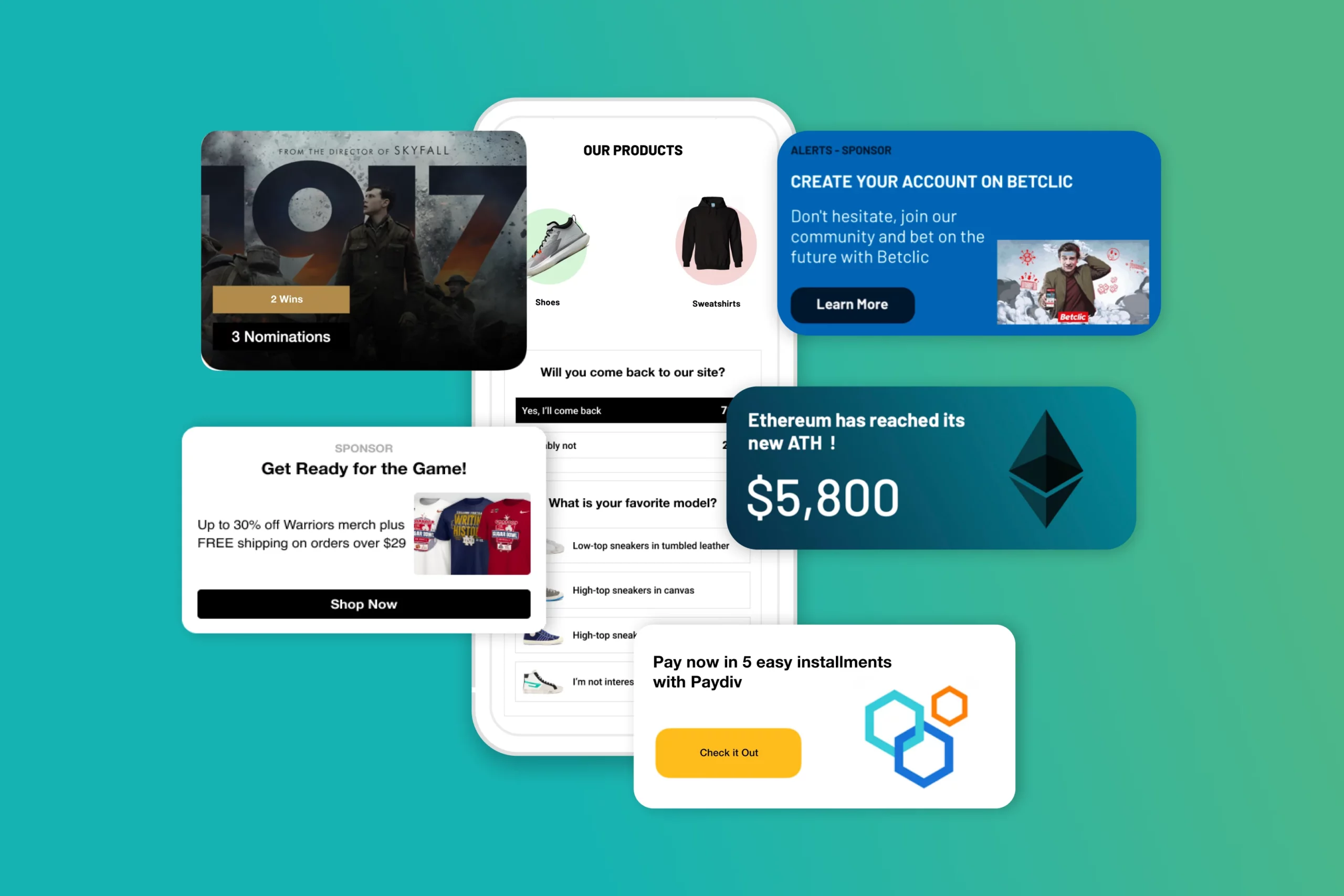
For most marketers looking to boost user engagement on their platform, interactivity is the first thing to come to mind. Of course, it’s intuitive to think solely of interactive widgets—exciting polls, trivia quizzes, and AMAs—when trying to draw in an audience and make them feel more inclined to use an app or website. And while interactive widgets are key to engaging users in this way, there is another widget type that is often overlooked but that is equally important to boosting engagement rates; the informative widget.
Informative widgets are exactly what they sound like: Widgets that provide your users with the information you want them to know about your product or service. These can include alerts about a schedule change during an event, pop-ups about deals you’re offering, notifications about an upcoming holiday promotion, or a social embed relaying brand information that’s been posted on an external social media platform.
Whatever information you’re communicating, informative widgets allow you to keep your users in the know, and give them the relevant updates you want them to get at the exact moments you want your users to get them.
At LiveLike, we’ve developed a library of informative widgets to make sure your users feel as connected and up-to-date with your brand as possible. With a suite of customizable alerts, deals, and social embeds, you’ll be able to communicate important timely updates as soon as they happen.
To introduce you to these major benefits and widget types, we’ve compiled a full rundown of our informative widgets library, with best practices, example use cases and the partnerships that make this offering possible.
ALERTS:
Give your users the best experience possible by providing the information they need, exactly when they need it. LiveLike Alerts allow you to broadcast breaking headlines, timely GIFS, special savings offers, and relevant event commentary, at just the right moments.
Our Alerts widget is extremely versatile, allowing you to easily broadcast text, media, or a combination of both on your platform to keep your users as up-to-date and informed as possible. As well, you’ll have the chance to attach relevant links to your Alerts to feature sponsorship destinations, or points of integration for other apps and websites.
Some best practices on how to use Alerts widgets:
- Enhance a live event (video or not) with a live feed with more information
- Showcase your own specific offers and discounts
- Showcase partners at specific moments with deals, promotions, discounts, etc.
- Reduce churn with content recommendations
SOCIAL EMBEDS:
Seamlessly integrate external images, videos, or posts onto your platform, no matter what kind of layout you love. Social Embeds include images, videos or posts originating from external social media platforms that are placed within articles to enhance the timeliness and relevance of a story.
You’ll be able to mix in any other social posts between all other types of interactions that LiveLike provides. Embed content from Twitter, Facebook, or any other provider that supports oEmbed.
AUTOMATIC ALERTS BASED ON DATA FEEDS (StatsPerform Integration):
LiveLike and Stats Perform have partnered to automatically deliver compelling and contextually-relevant widgets through mobile-friendly overlays:
Alerts: Use data feeds to automatically push out relevant alerts at exactly the right moment to engage and inform fans
Graphics: Use data feeds to automatically push out visually appealing insights to engage and provide fans with deeper informations
LIVE CLIPPING ALERTS (Wildmoka Integration):
Start automating the creation and publication of video clips, using our integration with Wildmoka.
The new partnership with Wildmoka will now allow partners to have Wildmoka’s Digital Media Factory near live clips automatically plugged into their timeline, facilitating the operators work and enhancing the end user experience. Media companies can now differentiate themselves by not only being the first to publish but also by delivering a superior viewer experience and engagement.
PR: https://blog.wildmoka.com/wildmoka-partners-with-livelike
Test Alert
ASK ME ANYTHING = SHARING INFORMATION
By letting your fans ask the questions, you’re able to tackle the topics that really matter to your entire community. Use AMAs to gather open-ended feedback, respond to users in real time, or even to compile a list of questions from the crowd to ask the on-air talent during a live stream. The Ask Me Anything or AMA widget not only gives your users the chance to ask the questions, it also provides you with crucial insight into what your audience is thinking and looking for.
Conclusion
So there you have it! While interactive widgets might be first to come to mind when thinking of ways to engage an audience, informative widgets can have similarly major benefits and successful outcomes. By combining the use of interactive widgets, informative widgets, live chats, and loyalty rewards programs, you’ll get the most of our audience engagement suite and start creating an experience your users won’t want to miss out on.
In 2023, customers crave authenticity more than ever before. Whether it’s on social media, TV commercials or even subway posters, we are all constantly being bombarded with sponsored posts, celebrity endorsements, and paid influencers, some of whom may not even use or like the product or service they’re advocating for. And with so much doubt as to whether the reviews we’re seeing are authentic or paid, word of mouth (WOM) marketing has become crucial.
So do brands have any control over WOM marketing? The short answer is yes. While creating a strong WOM marketing strategy isn’t easy, a key step is to make sure you’re doing everything in your power to build and maintain a loyal customer base. When you foster a tight-knit community of people who feel a sense of loyalty to your brand, you in turn build a customer base of users who are likely to recommend your brand to others.
With the LiveLike audience engagement suite, we offer features that work specifically to enhance your WOM marketing efforts and encourage your customers to remain loyal to your platform. In this article, we’re breaking down the top six ways you can use the LiveLike engagement suite to build effective rewards programs and maintain customer loyalty.
Remember that Consistency is King
One of the first steps to making sure your customers stay loyal to your brand is to create an experience they’re going to remember and that they can depend on. This involves offering a user experience that is not only unique and stands out amongst the rest, but also one that remains consistent.
Delivering a consistently positive experience allows your customers to form an emotional connection and a sense of familiarity with your brand. This in turn allows your users to depend on your brand experience as they know what they can expect, and feel confident when referring it to a friend.
Ensuring consistency across all UX touch points will build this brand credibility and trust, foster brand recognition, and maintain long-term relationships with your customers.
Create Personalized Engagement Opportunities Throughout the User Journey
No matter what kind of users are coming to your platform, something every faithful customer wants to feel from your UX is special. And creating an emotional connection with your users and then treating them like a new customer each time they interact with your brand is a sure-fire way to lose their loyalty.
In other words, a user won’t want to be prompted to sign up for your newsletter each time they visit your website when they are already subscribed. Sending a long-term customer an email that introduces them to your company will waste both your time and theirs. Similarly, celebrating the subscription anniversary date of a long-term user will let them know you care about them and value their loyalty.
Work to create an automated engagement strategy that is personalized to each individual user and meets them where they’re at in their customer journey. This can include creating unique user experiences, automated emails or interactive widgets for new, lost, or interested customers. Celebrating birthdays, holidays, and special events will build these customer relationships even further and make your users feel all the more appreciated.
Don’t Rely Strictly on Rewarding Purchase Actions
As previously mentioned, your users want an experience that is genuine, and not solely focused on encouraging them to spend money or invest in your business. If part of your UX strategy involves constantly finding ways to encourage spending, your users are likely going to seek out alternative experiences that feel more authentic.
In order to avoid this, make sure you are rewarding a variety of user behaviors that are not solely purchase actions. This could mean offering loyalty rewards to users who visit your app every day for a week, fill out a feedback form, or even simply vote on a poll. By offering this kind of rewards system, your users will feel as though you truly value their time and brand loyalty, and not just their spending habits.
Combine Engagement Widgets with Competitive Leaderboards
While interactive widgets in general are fun and engaging, what’s really going to draw in your customers is if they feel a sense of friendly (or not so friendly) competition with their fellow users.
For many people, there’s nothing more motivating than trying to top someone else’s score, keep themselves in the top ranking position, or even surpass their own previous scores. If this means returning to your platform every day or even multiple times a day to keep up with the competition, your users are likely to grow a feeling of loyalty, or at least dedication, to your site or app.
This works to not only draw in new users who want to be part of the action, but also to retain your existing users and keep them coming back for more.
Leverage Chat Functionality
Another key motivator to return to a platform is feeling a sense of community and connection with other users. This can be created most effectively with the use of public, private, and influencer chat capabilities.
By allowing your users to connect with each other from across the world, you’ll allow them to discover and create communities of like-minded people who they are excited to interact with consistently. This will not only keep them coming back to your platform, but will also make them associate your platform with the feeling of comfort, community, and interesting discussion.
Create Use Cases for All Users
The final way you can help to encourage WOM marketing for your brand is to create use cases for your product for all types of users or industries. If your product or service is only being marketed to a certain audience or industry, your users are not likely to recommend your brand to those that are outside of it.
However, by offering examples of all the diverse ways your product or service could be used by different people, your customers will be more likely to think of your brand when recommending services to their friends or family.
Of course, the first step to creating user loyalty is to make sure you are offering a quality product or service. Once this is the case, following these six methods will be key to building a strong WOM marketing strategy for your business.
Still not sure if gamification can be applied to your business platform? Get in touch today to learn more about how gaming elements can enhance your user experience.
No matter the size of your company or the industry you’re in, a good website can mean the difference between a new conversion and a lost prospect for your business. Your website is often the first impression you give to your potential customers and partners; the last thing you want is for a poorly designed, hard-to-navigate, or content-lacking website to dissuade them.
Now, we’re not saying our old website was bad—in fact, we’ve always been proud of our compelling design and quality content. But with our product being the strongest it’s ever been, we decided our site needed a little updating.
We’re so excited to announce the launch of our 2022 LiveLike website, created with our users in mind and made to better reflect our latest product advancements. Not only is our new website more easily navigable, aesthetically pleasing and dynamic, we’ve also added the content you’ve been craving. Read on to hear more about some of the exciting updates we’ve made.
Dedicated Industry Pages:
It’s no secret that LiveLike has seen great success in sports over the years. Partnering with brands like FOX, NASCAR, and Canal+, we have established ourselves as one of the best audience engagement solutions for sports companies around the world. And with this exciting achievement, we realized our capability to go even further, and move beyond just sports to cater to a wider audience of users—which is exactly what we did.
On our new website, you’ll find a dedicated Use Cases section, with individual pages for Sports, Fintech, Entertainment, Edtech and E-Commerce. On each of these pages, you’ll find industry-specific information on how the LiveLike Audience Engagement Suite can enhance your product or service. Browse our past partnerships, relevant widgets and use case examples, and start visualizing how you might implement our solution.
Detailed Widget Overviews:
Our audience engagement suite has so much to offer, with tools that can bring your UX to the next level. On the new LiveLike site, we’ve made it so much easier to learn about our amazing features, with individual pages for each of our unique Solutions. Now, you can read about and browse our Interactive Widgets, Informative Widgets, Live Chats, and Loyalty & Rewards tools with ease.
LiveLike Blog:
We have SO MUCH to say about the evolution of digital user engagement, and we seriously needed an outlet. On the new LiveLike website, we’re introducing the LiveLike blog hub, where we’re constantly sharing all of our coolest product updates, unique industry insights, and even our opinion pieces on where we think the world of DX is headed in the future.
LiveLike Podcast:
The future of fan engagement is fast approaching, and there’s no one better to talk to about it than the leaders of the brands at the forefront of it all. On our new LiveLike podcast, the Future of Fandom, we put these leaders in the hot seat, to discuss the future of digital marketing, user engagement, and the brand fan experience.
Launched at the start of 2022, the Future of Fandom has already seen amazing guests like NASCAR’s Tim Clark, Jordan Olivas from Qisstpay, and more. And now you can read all about it at www.livelike.com 😉
And So Much More!
We’ve worked hard to make our new website as dynamic, effective, and easy to use as our product itself, and we’re excited for you to take a look. But don’t just take our word for it; see for yourself! Check out the new and improved LiveLike website at www.livelike.com.
Still not seeing the content you’re looking for? We’d love to hear your feedback! Get in touch to let us know what our website is still missing.
Building a Decentralized Community
Today on the Future of Fandom, we’ll tiptoe into crypto and its passionate worldwide following with Ledn Co-Founder and Chief Strategy Officer, Mauricio Di Bartolomeo. Mauricio grew up in Venezuela where he learned about Bitcoin and truly understands its global applications.
Heads up if you’re in North America, where media-forward, Ethereum-based NFTs and simpling HODLing coins forever rules the day. Mauricio has a much broader perspective for how it can be used and how its fans come together across the world. Today, we explore how crypto communities coalesce and how to build a centralized brand presence within it despite Bitcoin’s decentralized nature.
Connect with Mauricio Di Bartolomeo on LinkedIn: https://www.linkedin.com/in/mauricio-di-bartolomeo-780284101/
Read more about Ledn: https://www.ledn.io/en
Here’s a quick sneak peek of this week’s episode:
FULL TRANSCRIPT BELOW
Adam Conner (00:09):
Today on The Future of Fandom, we’ll tiptoe into crypto and its passionate worldwide following. My name’s Adam Conner, I’m your host. And our specific focus on this episode is Bitcoin and how one FinTech founder is building a community around its global appeal. In particular, you’ll hear from Ledn co-founder and Chief Strategy Officer, Mauricio Di Bartolomeo. Mauricio grew up in Venezuela where he learned about Bitcoin and truly understands its global applications.
Adam Conner (00:41):
Heads up if you’re in North America, where media-forward, Ethereum-based NFTs and simply HODLing coins forever rules the day. Mauricio has a much broader perspective for how it can be used and how its fans come together across the world. Today, we explore how crypto communities coalesce and how to build a centralized brand presence within it despite Bitcoin’s decentralized nature. I was glad to learn from him if only for just a bit and I think you’ll enjoy his two cents too. So with that, let’s bank some insight as we predict the future with Ledn and Mauricio Di Bartolomeo. Mauricio, it’s great to talk with you. I hope you could take me to school today, but first, how are you?
Mauricio Di Bartolomeo (01:27):
I’m doing great, Adam. Thanks for having me on.
Adam Conner (01:28):
A word to the listeners here, this is an expert in the crypto world that we’re speaking with and I’m privileged to be chatting with Mauricio because every time that I have come into close contact with the crypto world, I’m not a robust investor myself. I think I probably should, or at least will be once I get finished with this conversation, but I am paying a lot of attention to holders or HODLers as you might call them, and their passion for this type of investment and what it unlocks for the world. So we’re going to get into that today and Mauricio, the first one that I want to ask, the first real question here is taking me through what Bitcoin is doing for the world today. Maybe how that’s evolved over time, or at least how you see it, and then we’ll get in a little bit to what Ledn is all about.
Mauricio Di Bartolomeo (02:22):
Definitely. And you are way too kind with your introduction, but you know I’ll do my best to answer or to share some of my learnings spending so much time in this space. I think Bitcoin’s doing a lot of things, but I guess to put it succinctly, Bitcoin means different things for different people in different parts of the world. For people in investment markets where money works and you have ACH and Zelle, and Venmo and Tap and Visa and no shortage of access to credit, Bitcoin to many are seen as one more asset that you can throw into the pool of already great assets to invest in.
Adam Conner (03:03):
Right. This is the traditional understanding that I think of because every time I look at it, it’s almost trading these things like commodities, whereas I know it has a much broader purpose and so yeah, I’m hoping you’d take me to school because I know there’s got to be more to it than that.
Mauricio Di Bartolomeo (03:18):
Yeah. Underneath that veneer of just one more asset is an absolute financial revolution under the hood. But to see that you need to go to a place like El Salvador and places like Venezuela, where I’m from and where I originally got into Bitcoin many years back. And the reason that it’s so powerful in those markets is because it represents an absolute shift in the toolset that you had available to you.
“So maybe I’ll put it to you this way, for anyone outside of the United States and Europe, it is virtually impossible to have a US dollar bank account or to have your assets in any kind of form that is not subject to the whims of your government. People in Latin America have experienced bank collapses, almost every 10 years a banking system collapses in Latin America, almost every 10 years a government collapses in Latin America or an entire currency collapses.”
— Mauricio Di Bartolomeo (3:42)
Mauricio Di Bartolomeo (04:18):
And that basically means that they just hyper-inflated into oblivion and they changed the name of it. And many times in Latin America, you go through these bouts of authoritarianism where assets can get expropriated from people and you basically see the value of what you thought was going to be a great asset, like real estate dwindle and have basically no market to sell into. And so what a lot of people in a lot of places of the world that don’t have the property assurances that investor markets do, what Bitcoin means to them is in many ways a life rack. Basically, a life vest or a life boat, if you want to call it, where until Bitcoin, it was very difficult to purchase assets that maintained their value over time and most people think of assets that can maintain their value over time as property and houses, perhaps gold, and maybe cars in some markets.
Mauricio Di Bartolomeo (05:17):
But if you think about that, all those things have very high price tags and in an inflationary market, like if you’re running a 20, 30% inflation and you’re trying to save a $100,000, to put down on a payment or say even $50,000 to put it down on a payment, and you’re trying to save it in $500 increments, if you’re up against 20% inflation, you’re never going to get to 50K, because inflation’s just going to eat away your savings, even as you’re trying to basically park them and to save up that critical mass to put down that down payment so you can buy your asset. Once you have the condo, it’s fine, because the condo can sustain its value over time, but the cash doesn’t.
Mauricio Di Bartolomeo (05:53):
And what happens now is that Miguel in Venezuela can essentially get 10% out of his paycheck every month and buy Bitcoin with it and by doing so, that little bit of Bitcoin will be hedged against inflation and will be able to essentially grow over time or not lose its purchasing power rather than grow, and essentially that enables Miguel to save faster and more effectively, and not only does it help him save, but now he can transfer those funds internationally without basically having to go through a local bank. And that is revolutionary. That is as revolutionary as when you first sent that first Blackberry messenger message or that first Whatsapp message where you realized that you could go from one end of the world to the other and exchange texts with your friends for free, where before you had to pay a $1.50 to your carrier to send the same text. And so it’s almost just as liberating.
Adam Conner (06:53):
So this is not just an asset as we see it in the US to maybe hedge against inflation here, but it’s an alternative way to store your money. It is a finite asset, which some people may say is not currently true about the US dollar, but abroad in places where things are a lot more volatile with regard to any type of money reserve, except for something hard like property. This is if I’m getting this correctly, another avenue of financial freedom, is that fair to say?
Mauricio Di Bartolomeo (07:26):
That’s absolutely fair to say. Yep.
Adam Conner (07:29):
So this is then a much bigger thing than what I see in the US with a very media forward approach to the exciting world of crypto, where it seems like every 18-year-old with a phone and a laptop is trading all these different types of coins. And I know I’m dumping them all into the broad crypto sphere and that Bitcoin is, can we say the gold standard here, as weird as that sounds with regard to this landscape, but regardless, there is and I’ll start domestically, a huge passionate followership and fan base of all things’ crypto. What I have seen the most recently is that it has proliferated inside of Ethereum.
Adam Conner (08:19):
So a currency that is not Bitcoin, but I’m curious from your perspective since Ledn is rooted in Bitcoin, what you see and what the typical profile is of somebody who’s a big fan of Bitcoin. And by the way, if me asking for that is foolish because there’s no characteristic to lump into a group like that, please tell me so, but I’m curious to try and get into the head of somebody who’s a big fan of Bitcoin. What might they look like? What interests might they have? Does it get that specific?
Mauricio Di Bartolomeo (08:52):
So I think Bitcoiners are as broad of the spectrum as probably any group of humans have ever been. I don’t think there’s a broader spectrum of people than Bitcoin. And I actually think that some of it hold true also for Ethereum perhaps, but I’m more familiar with the Bitcoin community so I can speak to that and there is no real blocks that you could put Bitcoiners into, but I think the underlying tone or the underlying sort of thinking that Bitcoiners have, or many of the Bitcoiners have, I should’ve said all, is that Bitcoin is basically the way of expressing financial independence. It’s their way of saying, I am able to choose my own path and I can self verify and this is a system that I feel that I can trust and understand better than my current financial system because I think the reason people become so fascinated with Bitcoin is very much related to when they understand how the current monetary system works.
Mauricio Di Bartolomeo (09:59):
I think once you understand how that system works, then you get a high-level understanding of how Bitcoin works, that’s when basically your blinders go on and that’s when it starts becoming very difficult to see beyond that. And again, there’s a broad spectrum of Bitcoiners, but most of them or not most of them, but a lot of them love this ideas of the fact that it’s a finite supply. It is programmatic money that they can understand way better than their current financial system. And because of that, they can feel that they are much more in control or at least have much more of a say or are much more aware of the changes in the system versus the current system. So it’s hard to put them in a bucket, and I would say that Bitcoiners, to your point about a lot of these new communities and new development that is happening in this Cambria explosion around Ethereum, that is very much the case.
“But I think both platforms and both groups celebrate different things. Bitcoin is a protocol that’s been around for many years and it’s basically in some ways ossified relative to some others because it doesn’t really change that much, but that’s exactly what people want out of Bitcoin, it’s that consistency, it’s that stability. Ethereum right now is very forward-thinking and some of the things that it does, for example, is changing its consensus mechanism. You know, that’s not a small feat, it’s kind of like changing a jet engine mid-flight. And so it’s exciting, but it also comes with some risk. And so I just think that both of them are catering to different fandoms if you would.”
— Mauricio Di Bartolomeo (10:59)
Adam Conner (11:36):
Okay. That’s helpful to know. And this is because when I have this thought in my head, it’s a much more targeted type, and this is because again, it’s outside of Bitcoin, but it’s really what I know this NFT landscape, people are buying digital art and sure it might represent real things eventually, but because Bitcoin’s been here for so long, it was really first to the world that its profile is similar to the profile of humanity, which I get and I appreciate. So let me ask about this, and maybe we can take a little history lesson here with when Bitcoin was the first and only player in the game, how communities of fans or of ardent users of crypto come together, and I ask that and it’s a bit loaded because I know that the whole point of Bitcoin is to not be bucketed anywhere, but, I want to push that for a moment. Can you help explain to me how communities in crypto using Bitcoin’s history as a base come together?
Mauricio Di Bartolomeo (12:44):
Yeah, so I can chat briefly about that and I wouldn’t consider myself the best Bitcoin historian, but I’m happy to speak to what I know of or what I do know about the history of Bitcoin and how it evolved. It all started with a mailing list and basically, it was the Cypherpunk mailing list and Cypherpunks were just a group of cryptographers that were just very into this movement or this idea that cryptography should be available to everybody because of privacy reasons and you should always be able to hold a high degree of privacy, no matter what you’re doing, whether it’s online, whether it’s a physical realm. And so they were already kind of these… It’s kind of hard to say it, but they’re the bleeding edge of FinTechno files as far as cryptographers go.
Mauricio Di Bartolomeo (13:37):
And so Satoshi kind of mails out his proposal to this list and hoping to find some volunteers to help him hash out some of his idea and then most of the discussion stuck around email, however, then somebody in the community created this forum called Bitcoin Talk and some of the discussion basically moved to Bitcoin Talk because Satoshi himself posted many times on Bitcoin Talk. And then from Bitcoin Talk, I believe it started spreading into Reddit and Twitter. And that’s how the community congregated around Bitcoin and exchanged information around Bitcoin. Then you started seeing some physical Bitcoin meetups here and there. Meetups started popping up in places like New York, Korea, and then people started mining it.
Mauricio Di Bartolomeo (14:28):
And so there was also the social activity happening around Bitcoin, and also the other interesting thing was that you can make money from Bitcoin by mining, by basically downloading the software into your computer and basically how did your computer contribute to the network? So there was a bunch of incentives that fed into this building of the community, and that’s how the Bitcoin community came to be. Ethereum was a little bit different and I don’t have as much of in-depth knowledge of how the Ethereum stuff came together. I have a high level understanding, but that’s how it came together around Bitcoin.
Adam Conner (15:03):
Well, then let’s stay with that because that’s what you know. I will now turn to the best, which is Ledn. Can you start by telling me what Ledn is and doesn’t provide the world? And then I do have that question, which I’d mentioned before about how to create a community yourself around it, but let’s start with what’s Ledn is all about.
Mauricio Di Bartolomeo (15:23):
Yeah, no, it’s a great question. Ledn essentially is a platform where people can get more out of their Bitcoin and digital asset. So our thinking in many ways of saying we like is the best of us have the smallest menu. So we like to do a few things, but we do them better than anyone else in our view. And so we let people earn interest with their Bitcoin. So we have a Bitcoin savings account and also with their USC so dollar Stablecoin, or our Bitcoin savings account, just to give you a sense, you pay 6.25% interest on your first half of Bitcoin. And our USC savings account pays nine and a half percent interest on Stablecoin on the US dollar on Stablecoin. And the additional products we have is people that use our flagship product and what people know us most for is our Bitcoin back loans.
Mauricio Di Bartolomeo (16:11):
So these are people that have Bitcoin and do not want to sell their Bitcoin, but want access to financing to either pay for school, buy a house, pay down their credit cards, invest in a new business, and they want to keep the upside of holding the Bitcoin. So what they do is they place their Bitcoin as collateral, and we give them a dollar loan. And then once they are able to repay the loan, they can get their Bitcoin back. And then if the Bitcoin went up in value, it continues to be their Bitcoin, then it never changed. And then we have another loan product that’s B2X, that’s basically the same loan product, but the proceeds are used to buy more Bitcoin and you can trade in between your savings accounts. So you’re always earning interest, even if you want to move from Bitcoin into UCC, or if you’re in UCC and waiting for the right time to buy Bitcoin, vice-versa, you’re always earning interest and that’s one of the things clients really like about the platform.
Mauricio Di Bartolomeo (17:00):
And then the things we do differently is we’re a centralized entity, so we’re a Canadian entity. And we have an amazing team, right now we’re over 65 people. We were the first lender ever to do a proof of reserves attestation with certified public accountants. So every six months we have an accountant that comes into Ledn, makes sure that the totals of all the assets that we’ve lent out to institutions and then totals all the assets that we have from clients and make sure that we have more assets than liabilities. And every one of our clients basically gets an anonymized ID code that they could use to log into the accountant’s website to make sure that the balance that we gave the accountant was in fact, their balance at the time. And so we crowdsource the liability side of the equation so that all of our clients can basically see that we did indeed give the accountant the right balances and the audits basically match to this associate to the scent and that’s something that we’re really proud of.
Adam Conner (17:56):
Okay, understood. So a couple of thoughts from me, first off, I don’t know a whole lot about using Bitcoin as collateral for things, but I do know one thing and that’s that those interest rates that you said are a lot higher than you would get at a typical bank with regular Fiat. But I will also say this because this seems to take the structure of financial instruments that most people are aware of with regards to savings and loans and things like that and apply them to a new and perhaps mostly unfamiliar type of currency for a lot of investors and including those that have been investing in different things for years and years and years, it might make them more comfortable, more familiar, more willing to dip their toes into this world and that’s great for you because more fans of this will arise, which means in this case, that you might work towards a more financially free world.
Adam Conner (18:47):
Here’s my rub and the most burning question I have in my mind here which is, Bitcoin’s purpose as a financial instrument is to be a decentralized currency. And by the way, correct me on any of this, because you’re more knowledgeable than I am. Fans or investors or users of the crypto, as we’ve just laid out during this interview have broad interests which quickly approach the breadth of all of humanity. It’s impossible to nail them down into one particular corner, though, they may have started in certain forms and now the movement has grown to be truly global and massive. You now run a brand that you hope retains a specific cohort of users of Bitcoin. How do you marry the user’s decentralized preference of the way they do finance with the need as a business to corral a centralized community of fans?
Mauricio Di Bartolomeo (19:46):
That’s a really good question. So while Bitcoin has a decentralized ethos to it, a big saying within the crypto community is, it’s not your keys and it’s not your Bitcoin. So basically they say that if you don’t hold the keys to your Bitcoin, then they are not your Bitcoin. Essentially, if you have your Bitcoin at a custodial service then they are not really your Bitcoin, because somebody else has the private keys for it. And so that’s just to show you and illustrate how emphatic the community is around this sense of financial independence. Not depending on anyone to process a transaction for you other than yourself. Now, there are some services that by the pure nature of how these services are provided, they need to have a central coordinator or an entity that manages the lifeline of the financial service.
Mauricio Di Bartolomeo (20:41):
And in this case, that is true for both savings and loans, right? You can’t generate interest by lending a Bitcoin if you don’t give someone else the ability to lend that Bitcoin out for a higher interest rate, right? Or to do something with that Bitcoin in some cases. So savings and lending, and also if you want to put your Bitcoin as collateral just to access financing, you cannot do that by holding the keys to the Bitcoin like no lender. That means that the lender has absolutely no protection on Bitcoin as collateral. And so what happens and what we try to do with Ledn is understanding that we have to be a custodial service to offer the services that we do. We try to structure those services in a format that is as transparent as Bitcoin and way better than the current options that people might have today.
Mauricio Di Bartolomeo (21:41):
And I’ll give you an example, this proof of reserves protocol that I just mentioned to you earlier with the accounts coming in, Ledn was the first lending company in the world ever to do that. And the reason we did that is because Bitcoiners have another big saying in their community, which is don’t trust, verify. And so it’s not necessarily always about telling clients what you’re doing, it’s giving them the tools to validate that what you’re saying you’re doing is in fact what you are doing. So basically prove that you’re doing what you said you would.
Mauricio Di Bartolomeo (22:13):
And by doing these things, and by being very transparent and remaining focused and keeping our simplicity into the core assets that we think we can do better than anyone else has helped us connect with the Bitcoin community and we’ve crafted that message in to let them know that it’s not that we’re holding the Bitcoin because we feel like it, it’s because it’s necessary for us to carry out the activities that we do to make these services happen. And so under that premise, they’ve been very receptive to the way we operate.
Adam Conner (22:45):
Thank you for that explanation, just because I was having a really hard time putting those two things together and my guess is that there will always be a line to walk here when dealing with preferences versus realities versus perceptions versus inherent, I don’t want to say skepticism, but perhaps the pursuit of verifiable truth, especially when it comes to things like lending. So that’s very helpful. Now I want to speak to the other key word of our show, which is the future. What do you predict the financial services world, the FinTech world, and this question’s going to be huge, so just bear with me for a second, where do you think that FIS will have to go? Maybe not just in the next year, but in the next few years to attract people who trust you above and beyond what they do today. Essentially, what I’m asking is, how will brands continue to make their mark such that consumers choose them over themselves? If that makes sense over just managing their own finances.
Mauricio Di Bartolomeo (23:55):
I think that is a really great question and a question that many people are exploring right now and just to basically make sure that their brand is going to remain relevant and just in these changing times.
“My personal view is that people aren’t watching ads anymore. Everything has a skip function. Everybody has blinders on when you have banners. So my view is that most successful companies are basically going to have media or an in-house or work very closely with a particular media arm to produce engaging content that’s relevant to their consumers. And I think that’s not necessarily a revolutionary new idea. You’ve seen this in the likes of a memorable and that’s Red Bull who a lot of people know for their extreme sports and videos, but it’s an energy drink.”
— Mauricio Di Bartolomeo (23:59)
Mauricio Di Bartolomeo (24:53):
And so that’s an example of a brand that uses content to just find a way to stay relevant. And yeah, another one that I can think of is Nike. So Nike had these amazing commercial around every world cup and it had the top players in the world just playing around and it was super engaging and fun to watch. And so I think that’ll become even more true in the years to come as people have more and more options to basically not watch ads and also people connect better with organic content. So I see that as a trend that is likely going to continue, and I think that’s where you’re going to gain fans because if people just want to use your product, they’ll be clients, but for people to be fans, they have to really be engaged with your mission and with where you’re going and with your values. And you have to communicate those often so that you can stay relevant I think.
Adam Conner (25:47):
I agree. And I’m excited to see how that world proliferates. It wasn’t too long ago that stock trading, at least in the US became appified. I mean, I don’t know how long, maybe five, six, seven years ago, and there was a craze and I don’t know how much trust there was, maybe not complete trust, but there was ardent fandom. This wave will come to crypto in a more mainstream way, not to say that it isn’t mainstream globally, but to the mainstream investor. And I look forward to seeing you lead the charge. So for teaching me a little bit more about it here, I really appreciate it, Mauricio, thank you for showing me the future a little bit and best of luck to you.
Mauricio Di Bartolomeo (26:32):
Oh, thanks a lot, man. You’re way too kind. And we’re happy to have everyone along for the ride. It’s an amazing time to be in.
Adam Conner (26:42):
Thanks again to Mauricio Di Bartolomeo for joining us. Crypto is undoubtedly a world mover and I appreciate you helping us understand that world a little better. And thanks to you, the listener for exploring The Future of Fandom with us, I’d encourage you to stay connected, so be sure to subscribe to The Future of Fandom, wherever you listen to your podcast asked, or you can also find all of our content at livelike.com and across socials, we’re also on LinkedIn at LiveLike and Twitter at LiveLike Inc. I look forward to predicting the future again with you soon, until then, I’m Adam Conner saying so long and thanks for being a fan.
Investing in How Fans and Entertainers Connect
Today on the Future of Fandom, get invested in the ways cheering for your favorite performer has evolved over time, from idol worship to surrogate coaching and quasi friendship, through the eyes of Pete Vlastelica from Elysian Park Ventures, the private investment arm of the LA Dodgers ownership group.
Pete made a splash in journalism as the founder of Yardbarker before being acquired by Fox Sports, and most recently, serving as CEO of Activision Blizzard Esports before joining Elysian Park. He’s a battle-tested champion of democratizing access to athletes and entertainers, and he’s turned his eye today to wellness.
We deep dive on how fans are craving more relatability and accessibility than ever before and of course, talk about how that affects the content and experiences, which we all see today and going forward. Pete has seen that as an operator and now broadly as an investor, which is a first for us here on the show. So let’s put our money where his mouth is as we predict the future with Elysian Park Ventures and Pete Vlastelica.
Connect with Pete Vlastelica on LinkedIn: https://www.linkedin.com/in/petevlastelica/
Read more about Elysian Park Ventures: http://www.elysianpark.ventures/
Here’s a quick sneak peek of this week’s episode:
FULL TRANSCRIPT BELOW
Adam Conner (00:00):
Today on the Future of Fandom, get invested in the ways cheering for your favorite performer has evolved over time, from idol worship to surrogate coaching and quasi friendship. My name’s Adam Conner. I’m your host and our focus on this episode is through the eyes of Pete Vlastelica from Elysian Park Ventures, the private investment arm of the LA Dodgers ownership group. Pete made a splash in sports journalism as the founder of Yardbarker, think the Athletic in the 2000s before being acquired by Fox Sports, and most recently, serving as CEO of Activision Blizzard Esports before joining Elysian Park. He’s a battle tested champion of democratizing access to athletes and entertainers, and he’s turned his eye today to wellness.
We deep dive on how fans are craving more relatability and accessibility than ever before and of course, talk about how that affects the content and experiences, which we all see today and going forward. Pete has seen that as an operator and now broadly as an investor, which is a first for us here on the show. So let’s put our money where his mouth is as we predict the future with Elysian Park Ventures and Pete Vlastelica.
Pete, great to chat. How are you?
Pete Vlastelica (01:32):
I’m very well, Adam. Thank you. It’s a bright, sunny day here in Los Angeles and just wrapped up a morning of calls, had a little lunch. Hanging out on the couch with my dog and talking to you.
Adam Conner (01:44):
What could be better than that? Other than talking with me, I suppose. You know I woke up this morning, it was minus 11 where I was so I am a little jealous of your dog-couch set up. Very comfy.
Pete Vlastelica (01:55):
Come on out, man. Everybody’s leaving California so there’s plenty of room for you.
Adam Conner (01:59):
Wonderful. Great. Okay. I’ll take it. I’m interested in chatting with you because of course, on the show, we talk about fandoms, but from the specific POV of an individual brand or sport or leader, and I certainly want to get that side of your story out. In fact, we’ll begin there. But now in your most recent chapter, you have evolved into an investor who looks at the market a little bit more broadly than your own thing.
Let’s go back to before you were an investor over the past couple of months here with Elysian. And I want to talk about your experience in building digital fandoms in the world of journalism. Can we start there?
Pete Vlastelica (02:40):
Sure. Yeah, I guess I’d start my fandom business story back in business school. I graduated from Stanford in 1999 and I bring that up because Palo Alto in 1999 was sort of the epicenter in terms of both place and time of the original internet boom. And I was all in on it and spent the first few years after college working in the internet business. And then, a few years later, went to business school also in the Bay Area, but across the Bay at Berkeley.
“Along with a couple co-founders, we created a company called Yardbarker. It was a network of sports blogs that reached about 20 million unique users a month at its peak. We were the first blogging platform for many, many professional athletes. And this is back in 2006, 7, 8. Really pre mass adoption of most social media as we know it today. Pre-Twitter, pre all that stuff. And it was the first time that at any kind of scale professional athletes were able to directly access their fans and vice versa or fans were able to read an athlete’s blog post, comment on it, interact with them in comments and feel sort of a direct connection to their favorite players across all the major sports.”
— Pete Vlastelica (3:15)
Pete Vlastelica (4:09):
Suddenly, it was less important that the outlet was objective and unbiased and more interesting to read content that was written in the voice of a fan. In other words, in the voice that they used when they were at the bar talking sports with their buddies, right?
So I think there was this upwelling of interest in a more colloquial and casual and honest form of sports content and that’s what was happening on the blogs. So that, along with the direct access to athletes that was sort of coming through blogs and then eventually social media, I think really shifted sports media in a way that doesn’t get talked about a ton today, but that you can see through the type of content that a lot of the more traditional sports media outlets today, the Sports Illustrated and the ESPNs of the world even have sort of shifted their style of coverage.
I think in a lot of ways that sort of blogging, that moment for blogging changed the way that we consume sports content.
Adam Conner (05:09):
Well, not only from the perspective of the fan, but also from the perspective of the athlete. It’s not hard to think about The Athletic in their recent purchase at the hands of the New York Times. When you think about how to get closer to the action, whether that be closer to how you feel about it or closer to the people that are actively participating in it… And sure, I have watched ESPN and noted the change from the objective style of Sports Center to the Stephen A Smiths of today, which are emotionally charged and that’s what drives engagement. That’s what drives passion and ultimately, that’s what drives fandom.
And then, sports went E and you were able to build up communities and passionate fan bases of course, of all the wonderful games that Activision was putting together. And listeners, if you are interested in video games at all, then titles like Overwatch and Call of Duty will be easy to come by. So what was different and what was similar about building and retaining experiences for fans of sports occurring IRL and sports based on games?
Pete Vlastelica (06:17):
Yeah. There were a few differences for sure. There was a lot of similarities. We sold out for the Overwatch League Grand Finals, for example. We sold out large arenas in Brooklyn and Philadelphia. Tens of thousands of screaming fans, where if you didn’t know you were in an e-sports event, you might just think you’re at a Nets game or 6ers game or something just by the scale of the audience, the noise they made, the enthusiasm, passion for their teams, all those sorts of things.
So in a lot of ways, if you squinted, it looked a lot like a traditional sport, but then when you looked a little wider, there were definitely differences. For one thing, the audience was global. That was one thing that was different and that I had to adapt to. It was a younger audience.
At the time I joined Activision, I remember doing some research and seeing that the average NFL fan was 55 years old. And this was again, five years ago so probably gotten even older.
Adam Conner (07:17):
Wow.
Pete Vlastelica (07:17):
The average NFL fan was 55 years old and had gotten 10 years older over the previous 10 years. In other words, 10 years prior to that, the average NFL fan was 45. So they’re getting older. Baseball fans were even older. I think NBA fans were a little younger, but not a lot younger. So one of the nice things about e-sports was that we were dealing with fans who on average were 20 to 25 years old, who were digital native, who were used to engaging on platforms like Twitch and YouTube and Twitter and didn’t have expectations that the content was going to be produced and available on an ESPN or on a national network or something because a lot of them didn’t even have television bundle subscriptions.
So that was different and I think gave us lots of opportunity to try and experiment with new ways of engaging the audience through digital platforms and in ways that reached all of our audience, not just some of our audience. And I think that’s a difference, right? At Fox and ESPN and these places, there is experimentation happening with second screen, multi view, multicast kind of digital first sort of ways to stream a match or to give…, let fans engage around a game, but they’re not reaching the entire audience because most of the audience is still watching that game on TV.
With a digital native sport like e-sports, when you roll out a new feature, it’s reaching everybody. So we did… When we worked with our partners, Twitch or YouTube to build some new feature into the viewing experience, that was getting rolled out to everybody that was watching matches and that was exciting. I think the stakes for a digital guy like me, the stakes being a little higher made it more fun.
Adam Conner (09:04):
So today, all the while you were looking for organizations which were certainly forward looking, but also were building their own fandoms within health and within wellness… And I know this is where you’ve turned in your most recent turn for Elysian. I’d like to talk a little bit about that because we’ve had a little bit of experience on this show talking about that wellness and specifically, the fusion of physical and financial wellness and I’m curious what your thoughts are there when it comes to new experiences for consumers.
Pete Vlastelica (09:41):
So I left Activision in March and then the last six or so months, I’ve been working with a group called Elysian Park Ventures, which is the private investment group that’s affiliated with the LA Dodgers ownership group. We’re investing in things that are either in or adjacent to the sports world. That might be something like a sports betting or daily fantasy platform like a DraftKings or it might be something in wellness. And this is an area that I’ve sort of personally been spending more and more time in.
And I think of wellness, especially in the context of sports… You can think of wellness as being largely about performance and longevity and elite athletes now are probably…, in our society, probably the ones with the most vested interest in optimizing their performance and their longevity. And there are things that most athletes, the average elite athlete wasn’t doing 10 years ago that now, many are doing that are no longer taboo. Things like thinking about their sleep, thinking about recovery, thinking about nutrition, thinking about mental health, adopting mindfulness, meditation, breath work practices.
These are things that may have sort of seemed quirky or unnecessary or maybe even if 10 years ago, if an athlete was participating in them, now they’re participating with a higher degree of sophistication just because the industries and the expertise around these topics has sort of expanded in the last 10 or so years and the access to that information has grown.
So we look at businesses in that space that have an opportunity to reach a mass market, but where an athlete or a team or a league can help grow the business and then help the mass market by sort of shining some headlights on the opportunity and demonstrating that you might actually help them perform at their peak or extend their careers.
Adam Conner (11:41):
It’s interesting. I think about the fan… I don’t want to say the fan of old, but the fan that you were describing. The average 55 year old fan, the ever aging football fan, who probably sees their heroes of the game as somebody on the big screen, making the big play and not necessarily somebody who’s so relatable. It’s like idolatry, almost. Whereas the newest age fans, consumers, viewers of any of these things expect a more direct social approach from the people that they are fans of, and whether that means the actions that they see on the field or the initiatives they take off of it.
I think about… I know that you all are involved with TB12, but that’s one example of… It could be anything from a funny TikTok or a relatable short piece of snackable content all the way up to some offering that allows me more direct access. How have you, as an investor, leaned into that specifically where that hero worship has become more of a surrogate coach?
Pete Vlastelica (12:50):
I think that’s really well said and a really smart observation and I completely agree. I think… Going back to what makes the e-sports fan unique, let’s say. They’re young, global and digital native. Part of the reason that the average NFL fan is five is that most NFL content is trapped behind a cable paywall and most young people aren’t subscribing to that bundle. So if your content is sort of locked into a bundle that young people aren’t accessing, then of course, they’re not going to be following you because they can’t even watch the games. And yet, meanwhile, they’re spending lots and lots of time on platforms that have more of a peer-to-peer feel than television does.
“Television is “one to many” peer-to-peer, as many to many or digital platforms in general, many of them are sort of many-to-many, and that many to many dynamic creates a different type of relationship between a hero and a follower, or let’s say an influencer and a follower or a performer and a fan. Suddenly, the relationship feels more relatable, more familiar, more like a friendship, more like the fan has a real stake in the success of the performer. And they feel a connection with him that I don’t think last generation sports fans felt with their favorite players.”
— Pete Vlastelica (13:35)
Pete Vlastelica (14:29):
I think to your point, it was just a very different dynamic where it was… The star was untouchable and unrelatable and the fan just sat there and watched and worshiped, I guess. But I think when it comes to things like wellness, I think part of the reason I’m so optimistic and kind of bullish on this as an investment category is that this dynamic plays right into the entire industry of fitness, nutrition, and wellness broadly, because it’s now easier than ever for a fan of an athlete to learn and follow an athlete’s training, nutrition, recovery, mindfulness, et cetera routine, and to use the services, the products, and to kind of follow the experts that these athletes are using and following to get the performance edge and the longevity edge that they’re looking for.
So that’s a big part of the reason that we’re excited about the category and I think 10 years ago, this wouldn’t have been such an opportunity because again, the dynamic would’ve been such that an average fan would look at an average elite athlete and say that person’s different from me. It’s changed.
Adam Conner (15:26):
It’s totally changed. And the idea that you can get more access in that way, whether it’s watching an e-sports star practice on Twitch, or whether it’s somebody that you maybe can only see through the screen on a YouTube going into something IRL like a music festival… It is just a vastly different way of experiencing your favorite people.
And by the way, it’s interesting that you note that you saw the lineup for Coachella. Listeners, this is being recorded just two days after the lineup for the Governor’s Ball in New York was released and wary eyes will have seen on day two, about halfway down the list… Wasn’t even a very big name, wasn’t a headliner. Was a single word, Diesel and anybody who knows what that is, would have said, “Wait a second? That not some no name artist. That’s Shaquille O’Neal and he’s there performing.
So if you’re in NYC, head on over and watch Shaq spin the records for you. But anyway, that’s just a… It’s a very interesting observation that I’ve seen and certainly the future. So I want to… Well, I’ve got to stick to the namesake here and round out with a question about what you envision going forward as to the future of fandom. What do you see as the future for fan engagement with celebrity? Right now, it’s in that wellness space with starting their own ventures, giving you access like you never had it before. Even that is new-ish over the last five to 10 years. What are we going to see in the next five to 10?
Pete Vlastelica (16:55):
Yeah. Well, I think there’s still lots and lots of room for this trend that I’ve mentioned to play out and I think that’ll happen quickly and start to spread into kind of other categories, not just wellness. Let’s say, elite athletes are able to provide a bit of credibility around and help businesses and these categories grow.
I think it’s sort of the traditional celebrity endorsement, but now with a real level of authenticity that just makes the pitch less of a sales pitch and more of a… Just kind of shining a light. I think that’s where things are headed. I think more and more openness, more and more transparency, more and more authenticity, more and more being called to account when something isn’t authentic or credible or transparent, and I think the personalities that are going to win are going to be the ones that can look you in the eye and explain why they like something in their life and have you believe it and have it be true.
So celebrities are going to build businesses. You’re already seeing this with… Talent agencies are no longer just interested in booking jobs for their clients. They’re building businesses.
Adam Conner (18:09):
And becoming venture arms as well, investing in these businesses too. They see the writing on the wall.
Pete Vlastelica (18:13):
Yeah. That’s been happening for a while and now that there are entire agencies popping up.
“Top agents leaving the traditional talent agencies and forming new ones with the explicit strategy of building businesses for their clients, which lots of them have tried to do for a while, but maybe not with the level of sophistication or expertise or focus on finding the right partners that it takes. I think this is what we’ll see more and more and whether those businesses are wellness businesses or sports betting businesses or really you name it, I think that there’s a story around, at a minimum differentiation of a business that’s founded by somebody that already has an audience built in versus one that needs to go out and build the audience.”
— Pete Vlastelica (18:19)
Adam Conner (18:57):
Yep. It’s going to be fascinating to watch, fascinating to see. And Pete, it’s cool that you’re on the front edge of it all, especially in that investment world. Looking forward to seeing everything that you get involved too personally, but for peering into the future a little bit with me here, I truly appreciate it and best of luck with everything.
Pete Vlastelica (19:15):
Thanks a lot. I appreciate your interest.
Adam Conner (19:20):
Thanks again to Pete Vlastelica from Elysian Park Ventures for joining us. And hey, thanks for investing in our future today and thanks to you, the listener, by the way, for exploring the future of fandom with us. I want you to stay right here. So stay connected. Subscribe to the Future of Fandom, wherever you listen to podcasts and hey, also livelike.com, socially on LinkedIn @LiveLike, on Twitter @livelikeinc. You’ll get all of our content right there. Adam Conner (19:49): I look forward to predicting the future again with you real soon, and until then, I’m Adam Conner saying so long and thanks for being a fan.
Checking Out Tech-Savvy Shopping
Today on the Future of Fandom, we one-click check out how consumers around the world are shopping faster, and what that means for fans here in North American, with QisstPay via their co-founder and CEO, Jordan Olivas. Jordan launched QisstPay in Pakistan and expanded through South Asia before his entry into the US market.
As it happens, fans and customers abroad are much more tech savvy in the way they shop, and Jordan joins a select few players in bringing that acceleration to our markets. That means by extension, that the future is actually now. We talk about that and then peer into what paying for stuff might look like down the road.
Connect with Jordan Olivas on LinkedIn: https://www.linkedin.com/in/jordan-olivas/
Read more about QisstPay: https://qisstpay.com/us/1click
Here’s a quick sneak peek of this week’s episode:
FULL TRANSCRIPT BELOW
Adam Conner (00:09):
Today on the Future of Fandom, get a glimpse at how consumers around the world are shopping faster, and what that means for fans here in North America. My name’s Adam Conner, I’m your host, and in this episode, we one click check out this topic with QisstPay via their co-founder and CEO, Jordan Olivas. Jordan launched QisstPay in Pakistan and expanded through South Asia before his entry into the U.S. market. As it happens, fans and customers abroad are much more tech savvy in the way they shop, and Jordan joins a select few early players in bringing that acceleration to our markets. That means by extension, that the future is actually now. We talk about that and then peer further into what paying for stuff might look like down the road. Let’s load up a shopping list and predict the future with QisstPay and Jordan Olivas. Jordan, thanks so much for coming on. How are you?
Jordan Olivas (01:17):
Hey, I’m doing well. Thanks for having me. How’s it going?
Adam Conner (01:19):
It’s going well. This area of shopping, next gen shopping, can we call it, is interesting to me as I saw it only for the first time last year here in the U.S. and even then only as a startup, as just a new idea. People thought, I can just click once and that’s the whole check out process, literally nothing else? Because everybody’s used to a different experience here. With that in mind, can you help set up for me and the listeners where that landed for you in starting this venture?
Jordan Olivas (01:56):
Absolutely. Once again, thanks for having me. For those of you who are not familiar with me, my name is Jordan Olivas. I’m the co-founder and CEO of QisstPay. We are primarily known for our buy now, pay later solution in South Asia. However, we have now launched our one click checkout platform into the U.S. as well as South Asia. Essentially, the idea behind everything is that in the U.S. and as a consumer, as a retailer, you have these mass amount of payment options and buy now, pay later payment gateways, wallets, and everything else. What’s becoming increasingly difficult for both consumers and retailers is differentiating which one is actually the best fit for you. As a retailer, you come in, you may have five, six, seven different payment methods thinking, hey, if I offer every option, I’ll have the optimized conversion, but the reality is, it’s creating a huge burden for the consumers because those payment options may not be relevant to your type of consumers.
Jordan Olivas (02:55):
And on the consumer side, having to constantly register, sign up, having it, remembering another password for another website is becoming increasingly confusing, and this is where QisstPay is looking to solve this. We’ve entered the U.S. market. We are engaged with some amazing brands, but essentially our platform, our one click checkout platform, allows consumers to register their information with us, and then we allow them to essentially, check out with just a simple click of a button and maybe a two FA and they’re off to the races, while merchants can go off and utilize every payment option available in the marketplace and actually measure which one is the most effective for their brand.
Adam Conner (03:38):
Interesting. So for a me, let’s say going and buying a pair of shoes or something like that, I go on the website and instead of navigate to check out, okay, list your card, list your address, all that, you’re going to take care of that if I sign up with you, and then all I need to do is click, hopefully a button that’s on that website, and say one click checkout with Qisst and boom, it’s done. I get some confirmation page and nothing else, right?
Jordan Olivas (04:02):
Exactly. Now, in what we do for the retailers, for example, we also provide a lot of fraud solutions for our retailers. For example, if we think that you as a consumer, maybe your account may be compromised, maybe for whatever reason we detect some abnormal activity in your account, we can add in a two factor authentication code that will be sent to your phone, to your email, for you to log in and then that’s it. It’s beautiful because we utilize a light box, which in layman’s terms is essentially, an overlay where you’ll see, hey, sign up for, give us your email and you’ll get 20% off, kind of that same technology. What that means is that you’re not constantly being redirected to different pages, slowing down your shopping experience. It’s just instants and you are just off to the races using whatever payment method you’re familiar with.
Adam Conner (04:52):
Okay. With that said as a foundation, let’s talk for a second about why consumers have gotten to this point. What market indicators were there for you out there to well, indicate, that behavior was driving towards this less clunky one click thing.
Jordan Olivas (05:11):
When you look at the market and from a consumer view and really from a retailer view as well, is there are just more options available. Look, seven years ago, your options was basically card and PayPal. That was really about it. Even today, many retailers still don’t offer PayPal. When buy now, pay later kind of came through, you saw a lot of traditional players in the financing space also coming online, it became overwhelming which options they should choose. That’s a big problem, so analysis by paralysis, essentially, and if you offer too many options, you are actually hurting your checkout. We saw the likes of Klarna, Afterpay, Zip, Sezzle, and Affirm, and everyone else trying to come out with all these solutions, and you had some of the other players like SynchroniCity, Catapult, Progressive Leasing, and everyone else coming online, but there was a huge, huge problem, and we’ve seen this before in other industries, where an industry gets extremely hot, you have a lot of players, you see a bit of consolidation, and then the natural iteration of that is really around creating platforms for a no code solution.
Jordan Olivas (06:25):
To give a little bit of background, essentially what we do is we integrate one time with the retailer and then the retailer has a no code solution where they can drag and drop to AB test different payment providers and see whose most effective with their consumers, and then we give them analytics around that, even as something as overlooked as click through rates. So, hey, I see that this one provider is converting more frequently than some of the others, however, they have a much higher click through rate i.e. consumers are actually clicking on their payment option more frequently. Even though they may have a slightly lower approval rate, it actually may be a better option for your brand because for whatever reason, that one payment option is a better fit for your consumers. And then from the consumer perspective, it’s great that my favorite brand offers this one payment method, but I really wish they would have maybe something else, so understanding these consumer preferences, measuring those results, and then providing those insights back to the retailers is really important for creating a great consumer journey.
Adam Conner (07:28):
Jordan, can you give us an analogy for the listeners? Because some of them may not have seen this yet on their favorite retailer, a one click checkout and may even think, hey, this checkout process that I have right now isn’t that bad, but perhaps if given a parallel to something else where they thought, oh, you know what, that was clunky and old school and I like the new way better, what might you be able to highlight for us there to open our eyes?
Jordan Olivas (07:50):
I’d like to take a side step on this and ask the consumers and ask the retailers, think about, if you, as an example, you use Chrome on your desktop, you use safari on your phone. How many times have you maybe abandoned a checkout or decided not to log into your bank account because your password wasn’t working and you didn’t want to take the time to reset your password. Every time you add friction in, you are adding the ability for a consumer to leave that journey and just not shop with you and go shop somewhere else. What we do is, because we are putting all this information into one place for the consumer, for the brand, we allow them to check out using only their phone number, and when you look at buy now, pay later and you look at really just the consumer psychology, almost everyone can remember the phone number.
Adam Conner (08:38):
You would hope, yes.
Jordan Olivas (08:39):
So imagine being able to remember your password. It creates an amazing consumer journey. For the brands, some of the responses that we get, and look, we’re engaged with some amazing brands right now, and one of the first responses I usually get is, “Well, we have an amazing checkout. Our conversion is top of class.” And I said, “Okay, really? Well, what’s your average time to check out? What’s your checkout abandonment?” And they’ll say, “Well, my cart abandonment is…” “No, no, no, no. What is your checkout abandonment?” And I may have said earlier, it’s interesting that brands spend so much time for paid leads, creating great consumer journeys, having great customer service, fast delivery times, good product availability and a huge skew of variety, but the point of checkout, which is literally the end of the tunnel, the most important thing in the website, they’re not really thinking about. Up and until five, six years ago until buy now, pay later made a big push, no one even thought about payments.
“This is in the next iteration of the payments focus is, hey, not only can I make more credit availability for my consumers and offer them more ways to buy, but how do we make this faster? Because for every one second a consumer takes is, you’re knocking off several percentage points off your conversion rates and is it really worth it to say, hey, I don’t even want to look at a way to reduce my friction? It’s just not a good way to convert more consumers, and if you’re really focused on the consumer journey, you should be doing everything in your power to make an easy way to check out.”
— Jordan Olivas (09:41)
Adam Conner (10:13):
Totally. I agree. And people haven’t yet really seen this in the U.S. I’ve seen it with one or two other companies as I set up top, but where you all got your start, as you mentioned up top was in South Asia, and I know that, that whole region, when it comes to their shopping experience, their connected experience, is the true future, way more than you have here in the U.S. for whatever reason, and I’ve heard that from retail experts, people who are experts in literally touring retail stores and shopping follows. What about that region made it take off? Why are those consumers so much more futuristic than we slow backwards Americans? I’m kidding.
Jordan Olivas (10:55):
Look, it came down to… What we were experiencing in South Asia was that you have a lot of this leapfrog type of scenario, that would happen, and what we noticed is that the checkouts there were being even more ignored. There weren’t as many payment options available. So, what we said was, “How can we evolve from just being a payment button to providing an entirely encompassing solution to make our journey much better?” Because what we noticed was, once someone selected us as a payment method, our checkout conversion was significantly higher than any other payment method in the region, and that kind of put two and two together to say, “Look, we can take our same user journey and apply it across the entire checkout,” and when I presented this to a few retailers that I have relationships with, because I’ve been selling into the U.S. for years, was, “Wow, can you do this in the U.S.?”
Jordan Olivas (11:49):
And what I realized was, it was just a matter of a few additional integrations and some slight tweaks to get it to work in the U.S. and it came off to an amazing success in terms of building a huge pipeline and I think what it came down to was that because we were there and there weren’t as many payment options, it was very easy for us to see the clearing at the other end, because there was really not as much fragmentation, and when you look at the U.S., the value proposition was literally 10 times as strong because there are so many payment options. There are just kind of a, hey, let’s just add more payment buttons and let’s try to get an easy upsell at checkout. For us, it was a clear indication that this was a perfect fit for this market.
Adam Conner (12:34):
It’s uncommon and not impossible, but uncommon, that an organization grows like crazy somewhere outside North America and moves to it and becomes crazy big and popular, and the movement comes here second. Maybe that’s just an arrogant thought, but I’ve seen that, especially in FinTech, so that’s why I specifically asked the question and was like, “What about everywhere else is more futuristic than here?” When it comes to other behaviors, what other behaviors have you noticed in consumers that in areas like North America just aren’t yet caught up to what you’ve seen globally? I think that’s important perspective. Too often, we get myopic about the behaviors here, and especially when we talk about the Future of Fandom, got to drop that, we got to look elsewhere. What else have you seen that might peer into the crystal ball?
Jordan Olivas (13:25):
My investors say the same thing. South Asia, Pakistan, Bangladesh, all that whole area to U.S., it really hasn’t been done, specifically from that region. You see some stuff coming up from [inaudible 00:13:36] to the U.S., but it is an interesting story to tell. There’s two sides of this. One are the differences. Two is the commonalities. The first is the commonality, which is consumers always want an easier way to shop and they want more choices within a reason. Those consumer habits are the same across the globe, no matter where you’re at. In terms of differences, one of the things that I think puts a big resonance is the reliability of infrastructure. In the U.S., you can go in and plug into any SMS provider. There’s probably a dozen of them with great reliability, and so you typically don’t get a lot of complaints of, “Hey, I’m not receiving text messages. I can’t access my account,” but it still does account for a very large portion of that.
Jordan Olivas (14:21):
You see those problems exemplified in emerging markets, and so when we build our platform, it’s built to not only scale, but support regions that may not have that same type of infrastructure. So for our SMS providers, we have five SMS providers, and we have a smart routing switch that allows us to essentially ensure deliverability. A lot of companies in the U.S. don’t have that, and I think what you’ll find is that in emerging markets where they leapfrog is the idea that the smartphone, the phone number itself, is tied directly to things like the equivalent of a social security number in a lot of regions. You don’t really have that here in the U.S.
Jordan Olivas (15:01):
Yet, the phone number is, to be frank, probably the second most reliable way to identify an entity next to social security and EIN, which is an extremely powerful statement. Yet, when I was 12, 13 years old, I think when I got my first cell phone, I knew my phone number, but I don’t think I could recite my social security number. Understanding that, hey, what is it that’s top of mind for consumers in these emerging markets is typically applicable to the U.S., but we haven’t gotten there because we have some more legacy technology that needs to be further removed in order to be relevant.
Adam Conner (15:38):
Let me round out this with a big question that you’ve tackled in pieces here, and I appreciate it, but it’s the namesake of the show, and instead of talking about where we are yet to go, just to catch up to what is present globally, let’s talk about what can consumers expect about the shopping experience, and let’s go with North America, but maybe if you want to expand to the globe, fine, by 2030. Let’s go with that because one click checkout now seems obvious for anybody listening here. I’m guessing to you, it seems easier than the process you go through today, but we are just in the infancy of that, and my guess is that there are things way beyond our comprehension that will look at you cross eyed and think you’re nuts, but you’ve thought about by then. What can you do to help us predict?
Jordan Olivas (16:25):
Without going into the rabbit hole of blockchain, Web3, and everything else, that’s kind of a big buzzword at the moment, which I fully believe in. I think what we’re going to see is there are always two sides of the coin. From the retailer perspective, retailers will start to come around to realize, I can’t ignore this. I cannot do everything, and I think that’s something that SaaS companies have always been further ahead than a lot of other industries is that, they say, “Look, I’m going to do one or two things. That’s it and I’m just going to do them really, really well.” And I think we’re going to start to see a lot of retailers and E-commerce brands, which are essentially new age retail, if you think about it versus brick and mortar. These brands are going to start to realize, hey, I’m just really good at the consumer buying. I’m really good at, not logistics, but I’m good at finding the right skews, creating personalized shopping journeys for my consumers, but I’m maybe not the best at XYZ, and I need to find specialists in those fields, but B) I think on the consumer side, you are going to start to see more consolidation of information into single platforms, while still protecting consumer identity and protecting consumer data.
“When you talk about blockchain and the ability to securely tokenize consumer information on giving more power back to the consumers is extremely important, and that’s something that we take a lot of pride on is that because we understand our consumers probably better than most other people, we want to make sure that we are one, not only protecting their data, but two, providing them relevant information because I don’t think there’s anything that’s more annoying than getting an email that’s completely irrelevant to you. I think everyone realizes that we’re constantly marketed to, but it’s the idea that, I think people want that personalized journey. Look at things like TikTok. Talk about consuming, personalized digital media. That is a perfect example of how consumers love to consume this content, but at the same time, make sure it’s personalized to them and make sure it’s relevant.”
— Jordan Olivas (17:34)
Adam Conner (18:30):
That personalization is something that I’m sure we will continue to see blossom in the coming years. For now, it’s wild to think that something as simple as one click to check out from your favorite place is revolutionary, but thanks to you, Jordan, that may be more prevalent going forward. I appreciate you peering into the future for us and for explaining a little bit about that phenomenon. Hopefully we can catch up to the rest of the world, but for now, keep doing what you’re doing and thanks so much for coming on.
Jordan Olivas (18:57):
Hey, thanks for having me. Hope you have a great rest of your week.
Adam Conner (19:02):
Thanks again to Jordan Olivas from QisstPay for joining us, and filling our cart with knowledge about checking out, and thanks to you, the listener of course, for exploring the Future of Fandom with us. I’d encourage you to stay connected, too. Here’s what you can do. Subscribe to our show, the Future of Fandom, wherever you listen to your podcasts, and you can also find all of our content at livelike.com. Across socials, also, LinkedIn @livelike and Twitter @livelikeinc. I look forward to predicting the future again with you real soon. Until then, I’m Adam Conner saying so long, and thanks for being a fan.
The Broadening and "Bespoke-ing" of the Baseball Fan Experience
Today on the Future of Fandom, we step into the batters box with the Boston Red Sox and their Chief Marketing Officer, Adam Grossman. Adam explains how a broadening of content and advertising has brought a more bespoke approach to the way in which fans both new and long-standing interact with their favorite franchise.
Connect with Adam Grossman on LinkedIn: https://www.linkedin.com/in/grossmanadam/
Read more about the Boston Red Sox: https://www.mlb.com/redsox
Here’s a quick sneak peek of this week’s episode:
FULL TRANSCRIPT BELOW
Adam Conner (00:09):
Today on the Future of Fandom, we step into the batters box with a household name in sports. My name’s Adam Conner, I’m your host, and today we go nine innings with the Boston Red Sox and the ways in which their fan experience is evolving. Up at the plate for that discussion is their Chief Marketing Officer, Adam Grossman. Adam and I first spoke in 2018 amidst Boston’s World Series championship run. A lot has changed since then, both in the world and the team. Adam explains how a broadening of content and advertising since has brought a more bespoke approach to the way in which fans both new and long-standing interact with their favorite franchise.
Adam Conner (00:54):
We also touch on a few of the more recent innovations Adam has overseen, like an overhaul of their student program and their entry into music, as well as a few looming changes yet to happen, like sports betting in Massachusetts and their implications for the fan base. Let’s play ball and predict the future with the Boston Red Sox and Adam Grossman.
Adam Conner (01:19):
Adam, how are you?
Adam Grossman (01:21):
I’m great, Adam. Thanks for having me.
Adam Conner (01:24):
I am glad to have you. Again, listeners, a little bit of trivia. I’ve been dancing around this podcast game a little bit longer than the last couple episodes of the Future of Fandom. As a matter of fact, when I first started talking to people in this world, sports marketing, anything like that, Adam Grossman was my first interview. That’s a little bit of trivia for you, and it’s a great coming back to where it all started. I am appreciative for that, Adam. I want to say first, welcome back to me and then welcome to the Future of Fandom for the first time.
Adam Grossman (01:58):
I know the last time we were talking, we were in the World Series. Maybe that’s a harbinger for next season. Maybe it’ll be good luck.
Adam Conner (02:05):
Hey, let’s see. Maybe. As I’m recalling the Orioles were nowhere near… I don’t expect that to change, but maybe if it adds another win to our tally, that’ll be good for me. Baby steps, baby steps. When we last spoke, I’ll begin there, and for the listeners, we spoke in 2018. That was a time in which, the Sox were red hot at that particular moment in time, but the fan base was as a result, as passionate as ever. We spoke a lot about where you saw the fan base going, how the pinnacle of experience was to get to the park. Things around that changed a little, obviously, with ’20 and ’21, just due to the force of nature of a pandemic and all that. For starters, let’s set a foundation with… Let’s go with over the last two or three seasons, how you’ve seen the fan experience change in the filter of the Sox, and then maybe we’ll broaden a little.
Adam Grossman (03:01):
Yeah, I think for us, we are actually in a moment of massive transition and I don’t know that we can answer how things have changed because I mean, 2020 was so extraordinary. I mean, for us, as you had mentioned, our whole ethos is how do we drive people to the ballpark? Obviously we want people to engage with content, watch on NESN. For us though, from a revenue stream standpoint, getting people to Fenway is really the core of our business. 2020 didn’t allow us for that. It did allow us though to focus much more on the broadcast.
Adam Grossman (03:40):
I think we were able to do a lot of different elements in terms of trying to incorporate alums, trying to have Zooms with… Again, for the first time you say, okay, well, even if you’ve got David Ortiz who may not be able to physically be in the ballpark, doesn’t mean that we couldn’t put him into a broadcast. Doesn’t mean that even though we have fans who are not physically in the ballpark, doesn’t mean that you couldn’t hang out for a couple innings with Tim Wakefield during a broadcast and sort of experience that time virtually.
Adam Grossman (04:11):
There were a number of different initiatives that we tried in addition to those. Like try to get our guys mic’d up more. Local broadcasts was another piece that we really pushed during the pandemic. We thought that would help accentuate our broadcast. You have a lot of those elements that we take with you going forward. Last year when we were able to fortunately have fans back, what we saw was the rise for us in our digital ticketing. Without having paper tickets anymore and physical tickets, what we saw was a massive digital transformation. We were reticent in the past to force people to go digital. Last year, there was no option. Now we’re amongst the league leaders and digital adoption. For us now, we’ve got a real different view going forward of who’s coming in and what opportunities we have as it relates to data and information and how we can service our fans better as well.
Adam Grossman (05:12):
I think as things, hopefully normalize, quote, unquote normalize over the next year, I think we will… Our eyes are certainly open to what that transformation feels like, and also the generational components of what either different trends or different experiences or opportunities are, based on the segments and the interests of each fan.
Adam Conner (05:35):
That’s what I remember the most from my perspective as an OS fan. Listeners, NEST, New England Sports Network, that’s correct, Adam?
Adam Grossman (05:44):
Yes.
Adam Conner (05:45):
Down in the Mid-Atlantic in the Baltimore area, we have MASN, the Mid-Atlantic Sports Network. Nothing changed more in my eyes than what that broadcast felt like to watch. We had in our case, it was Jim Palmer, the Hall of Fame Orioles pitcher, for listeners, join in for a couple innings where normally he would be physically in the booth. Where you would get these folks who were legends of our team coming in. It felt a lot like that. At first was something which felt natural, even though it was completely unnatural. Then over time, of course, we were happy to get folks back in. Although, I have to say, we had this legend in broadcasting who moved on during the time Gary Thorne… Red Sox fans, if you’re listening, you may remember the trivia that he was present in the booth in ’86, when the ball goes by Buckner and then moved on. He’s now with the Mets or he was with the Mets in the last season.
Adam Conner (06:38):
Lots of things change there, but the digital side is also very interesting to us because that’s how I’ve interacted most of all. How else beyond ticketing has the digital experience just been put into the spotlight, regardless of what’s actually changed with it? How’s the emphasis changed for what you’re seeing?
Adam Grossman (06:58):
I’d say maybe two categories to start. One is just with content and the proliferation of content. Even three years ago, it was probably, we were talking more about, okay, you got Instagram, Facebook, Twitter, and Snap, and now TikTok has become a central theme, central focus, central platform for us. Making sure that we are carving out different pieces of content for the platform and for the audience on that platform is crucial. Part of that is to ensure that we have this mindset of we’re reaching fans wherever they are on their terms, not on ours. But we do feel as though we have a content and a production house and our Red Sox productions team is really extraordinary and starting to be more sophisticated around what we’re putting out, how we’re putting it out, when we’re putting it out. Again, making sure that it’s customized per platform. That’s from a content standpoint.
“In addition, I would say from an advertising standpoint, there is a bit of a blend that’s occurring now, but what we are also seeing even on the digital space is how we are spending money, how we’re putting our content, again, on those platforms, boosting that piece of content and marketing more directly to our fans in the digital space versus where the tools and where our strategy was two years ago or pre pandemic has changed dramatically. Our strategy, our resources, how we’re spending money and where is completely changed. When you see how we show up on digital, it’s very different than where we were two years ago.”
— Adam Grossman (08:05)
Adam Conner (08:48):
If I can get into the weeds for just a second, how did those… Without opening up the minutes to the meetings that you have, on what metrics does that success change? I mean, what was something that is focused on now that maybe two or three even years ago it would’ve been like “yeah, so?” or “that’s nice” but is now critical.
Adam Grossman (09:09):
Well, there’s one program in particular that completely… from a ticket standpoint, that completely went through the roof last year, which was our student program. One of the things, we probably talked about this when we first talked three years ago, was our focus on the next generation of fans. Students have always been a real key focus of ours because of where Boston is situated and that so many academic institutions around the city and in New England… We had the #Student9s program for a couple years, probably about last the six years. It was always fine. We would sell a couple hundred tickets. This past year we at times would be selling three to tickets a game, depending on the game, the day of the game. We would send out a text message to our student database and within minutes we’d be selling thousands and thousands of tickets.
Adam Grossman (10:07):
We now have over 50,000 students in our text database and it’s a two click solution. Two clicks and you’re in ticketing opportunity. That is something that we were sort of blown away by and at a time when we as an industry and as an entertainment sports industry were really struggling, that was sort of our digital pop of saying, wow, there’s a product here that has just gone through the roof. It’s been really amazing to see that. It’s not like that’s a big money maker, but what it did do for us was it made sure that the energy of the ballpark was literally never higher than it was last year. It was a really extraordinary set of circumstances and the student piece of that and the energy that they brought was a big piece of it.
Adam Grossman (10:54):
Then on the advertising side, I think for us to be more… We really got more sophisticated with omnichannel marketing and being able to understand, again, taking a big step forward, not perfected by any means, but of where our fans are. Again, what platform and understanding our database and trying to get more segmented, more targeted and being able to invest in a more targeted way on digital platforms throughout the season. It used to be several years ago where you had a bucket of money for an on-sale in January, and a bucket of money right before the season, and then a bucket of money that we would sort of play around with throughout the season. Then when we going into selling for the future years, December was a big spend. Now, the way that we’ve redistributed our ad spends are much more methodical. They’re not these sort of big up and downs. They’re much more consistent, much more evergreen campaigns. Also being able, like I said before, to use some of this different content to have different targets based on what people are into.
Adam Grossman (12:02):
I mean, knowing that some of people that are coming are super into baseball, other people are just into the experience or just being with friends, we want to make sure that we’re targeting with the appropriate messages on the appropriate platforms. There’s a lot there from a quote unquote science standpoint that we have come a long way in, in terms of being able to be more targeted and more direct with our advertising and our spends.
Adam Conner (12:27):
Yeah. More bespoke to platform, as you mentioned, ties in really well with what you said on the content side, just before we were talking about the ads, which is those students. I mean, what a great thing it must be to have that infusion of youth. Not only into the proportion of seats and fans at any given game, but just as to maybe who are the most socially loud types of fans that you may have. You talk about a next gen fan, a next gen consumer, in any way is most likely to be from gen Z. Students who are coming in who maybe have a little disposable income for the first time. Last time they came to the park might have been with their parents or their families. Now it’s them because they got nothing going on on a Tuesday or Friday or whatever. What has changed in terms of the platforms that you’ve used and what you see as being the most attractive types of content within those platforms for the newest age of sports fans? I guess specifically Sox fans.
“It’s not one size fits all. Take TikTok as an example. One of our big wins on TikTok last year was a short video from a previous year with Wally, our mascot, with a poster saying how much he loves J-Lo. That was sort of after the A-Rod J-Lo breakup. It became a big deal and it was just… It was quick, it was timely and it was relevant, especially on that platform. Now, if we did that on Twitter, it feels different. It’s wouldn’t have done much. I think that’s the part, based on audience and based on the look and the feel of that video and the timeliness of it, the culturally relevant elements of that message, that was something that took off.”
— Adam Grossman (13:30)
Adam Grossman (14:24):
On Twitter, our focus is a lot on information and statistics and making sure that our fans are getting the latest information that we can provide. It’s a much more centralized focus on information, less about sort of per se, about entertainment in the same way. Again, it’s not that they’re mutually exclusive, but there are different focal points on that. Even with what we’ve been trying to do on Instagram, I think what the NBA has done and where Instagram… Instagram’s really about individuals and it’s about individual expression. What we’ve tried to do even as a brand is to really hone in and focus on our individual players and sort of giving them that space and that opportunity to make sure that we’re capturing them. Again, not just between the lines, but during their off days, when they’re arriving to the park, what they’re wearing, what they’re feeling like. That arrival side is really important. That’s something that for us has been a real theme. I think going forward, what we are trying to do is provide more opportunities for our players to express themselves, whether it’s on our channels or on theirs, but to be creative and diligent and thoughtful around how we are building their brands and using Instagram as part of that.
Adam Grossman (15:46):
Those are three examples of how we’re sort of carving things and looking at things differently. It’s a very interesting science as it relates to making sure that, again, we’re delivering on each of these platforms, but at the same time, I think it sort of lends itself to making sure that we as an organization, as a brand, are forward thinking and investing in the resources and the time and the talent, frankly, to be able to make sure that we are showing up in all of these different ways. When you combine them all, that is really what is so important for a team and you can’t just be on one. I think for us, that’s been a real important… We’ve sensed that, but again, I think it’s been even more and more important as gen Z and different habits are forming on these different platforms.
Adam Conner (16:38):
Yeah. It’s about showing the personality, that composite of a team needn’t just be the statistics heavy post that you make on Twitter. Of course, not everything has to be the same as… I believe it was last May when that sort of devotion to J-Lo TikTok went out, but it’s capturing different sides of a personality. Getting behind the scenes, learning more about players. That’s something that people crave regardless of their age or their generation, but then of course, to have that sort of cover off, not lack of polish but definitely just a little more grit, I think, when it comes to something like a TikTok where you’re allowed to sort of let your hair down a little bit more. Especially sports teams, because, well, there’s just such a passionate emotion there anyway.
Adam Conner (17:18):
Let me ask about something else that is not quite yet to Massachusetts, but is taking a lot of the rest of the country by storm. I want to know how it impacts your treatment of fans, or rather what you put out there for them… Is this sports betting thing. I mean, it just came online in New York, came online in the Mid-Atlantic a little while back too. Of course, Massachusetts seems like it’s halfway there. I believe it’s passed in the state Senate, but not the full Senate. I forget. I don’t know exactly what that is. I’m not big on that news, but surely that should have some halo effect for fans who cannot drive down to the stadium on a given night. As a brand exec and as somebody who’s stewarding the Sox forward in this way, how do you look at that?
Adam Grossman (18:03):
We think it’s an important and massive opportunity. I think when you start looking at the numbers in other states, and there’s been a lot of research on who’s betting on sports and it is a younger and it’s a more diverse group of fans… We think it’s a really important opportunity for those who are already fans to be even more engaged with the broadcast and the game and the experience here. It also is a great on ramp for those that may have a mild interest, but we think could sort of allow those people to gain an even greater connection, a greater emotional connection to the game and to the sports industry.
Adam Grossman (18:51):
We’re really interested and excited about the opportunity and we know that it’s going to drive much more engagement and expand the sports industry. As you mentioned, we don’t have sports betting yet in Massachusetts, but we are anticipating, again, at some point the near future, that it will be here. It’ll be opening up a whole new opportunity and whole new experience for, again, different on ramps of fans and also a different way for us to market and to partner. I think that’s the other piece that is so important to think about.
Adam Grossman (19:29):
Especially as we look the last couple years where things have gone… The partnerships of this industry are really second to none. I mean, we’ve got incredible tech partners in the sports betting space and with what’s going on as it relates to this sort of confluence of sports, sports betting, information, data, and content and commerce, it’s going to be fascinating to see how all these pieces come together. Again, not only for sort of the day to day sports side, but just culturally relevant entertainment, and what sort of the definition of entertainment’s all about. It’s an incredibly, incredibly exciting time to see how this will fit together especially, again, hopefully as the pandemic gets in our rear view mirror and there’s a bit of quote unquote normalcy. The pace of all of this collision is really going to be interesting.
Adam Conner (20:22):
Yeah. That’s where I’ll go here and we’ll make this the penultimate focus today, are brands who typically would be sponsors, partners of the team leaning harder into the ways that they each the fans? Like, are they putting a proactive hand into the experiences that you build? How has that changed? Of course from the sports betting side where it’s a whole new technology that’s necessary, but there have been names who have been long standing at the park, for example, for years and years and years. Has their approach matched your approach in its proactive change over the last two or three years?
Adam Grossman (20:52):
Yeah, I think it has. I think at the end of the day, we have put a huge premium just on relationships. That’s always been for 20 years… with John Henry, Tom Warner, Sam Kennedy, the top of the pyramid for us is how are we… We’ve built our business on relationships. That’s with our corporate partners, with our fans, with our players. That sort of principle hasn’t changed and I think especially going into the pandemic, that was something that we thought about a lot and said, we know that this is going to be a really difficult, unprecedented period, but we want to take a long look at how we’re approaching relationships and looking at it in the long run. We’re really fortunate that our sponsors have continued to be not only sticking with us during a tumultuous time, but just excited about the affiliation around the partnership.
Adam Grossman (21:53):
You look at the brands that we are fortunate to have, between Sam Adams and Boston Beer and Bank of America and MGM. We have really blue chip brands and their needs, just like ours, are changing in terms of like getting to the consumer. Every year it just seems like there’s more and more opportunity. Again, what’s amazing about sports is that it is such a connector and it really opens the doors to millions and millions people.
Adam Grossman (22:29):
I think for us what we are looking at, going back to your question is, yeah, how are we tapping into them? How are we appropriately engaging them with our brand partners? I think the relevance and the power of sport, I think has never been… I would say has ever been as exciting, especially going through what we’ve been through and knowing like, even for us last year, again, that energy, our attendance, I mean, it just… People love sports and they love coming together. They love being part of it. They love following our teams and our athletes on a day to day basis. If we got through the last couple years, there’s no telling what’s going to happen in a really positive way with the confluence of technology and normalcy and sports together.
Adam Conner (23:17):
Last focus here because the next iteration, of course, the new season is coming up soon, in the next couple weeks you’ll be heading down to Fenway South to begin spring training. What are you most looking forward to for ’22, again, as a steward of the brand. Maybe on-field product aside, we can assume that we’re all going to be dazzled by the Sox yet again, but I’m curious what you are most looking forward to outside of that.
Adam Grossman (23:39):
Yeah. I think there’s so many things to look forward to. I give you just instinctually, maybe two that I think are relevant to what we talked about before. One, just as someone that’s been working for a baseball team for a long time, opening day is always something that we relish. It’s our industry’s highest… in many ways, in some ways, our highest collective point. We haven’t, at least here, we were not at full capacity last year nor in 2020. Having a fully packed opening day, especially given the momentum that we had in October coming into this season will be something that we really relish and cherish.
“Down the road in September, we are slated to open the MGM Music Hall, which is a music hall that is a 5,000 seat indoor music and a venue that’s on the backside of our bleachers. It’s a partnership with Live Nation. It’s going to be an incredible, intimate, dynamic venue. It’s something that I think speaks to sort of this idea around sports and entertainment and this ecosystem of, it’s not just about sports. It’s about congregating, it’s about entertainment. It’s not having to choose between an area in a neighborhood that has a ballpark or a sports venue, but also has concerts and an entertainment district almost 365 days a year. That’s something that we’re really looking forward to as well. Some traditional and some non-traditional elements, but it’s going to be an exciting 2022 for us and for Fenway Sports Group.”
— Adam Grossman (24:27)
Adam Conner (25:30):
Yeah. I would say so. The whole entertainment district, I like that sort of re-imagining of what most might, “Oh yeah, the ballpark.” Well, no, it can be so much more than that. Yeah, hey, best of luck to you and the Sox and all of Fenway Sports Group. Go Liverpool, Go Pens. Well, I can’t quite say Go Sox because I’m an O’s fan, but have a very nice time at the top of the East all season long.
Adam Grossman (25:55):
Thanks so much.
Adam Conner (26:00):
Thanks again to Adam Grossman from the Red Sox for joining us. Individual allegiances aside, I do look forward to you continuing to swing for the fences for your fans. Thanks to you, the listener, for exploring the Future of Fandom with us. I’d encourage you to stay connected. Subscribe to the Future of Fandom wherever you listen to your podcast. You can also find all of our content at livelike.com and across socials. We’re there on LinkedIn @LiveLike and Twitter @LiveLikeInc. I look forward to predicting the future again with you soon. Until then, I’m Adam Conner saying so long and thanks for being a fan.
The Fusion of Financial and Physical Health
On this week’s episode of the Future of Fandom, how’d you like to get paid for being fit? Today we predict the future with Joel Lieginger, Founder & CEO of Paceline. Paceline is pioneering unified wellness and giving its fans real compensation in exchange for their healthy habits. In a world where most consumers get rewarded based on expenditure, today we explore a future in which they can also and should be based on exercise.
Connect with Joel Lieginger on LinkedIn: https://www.linkedin.com/in/joellieginger/
Read more about Paceline: https://paceline.fit/
Here’s a quick sneak peek of this week’s episode:
FULL TRANSCRIPT BELOW
Adam Conner (00:09):
Today on the Future of Fandom, how’d you like to get paid for being fit? My name’s Adam Conner, I’m your host. And today I actually have a way for you to do that, thanks to a company called Paceline. In particular, you’ll hear from Joel Lieginger, who is their founder and CEO. Paceline is pioneering unified wellness and giving its fans real compensation in exchange for their healthy habits. In a world where most consumers get rewarded based on expenditure, today, we explore a future in which they can also and should be based on exercise. It’s easy to agree that if a person spends their time with a business, that business should spend right back, but it’s rarely done this directly. And Joel describes why it should be that way going forward. Put this on while you go for a run maybe, as we predict the future with Paceline and Joel Lieginger. Hey Joel, how you doing? Thanks so much for being on the show. I hear it’s your first podcast. No pressure.
Joel Lieginger (01:20):
Thanks, Adam. Appreciate being here and look forward to the conversation.
Adam Conner (01:24):
I do want to learn all about Paceline of course. What people who use it can expect, what people who don’t use it should expect, the unified wellness movement. I’ll get to all that in just a second. First thing I want to ask you is just from looking at your Twitter profile, what’s a recovering insurance exec doing tiptoeing back into that game in the health world?
Joel Lieginger (01:45):
Yeah. A great question. I think one of the things that’s been happening a lot lately is the emergence of new technologies is allowing older industries and perhaps even more state industries to be able to reinvent themselves. And one of the last bastions of what I call as yet, undisrupted financial services is insurance itself. And in this case more specifically life insurance, but one of the things that is required to truly change highly regulated, highly complicated money industry is expertise. And so having spent nearly 20 years in the insurance sector, the opportunity to reinvent it for the next generation, obviously in this case through health and wellness, was almost good of an opportunity to pass up. After 17 years in the industry, I jumped out to create a new one.
Adam Conner (02:35):
Yeah. What specifically was about it that you wanted to change or evolve on? Because that’s a heck of a lot of time to be in one industry before making a change and a change to founding something, so I’d be curious what the Genesis of it all was.
Joel Lieginger (02:47):
The simple concept is that life insurance can and should be the payer of preventive health in society. And it’s really a pretty intuitive and you know, almost obvious concept, but if people live longer, that means that they’ll pay premiums to a life insurance company longer and they’ll claim less because they get sick less and hopefully, as they’re living longer, they die later. And that means that a life insurance company will make actually anywhere between three to five times as much money from that consumer. And if you are believing in that outcome, you can actually create a paradigm shift in the industry where actually the insurance company should invest proactively in creating that outcome and actually share that increased profit back with the end consumer itself.
Joel Lieginger (03:35):
And simply the business model exists to do that was enough to get me to change my career, to go try and achieve it. And the simple concept was there is product out there like a Strava or a MapMyRun or MyFitnessPal. There’s digital consumer engagement that can really lead to, through behavioral economics, better health outcomes for end users. What we know to be true is that money talks and we should, and almost are obligated to, figure out how to fix healthcare because healthcare is not healthcare, it’s sick care, but we can actually pay people to live a healthy lifestyle. You just need to bring the right business model to it. And life insurance knows how to do that.
Adam Conner (04:15):
It’s an interesting incentive misalignment that you identify there and you’re right. If I’m healthier, they make more money on me. Why shouldn’t I also share in the longer tail of that benefit and all you got to do is go to Paceline.fit. Hey listeners, if you haven’t yet, you should. Because the first thing you’ll see on that page is you should get paid to be healthy. Wow, that’s great. I don’t even have to do anything except well take care of myself. Haven’t heard of that elsewhere. And it’s also clear by scrolling down for two seconds that you also launched the first health and wellness credit card, which is interesting. I will get to that in just a second. First off, when you initially broke into this world, who were you going after and how has that changed over time?
Joel Lieginger (05:03):
I guess twofold. One is from a business model perspective, what we’re going after is the confluence of new technologies allows for us to better engage with consumers through very sticky means, right? Not just a sticky product, like an Uber or an Airbnb or a Strava, but actually a sticky business model, like an American Express. And ultimately if you can have really high engagement in a financial services product, like a credit card, which American Express platinum cards, now Chase Sapphire, Reserve and others have proven to be true, that people pay as much as $550 a year to get a perceived value a reward from being a member in this program, right? That is the same exact thing as paying an insurance premium to an insurance company, to be a quote unquote member. The problem is you don’t actually get anything every day or every week or every month in a return for that.
Joel Lieginger (05:56):
But you do from AmEx or at least you perceive that you do. And so if we can actually just blend those three worlds together, again, the power of a consumer product, like an Airbnb, Uber, or a Strava, with the power of a credit card engagement platform like America Express, but actually power it with the P&L power and financial power of insurance company, that will allow us actually go after and end consumer, right? Who we’re really going after is anybody who aspires to be more physically active and healthier next week than they were last week. We’re not going after athletes. We’re not after performance oriented individuals. We’re going after everyone because the Untied States of America spends 16% of GDP on healthcare. And again, that’s not healthcare, that’s sick care. And if you can actually reorient the power of that spend, not in economic waste, which is generally speaking again, more destructive because you’re trying to fix people who are already sick, spend it on keeping people healthy to begin with. That’s who going after.
Adam Conner (06:59):
And I’d be curious to know from your not only expertise here, but from your learnings over time, the extent to which financially conscious people overlap with health conscious people. They say that health makes wealth or wealth makes health. I think any intro to economics classes probably had that lecture, but what have you found to be the way in which you’ve enriched the relationships with your consumers and thus your fans by tying those two together?
Joel Lieginger (07:25):
Absolutely. Fantastic question. And that’s ultimately a question of causality, which in many ways is hard to unpack,
“Ultimately, the social determinants of both health and wealth are significant. And actually if you can take a step back and think about the increasing access and inclusion into financial services, by lowering the cost, ultimately lowering the cost in financial services is about better understanding and identifying risk. And both in credit cards and in life insurance, the true nature of the relative responsibility of the individual, which is what we’re trying to understand, is actually best looked at not by the track record of how much money I make or how often I pay the bills. It’s actually by looking at who they are individually.”
— Joel Lieginger (7:33)
Joel Lieginger (08:25):
And if we can actually identify healthy people who are, generally speaking, more responsible, but build a platform where we’re not just rewarding already healthy people who are the outcomes of a socially determinate system that is largely incorrect today, but build a dynamic one that allows everybody to lift themselves up just by going and being more physically active.
The correlation between healthier people, being more responsible, getting better access to financial services because they’re healthier and then actually the virtuous cycle that we create by giving them more money back in their pocket to go do the same, really fundamentally can change, not just the social health and individual health of people, but it can actually change the long term economic growth and trajectory of the entire economy because you’re actually reinvesting what is otherwise spent on sick care back into people being healthy to begin with. And that actually then drives increases in productivity, increases in better nutrition, increases in better output, increases in happiness.
Adam Conner (09:19):
Okay. The business case is clear here that this is a way to fundamentally disrupt this sick care, as you’ve said, and further cement the similarities, and in fact, the inextricable nature of those who are financially conscious and health conscious because that makes everybody better both individually and collectively. And now will get into the actual Paceline, what it is, for people who should know, but don’t today, how exactly does it work? And the reason why I’m asking that purposely broad question is to dive into a trend that I’m seeing, but I want to ask it secondary to your direct explanation of what is it?
Joel Lieginger (10:00):
Great question. And it’s quite simple, but if you just take a step down into the funnel now of what we just talked about, what we actually have to do to prove that people are being healthier is very science based in cardiovascular health. All of the studies out there that go back decades and decades and decades really do show that cardiovascular health is, this is an insurance term here, the number one predictor of all cause mortality. And so if we can actually understand your current cardiovascular health and then improve that going forward at scale, we can change societal health. What does that actually mean? That actually means doing 150 minutes of elevated heart rate activity each week.
Joel Lieginger (10:44):
And everyone’s heart rate is constantly calibrated and dynamic based on you. 10,000 steps is something that’s been around now for over a decade. And as Fitbit started first as a pedometer and it was trying to get people to be more physically active it was very easy to count steps. But steps for me, steps for you, steps for my mom, steps for your mom, 10,000 steps is not dynamic and it can mean very different things to each of us. If I go do 10,000 steps everyday, I am not actually living a healthier lifestyle because I happen to be a quite fit individual. But for me to go get an elevated heart rate minute because I happen to be fairly fit is quite difficult for me to do.
Joel Lieginger (11:24):
I actually have to go work out with a certain level of intensity, right? But anybody who might be more sedentary or even perhaps chronically ill, they can just get up and start walking and still have that 150 minutes of elevated heart rate be achieved just by doing a couple of laps up and down some steps or a couple of laps around the block. Whereas you could even have an endurance athlete who’s an iron man on the Paceline platform who to get his 150 minutes or her 150 minutes, they have to actually go out and do something with a certain degree of intensity. And we’re not the experts when it comes to this. What we simply do is reference what the World Health Organization and the American Heart Association have been saying for decades. And unfortunately we also know from the National Institute of Health that less than 18% of Americans actually regularly engage in this. And if we can simply just put behavioral economics with material, financial incentive, alongside of actual physical activity, that can be tracked at scale, we can make this happen.
Adam Conner (12:26):
And you needn’t be an expert in this world to understand that health, while on the overall spectrum is absolute, improvements are relative to everyone, as you say. No marathon runner putting in 10,000 steps is going to have close to the same health impact as somebody who may be chronically ill getting in 10,000 steps, and the rewards should scale and be relative as such. I get that. What’s fascinating about this world though, is being rewarded for healthy activity. Now, the reason why that is so interesting is not because it’s novel.
Adam Conner (13:00):
You said so yourself, getting that 10,000 steps has been around for a while and the reward may have just been mental rather than financial. But that construct has been around just for a little bit. However, customers getting direct rewards, I say a customers here because in this case, I guess they’re consumers of Paceline, but just people, let’s say, getting direct rewards for an action, which is not necessarily tied to a prerequisite expenditure to me is novel. Where else is that happening in the world? And by the way, I’m okay if the answer to this is it’s not happening. That’s why we’re doing in it, Adam. But I’d be curious because I don’t think that’s something that your everyday consumer can expect out of basically anything right now.
Joel Lieginger (13:43):
Yeah. I think the answer really is that it’s not really happening in a truly direct to consumer way with literally no existing infrastructure context or business model behind it. I think that’s something that we are pioneering ourselves and it’s never been done before. I think the places where the proxies exist or the corollaries exist, certainly exist in the employer world where most wellness platforms, just to use a generic term, exist today within large Fortune 500 employer health platforms where the primary beneficiary of trying to keep an employee healthy, isn’t actually the employee itself. It’s the company and the company’s reduction in annual healthcare premiums, that they pocket based on your increased activity. But because of those programs and platforms are built for ultimately the HR person to buy, they have extremely low engagement in adoption from the broader employee population, particularly the healthier employees. Most employer wellness programs are actually targeted at the already sedentary or chronically ill because that’s where the vast majority of healthcare dollars are being spent.
Joel Lieginger (14:57):
It’s on smoking cessation, diabetes management, hypertension, et cetera. But again, you can’t fix healthcare by only fixing the people who are already sick. You actually have to truly build healthcare for the first time by actually keeping healthy people healthy to begin with. And you can’t do that only in an employer construct. I think again, back the social determinants of health, the fact that good healthcare really is only accessible to people who work white collar jobs is bad. It’s bad for society. It’s bad for families. It’s bad for individuals. It’s not portable. There needs to be a direct to consumer health platform that actually rewards and incentivizes good behavior, but not penalize you, right. It literally just needs to be upside to get everybody moving to begin with. And in that construct, not only does our platform and our health and wellness credit card and where we go by bundling life insurance into it, that unlocks an immense potential.
Joel Lieginger (15:58):
And I use this example a lot, but if you’re going to change the future, a lot of companies, particularly startups, start out by building an employer version of that product because you can go just sell it to a number of a couple of big corporates and you can build a billion dollar business if we just rolled this out to Apple or we just rolled this out to another big company. But actually, if you do that, you ultimately limit the potential of what that business could be. And the best example of that is if you’re going to build a brand new thing, don’t build the Blackberry. Build the iPhone. Because Blackberry was so successful early on because it was enterprise based, but it was an inferior product. If you actually build an iPhone that is designed for the end consumer and delights the end consumer constantly, you’ll eventually dominate the market and truly create the category of what is now we know to be true, the only smartphone that really matters. We’re approaching the same thing by building a health and wellness platform in a brand new way to go direct to consumer.
Adam Conner (17:03):
Well, let’s peer into that direct to consumer future then, and let’s drive the democratization home. The movement, the business model, which you are pioneering is underpinned by this name, which I want you to define, which is Unified Wellness. This is at least what I’ve heard. Do you mind defining that for us or perhaps you just have, but I’d be curious to learn how you look at that as the overarching trend here, that via Paceline, you are the first to move in.
Joel Lieginger (17:32):
Appreciate the question. I think yes it is. We are trying to unify two things and that’s the traditional health world with one of the most important things in health that people don’t recognize, which is your financial wellbeing. And ultimately what is actually quite fascinating about just the definition of health, right now, healthcare as it’s defined, actually only treats disease and sickness, but the true definition of health isn’t, and this is actually the dictionary definition of health and particularly from the World Health Organization, is it’s not the absence of disease. The definition of health is the presence of physical, mental, and social health. And what we believe is necessary to truly unify wellness is to materially financially, incentivize that outcome.
Joel Lieginger (18:27):
And so to unify what wellness, we need to see the presence of physical, social, and mental health, and we need to pay people to achieve it. And that’s where Unified Wellness really brings in this financial angle. You can’t truly be well, if you don’t have good finances. You can’t truly be well, if you don’t have presence of physical, mental, and social health, and by increasing the access and inclusion to financial services products by better identifying risk and lowering the price of those products, we can actually do both of those things.
Adam Conner (19:04):
Well, let’s talk about getting paid then because as a consumer on the outside looking in, that’s fascinating to me. If I can keep fit, I want to get something for it and something real, not just the knowledge in my head that I am getting better. As part of the Paceline offering, my understanding is that there are more parties at play than of course just Paceline. There are wonderful partners out there who you are joining or who are joining you in this journey to provide these sorts of rewards. In that of course, Paceline as a platform, but it’s also working sort of as an aggregator brand here. Can you talk briefly to the power of those partners and maybe touch on how other businesses can be leaning in assuming that answer is beyond well, part of Paceline?
Joel Lieginger (19:49):
Yeah. Well, and I think this really goes to the future of Fandom type-
Adam Conner (19:53):
Thank you for dropping the name. Let’s go. Appreciate it.
Joel Lieginger (19:57):
Absolutely. That’s why we’re here, but it really does speak to the future of Fandom type platform, access and gamification of what really truly engaging through health and wellness means not just for us to be able to bring together or these historically disparate industries, but actually to change the way that brands market and position themselves to end consumers. Every brand out there ultimately wants to be able to be a part of your health and wellness journey. It is the most powerful way to engage with anyone because it starts with you living a longer, healthier, and better life. And so what we’ve done quite well is, particularly in the booming health and wellness industry, give exclusive access to our end consumer, to health and wellness brands that are equally rewarding them for that activity. And these affiliate marketing deals that are typically out there in every industry where you can go get a discount, you can go get a gift card, you can go get, quote unquote, value from a health and wellness company or any other company is not exclusive in nature.
Joel Lieginger (21:05):
And for people to really feel a sense of community, a sense of accomplishment, a sense of value, those things can be and should be exclusive. And particularly for us, not only do we give you hard dollar cash for working out, but we really want to foster this sense of your physical activity is in its truest form, your biggest asset. And so for brands to want to participate in giving you that value, it makes perfect sense. We on our platform because of the data that we get the privilege to work with because our end users give it to us. We know when you ran 300 miles on a pair of Nike running shoes that you now need a new pair and Nike is more incentivized than any other company on the planet to ensure that you go get another pair of Nikes and not switch brands.
Joel Lieginger (22:06):
What they want to do is engage with you through us to actually surprise and delight you with pair of Nike shoes, not just with a discount, but even perhaps drop shipped to you for free because we have all of that data to create an end used experience that is unparalleled in the marketing world before. And so this is the power of the platform, which is we can create and foster true fandom by leveraging high intent users through health and wellness who give us privileged access to their data, to continue to surprise and delight and further their health and wellness journey. And everybody wants to be a part of it.
Adam Conner (22:47):
I just want to repaint that picture in the eyes or the ears of the listeners here. Imagine that, and we’ll be as illustrative as possible, but your favorite athletic wear, the brand that you shop from already that you already like, through Paceline, maybe drops it at your door every year. I think about this, every year on my birthday, and it’s just because I tell my wife that’s my birthday gift. It’s what I want. I get a new pair of running shoes. True story. And how interesting would it be, and maybe more convenient for my wife, if instead I log a certain amount of miles and show those active minutes on my Paceline and boom, shows up in my door.
Adam Conner (23:29):
That’s a fandom and a relationship that I could get behind, one of surprise and delight. I get it in a microcosm. Let’s round this out by speaking a little more broadly to the future, but maybe just over 2022, because my guess is once word gets out across multiple industries and sectors and even businesses that this is the best way to engage with and incentivize people, we’ll see this model all over the place. For 2022, what do you expect for consumers to be future of their fandom of these types of organizations? Understanding of course, that you’re the leading edge of that.
Joel Lieginger (24:12):
I think that some of the biggest macro trends that are going to drive 2022 really do continue along the lines of, I guess, two big things. One is COVID and the pandemic has pushed every industry to digitize in ways that obviously many of the technology leaders have been doing for more than a decade now, but now everybody’s been forced to do it.
“What’s most interesting about better digital engagement isn’t just that you can have more frequent engagement and more eyeballs in a product, but actually it’s all ultimately about how do you actually add greater value to that end user’s life. And through direct user consent and permission to access their data and their most valuable data, which we’re very privileged to have both in terms of their health ad wellness and in terms of their financial lives, if you can actually have an end user trust you with that data, because the only thing you’re going to do with that data is what I call create added value, goods, and services back to that end user.”
— Joel Lieginger (24:35)
Joel Lieginger (25:16):
To me, that’s the future of everything. And you can see everybody moving in that direction. Every brand wants to figure out how to better engage digitally, but actually to exist with the end user out in the real world, in their natural course of their lives, organically as possible. And digital technology, truly the nature of AWS and native serverless architecture really does allow for the immense processing power of data to create hyper targeted and hyper personalized experiences. And back to us, if you can harness the power of health and wellness, but through a credit card actually deliver seamless rewards and redemption surprise and delight experiences because we know what you love most in life and we exist basically just to give it to you, that really changes the fundamentals of all engagement for all industries.
Adam Conner (26:18):
I think there will be plenty of change there to come and all good news for consumers. Once again listeners, you might as well all get rewarded for stuff that you’re already doing. And you know what, if you’re listening to this around the beginning of the year, my guess is that you’ve recently set a New Year’s resolution. My guess is that it also has something to do with your health. You might as well set up a reward mechanism for that. And thankfully, you’ve just listened to the story of somebody who is pioneering that journey in a real way, that’ll pad your wallet. For telling us that story, for sharing this world of unify wellness with us, and for helping me get paid for elevating my heart rate a little bit, maybe I’ll just do that later this afternoon. I’ll go out for a run and I’ll think of you. Thanks so much, Joel, for joining us and telling the Paceline story.
Joel Lieginger (26:58):
Thanks for having me. I really appreciate the time and look forward to staying in touch.
Adam Conner (27:05):
Thanks again to Joel Lieginger from Paceline for joining us. This really is the next step, or should we say 10,000, towards more closely aligning personal and financial wellness. And thanks to you, the listener, for exploring the Future of Fandom with us today. I’d encourage you to stay connected, so please do that. Subscribe to the Future of Fandom, wherever you listen to your podcast, or you can also find all our content at livelike.com. Across socials, we are on LinkedIn at LiveLike and Twitter at LiveLikeInc. I look forward to predicting the future again with you soon. Until then, I’m Adam Conner saying so long and thanks for being a fan.
Racing For the Next-Gen Fan
Today on the Future of Fandom, ride along as one motorsports brand races ahead in the digital landscape. Our specific focus on this episode is to learn how NASCAR is building a next-generation fan experience. In particular, you’ll hear from Tim Clark, NASCAR’s Chief Digital Officer.
You might not know it, but NASCAR was the first sport to return to the airwaves following COVID’s initial rise, due primarily to its virtual savvy and realism. Since then, the sport has only expanded its digital footprint, and today we explore how it’s evolving side-by-side with the sport’s on-track product.
We also expand on the importance of personality in motorsports, something which any fan of F1 will appreciate, plus how brands get involved given how sponsor-forward NASCAR is in all aspects of its existence.
Tim’s on the front row of it all, and I’m happy he could make a pit stop here with us. So let’s put you in the passenger seat as we predict the future with NASCAR and Tim Clark.
Connect with Tim Clark on LinkedIn: https://www.linkedin.com/in/timclark3/
Read more about NASCAR: https://www.nascar.com/
Here’s a quick sneak peek of this week’s episode:
FULL TRANSCRIPT BELOW
Adam Conner (00:09):
Today on The Future of Fandom, ride along as one motorsports brand races ahead in the digital landscape. My name’s Adam Conner, I’m your host, and our specific focus on this episode is how NASCAR is building a next generation fan experience. In particular, you’ll hear from Tim Clark, who is their Chief Digital Officer. You might not know it, but NASCAR was the first sport to return to the airwaves following COVID’s initial rise due primarily to its virtual savvy and realism. Since then, the sport has only expanded its digital footprint. And today we explore how it’s evolving side by side with the sports on track product.
Adam Conner (00:52):
We also expand on the importance of personality in building Motorsports Community, something which any fan of F1 will appreciate. Plus how brands get evolved given how sponsor forward NASCAR is in all aspects of its existence. Tim’s on the front row of it all, and I’m happy that he could make a pit stop here with us. So let’s put you in the passenger seat as we predict the future with NASCAR and Tim Clark. Tim, it’s a true honor to chat with you for the podcast. How you doing?
Tim Clark (01:29):
I’m good, Adam. I appreciate the opportunity to spend some time with you and appreciate having me on.
Adam Conner (01:35):
As a lifelong diehard of this sport, the first thing I want to say before I ask any question about the business is thanks for leading the charge because it’s been through so many different stages of its life in the time since I’ve started watching, which was about 1997, for those listening at home, and plenty of things have occurred. I’ve gotten the opportunity to meet a couple folks within the sport, I’ve gotten a few moments where I’ve been unable to speak when I’ve been walking next to drivers in pit lanes over the years. So for allowing me to do this eloquently here in a produced environment, I appreciate it. So thank you first for all your contributions to the sport.
Tim Clark (02:18):
My pleasure. I grew up a fan of the sport as well. Have been going to races for about as long as I can remember. So it’s been a really exciting experience to turn something like that into a career. And to your point, I don’t know too many sports, if any, that have the passionate fan base that we are lucky enough to have.
Adam Conner (02:39):
What was your first race? Can I start there?
Tim Clark (02:43):
So I’ve thought about this. I can’t recall the year, probably because it was before I was cognizant of what year it was, but I grew up not too far from what was then Richmond International Raceway, which is now Richmond Raceway. And my dad was a police officer in that county. And so in those days, there was no way you could buy a ticket to go to those races, you had to know someone. So it was me tagging along from as far back as I could remember in the 80s to attend every race I could at Richmond Raceway.
Adam Conner (03:17):
Richmond is also the track closest to me, although that was not the first one I went to, I went to… First one I went to was Dover. I don’t think, so it was 2001, but it wasn’t the one that Junior won at and flew the flag. That was awesome. That was a great moment. I think it was the Bush race at that point. I think I went on a Saturday because my dad had work like early Monday morning. So we went to the Saturday race, but wonderful experience. Anybody listening to this who are already, or were already off the rails, if you have not been to a NASCAR race, you got to try it. You got to try it once just because it’s for the untrained eye and ear, it’s going to be a crazy sensory spectacle. And then obviously if you’re a fan, you’ll know and love it and you’ll know what you’re getting into.
Adam Conner (03:56):
But Tim today, your role at NASCAR being chief digital officer means that you are working on a lot of the things which aren’t necessarily on the track at any given time. So let me begin with the combination of the two that I think we most clearly saw, of course, in 2020. My personal experience with the sport from a digital side began in 1999 when I got NASCAR 99 for the N64 and one of my dad’s brother’s houses, I think I tried NASCAR Racing 3, which was the precursor to the great PC line of games, that Papayas games did in the early 2000s.
Adam Conner (04:35):
Those were the ways in which I interacted with the sport was through games, but that has developed wildly through today across all your social presences, but it seemed like we got back to the games in 2020, the sport was the first of any major sport to return to some semblance of competition, through iRacing, which shift listeners don’t know is the premiere eSport for NASCAR, officially sanctioned by NASCAR. And that was pretty much forced on us all, of course, because of the pandemic. And I think you guys did wonderfully well putting the experience together and having it be as close as possible to the real life thing. I’d just be curious to learn first from you what that was like to go digital first, immediately, right at the beginning of a season.
Tim Clark (05:22):
I think it’s a good combination of lucky and good Adam. So I think, the lucky thing for us in particular is having a partner like iRacing, and I think to a lot of maybe new fans or casual fans or viewers that saw iRacing in early 2020, I think they maybe were under the impression that that came together very quickly. It actually was the manifestation of a, of a partnership that has been in existence to some degree for more than a decade. To your point, iRacing is the, they don’t like it when you call it a game, they get really offended and rightfully so because it is a simulation, it’s incredibly lifelike to the point where it is able to straddle the line of being kind of an eSports gaming type of environment, as well as a training vehicle for some of our drivers.
Tim Clark (06:17):
And so having that partnership and having our drivers aware of it and familiar with it, and in many cases, active on that platform, became one of those things that as the conversations were happening in real time of having to suspend the real life on track action, as the pandemic set in, those conversations were also happening of, we’ve got a virtual environment that exists, it could be something that we want to turn to, at the time, not knowing how long the kind of “real life” delay would happen.
Tim Clark (06:52):
So being able to pivot into the virtual environment and into iRacing and then having a broadcast partner that was agreeable enough to put that on television, within eight days of us suspending the season was pretty remarkable. And honestly, I think if you look back on it, one of those things that I think we moved so quickly that we didn’t even have time to overthink it, which sometimes we have a tendency to do, but it moves so quickly and everyone was so aligned to it from the very beginning, we were able to put together something that, I think was truly special.
Adam Conner (07:29):
I didn’t mean to misspeak there and call it a game myself, being a customer of iRacing various points since 2011, it is. And only ever having been in a real car like one time at a short track, it’s an incredibly lifelike experience. And it’s amazing eight days at that turnaround. And like, thank God that Fox at that point was willing to do something because I think it was also really important to get back to something and to be first was especially powerful in my mind. From that time, what do you think is going to stick? And if not the half a season of iRacing on Fox, instead of real racing, of course, that’s not going to happen. What elements of that eight day transition and the playbook you wrote will remain as future seasons play out?
Tim Clark (08:26):
So I think there are a couple of things, and I’ll focus your question on two. One of them is on the driver’s side and one of them is on the kind of engagement of audience side. On the driver’s side, I think one of the things, if not the biggest thing that made that such a success back in 2020 was the fact that it gave the drivers and opportunity to really showcase their personalities where they weren’t wearing helmets, they weren’t strapped into a race bar with protective equipment, they were, in most cases, had a camera on them and in most cases were mic’d up and their audio was being brought through on the broadcast.
Tim Clark (09:11):
So, I think for, not only existing fans that were tuning in, but certainly for new fans to kind of get exposed to the sport that way, where our drivers had that unique platform to really show off their personalities and who they are, and in many cases, their families or their kids or their pets being part of it, I mean, it was such a unique opportunity that I think it allowed us to maybe carry that through. So you know this from being a fan, but we bring through in-car cameras and we bring through in-car scanner audio, so that you’ve got that experience when we resumed real racing, I think there was some carry through from fans that had been exposed to it for the first time.
Tim Clark (09:52):
So I think that’s certainly a big piece of the continuation. I think the other one though is, I think that, perhaps the NASCAR fan of 2022 was introduced to the sport for the first time through iRacing, but I think a NASCAR driver of 2029 could have been introduced to NASCAR of the first time through iRacing as well.
Tim Clark (10:18):
The fact that we’ve got this eSports platform and this partnership with iRacing is incredibly unique, we’ve made the point before of you don’t get to refine your skills as a potential NFL quarterback by playing Madden, but you do potentially have that opportunity to get accustomed to the sport of auto racing by way of iRacing. So I think the opportunities for development of fans is certainly evident, but I also think it’s a really interesting way for us to consider the next evolution of drivers.
Adam Conner (10:53):
Well, that’s for sure. And listeners who are unfamiliar with the sport, we have seen that play out a time or two where today’s drivers began in these virtual digital environments, very close to real life in terms of the product, but that’s where they cut their teeth. I think it’s an interesting insight that you point out that the fan of ’22 may have been introduced through that simulation or recently through its explosion into what was a forced mainstream. And all day at the sport, you’re not just thinking about what we’re doing with iRacing, you’re talking about the entire digital landscape of what NASCAR brings to the table.
Adam Conner (11:31):
And I know that beginning with next season, we’re going to be looking at a new car. We’re going to new tracks. That’s going to continue to evolve as it always does. How will the digital experience evolve right alongside it? What other things are you putting together to thrill and wow the fan of ’22 who you hope remains a fan for life?
Tim Clark (11:54):
Right. So to your point, the next gen car will make its on track debut in ’22. And it’s a huge pivotal transformational moment in time for the sport and one that I think we’re all extremely excited about. Obviously that puts the onus on us to create a second screen, a fan engagement experience that’s befitting of that car. What I would tell you, preemptively, going into the ’22 season is I’m not going to get it right, we’re not going to get that experience right out of the gate. And I think we almost have to be okay with that. And the reason I say that is, we’re going to build this experience around a car that’s never been driven before in competition, and we’re going to make some assumptions based on what our fans have traditionally wanted and what we’re able to do with the data that is available off of this car that hasn’t been in previous iterations of a NASCAR race car.
Tim Clark (12:56):
But what is really going to dictate what that experience should look like is what the engagement around the new car and the new race formats, what that looks like in ’22. And I think what is, it’s certainly important that we get out of the gate strong in ’22 with our fan experience, but I would argue that it’s even more important for us to be adaptable to what we’re seeing and what we’re hearing from the fans in ’22 to evolve throughout the course of that season and then certainly get it, not perfect, but certainly closer to perfect in ’23, because it’s an ongoing process. It’s an ongoing evolution of, how do you take a sport that has upwards of 40 cars going nearly 200 miles an hour on a track thousands of miles away and create a second screen experience around that?
Tim Clark (13:47):
The blessing of all of those data points and camera angles and audio streams, and then the curse of trying to take all of that data and all of that information and consolidate it into a fan experience that’s not completely overwhelming, especially for a new fan who’s using that as kind of an educational opportunity. So I think that we’re excited about ’22, but I think we’ll be even better in ’23.
Adam Conner (14:15):
And I’ll be waiting on abated breath as a fan to see how that ultimately manifests. But it’s an important thing that you bring up because we race all over the US for now, for the sport, which means that most times, yes, the event is happening thousands of miles away. And yet the mandate to have a robust digital experience remains of high importance, and I think will continue to grow. Similar to another global motor sport, which is definitely global in F1. If you’re a US fan that watches that, you get to see the action very, very rarely even in North America. And yet they have managed to put together an environment through which the sport can be broadly enjoyed. I know you’re well aware of that.
Adam Conner (15:08):
They also do a lot of work to make sure that people know the drivers as people and the teams. I wonder what, if any, page you look at that book and borrow for the way that NASCAR moving forward attempts to attract a similarly global audience?
Tim Clark (15:28):
Look, I think we are all kind of number one fans of F1 and number two students of F1. And for that matter, every other sport and Motorsport, I think, I’ve spent the better part of my career working in sports. And I think there’s a misconception that leagues and teams and sports are competing with one another. And look, to a certain extent, I think that’s probably fair right, in that sports fans are generally fans of multiple sports. And so you’re looking for more eyeballs and more engagement, but I would say specifically with something like F1, we look at the excitement level and engagement with fans and consumers around Motorsports is very much a positive thing for everyone.
Tim Clark (16:17):
I think they’ve had a very exciting season, and obviously have a lot of star power.
“One thing that stands out in particular with F1 is what they’ve done with their Netflix show, Drive to Survive. It’s a very entertaining show on a major streaming platform. But I think the key to the success of that show has been personalities and its team principles, its crew members, its drivers. I mean, it’s throughout the paddock where you really expose some of these personalities and given people, especially casual fans are reason to tune in and follow those broadcasts and follow this season.”
— Tim Clark (16:20)
Tim Clark (16:56):
I don’t think it’s incredibly unique in terms of follow docs and content and behind the scenes type of executions have happened with other sports and with other league properties. But I think what they have done over the last few years with that show in particular and the evolution that it’s had on fan engagement specifically domestically has been really impressive to see. And certainly something we’ve got a big focus on as well.
Adam Conner (17:25):
Well, once again, let me say, I look forward to seeing that because the drivers have a huge impact on the fans’ perception of the sport, so much or perhaps even more so than any given change that NASCAR as a governing body brings to light. And speaking to those personalities and what they do on and off the track, in this case, mostly on, we’ve seen them diversify even the types of Motorsport that they get themselves involved in. All the way from Daytona down to the dirt tracks, I’m curious how you, as the holder of the digital experience, the flagship experience going forward, how does that flow from the national scene all the way down to the local tracks that race on Tuesdays and Wednesdays?
Tim Clark (18:12):
Well, it’s interesting that you use the word flow, Adam, a partnership that we recently announced was with FloRacing and that partnership was specifically designed to increase the exposure of some of those non-national series, NASCAR events and tracks and races on a platform like FloRacing that is distributed widely and has a big investment behind it. Again, back to what we talked about with F1, I think we’re firm believers that the passion and the fandom around Motorsports in the US is good for everyone. The rising tide lifts all boats analogy. Especially for us where we’ve got drivers like Kyle Larson, who has a dominant championship season and then is on Tuesday or Wednesday racing in California and the next week racing in Iowa, there’s no sport quite like that where you could take a champion caliber driver and have those drivers race in other forms of Motorsports or in other series, or completely different vehicles just a few days later.
Tim Clark (19:29):
So I think we’re incredibly passionate about that. And I think for, specifically on the media side or on the digital side, we’re looking for partnerships like the one with Flo or like the one we created a few years ago with SPEED SPORT to put content behind that and amplify it, put it on a bigger stage to kind of be authentic and how we’re telling those stories and how we’re creating those opportunities for fans to be exposed to Motorsports in general, and not just kind of the NASCAR national series content, that’s kind of our crown jewel.
Adam Conner (20:03):
I have to admit, I do get into some of those non-national series from time to time. Admittedly, at this point, it happens closer to February every year, just because I’m psyched about Daytona in the beginning of the cup series events. But I do think that there is room for my fandom to grow there. And certainly that extends to the fandom of Motorsport across the US and abroad when it comes to the depth of the experience and the consumption. Speaking to the depth that goes into putting these sorts of environments and experiences together, I do want to ask a question that is less driver and fan centric and more business centric, just because NASCAR is, in my opinion, probably the sport which is most intertwined with the brands with which it partners. Sponsors are inextricably linked in some cases with teams and drivers and car numbers and even colors over time, though their logos may change, the memories do not.
Adam Conner (21:00):
And so I’m curious as, again, the person who curates the digital environments, where things are always changing, but where brands consistently asking for more, how do you thoughtfully include the brands that sponsor and pony up crazy amounts of money to the sport and to drivers and teams? How do you include them in the digital environment and how do you expect that to evolve over time as well?
Tim Clark (21:22):
I think there’s two words that I come back to on the sponsorship front in our sport and that’s authentic and honest. And the reason I use those two is because I think in a, and this goes beyond sports across all of media, I think consumers are just conditioned now to be accepting of advertising and marketing. That messaging and that promotion is intertwined in almost anything that you do on a day to day basis. I think the authentic and honest relationship that our sponsors have within the sport is that our fans are able to understand how those brands are supportive of their favorites.
Tim Clark (22:05):
So if you see Kevin Harvick going faster and competitive and winning races and his car is branded with subway, I think you, as a fan and the consumer understand that that brand is something that is helping that, that is making an investment in that driver and that team to allow them to be competitive. And I think you see that across the drivers and teams in our sport. I think as you have that kind of honest dialogue between fans and consumers and brands, it allows that activation on digital platforms to be a whole lot easier because now I think you’ve got a reason to integrate that subway ad into an article or social media post or a video featuring Kevin Harvick.
Tim Clark (22:52):
So you can pull that brand through and activate it in such a way that it really feels authentic. And I think there are examples like that across the board. Root Insurance and Bubba Wallace is a relationship that comes to mind that came about based on Bubba’s involvement in some social justice issues last year. And there are so many examples of these brand and consumer relationships through teams and drivers that have existed for years and years.
Tim Clark (23:23):
And Denny Hamlin is now synonymous with the number 11 FedEx car. And that’s because of the investment that FedEx has made and making that team more successful and making Denny as competitive and as great of a driver as he is. So when it comes time to integrate that brand into digital or social content, it’s a much more authentic, I think, dialogue with those fans. I think they’re conditioned to understand how that works.
Adam Conner (23:54):
Got to ask, since we are in the run up to the beginning of next season, what are you most looking forward to and what should fans look the most forward to?
“We’re going to make a big swing the start of next season. So traditionally, the season starts in Daytona, you’ve got the clash and you’ve got the duals, and then you’ve got Daytona 500 qualifying. And then obviously the Daytona 500, and that all happens in early to mid-February and the season, it’s kind of off and running from there, which is the birthplace of the sport. And instead, what we’re going to do next year is we’re going to build a track inside of the LA Coliseum and run that the Sunday before the Super Bowl in Los Angeles, which is every bit as big and undertaking as it sounds.”
— Tim Clark (24:04)
Tim Clark (24:42):
So this is not something that has been done before, it’s not something that there’s much of a blueprint for. And then, oh, by the way, the cars that we’ll bring to that track to run that event will be the next gen cars that have never run competitively in an organized race before. So to say that we’re going to get out of the gate with a lot of new and big changes is probably an understatement, but we’re incredibly excited about it. If you go back to what we talked about a few minutes ago, the experience of attending a NASCAR race in person is so unique, and it’s so thrilling, and it’s such a sensory overload. I think we realize that that is the ultimate unlock for fan engagement in our sport.
Tim Clark (25:30):
But I think we need to look for opportunities to take that experience to the fans as opposed to enticing them to come to us. So I think we feel like looking at markets like Los Angeles and Chicago and New York as places that we can hold events like this, even if they are exhibition races like the race that we’ll have at the LA Coliseum, it’s high on our list of things to do, so we’re excited to kick off that way.
Adam Conner (25:58):
If we have any listeners in the LA area, I would highly highly recommend that because, and this is the host’s bias here, the short track experience, as I’m sure that you saw Tim with your first race at Richmond is really, really, really different from the high banks of Daytona, simply because in my mind, just because of how loud it is, but also just because of how close everything is. And you LA residents, even if you didn’t see the last racing event in the Coliseum, which was all the way back in 2013 with a bunch of trucks, which was from a series founded by a former NASCAR driver, it should be noted. This is an interesting way to dip your toes into the sport, of course, right before the marquee event to kick off the season.
Adam Conner (26:42):
But for telling me a little bit more about what to expect next year broadly, especially in that digital landscape and given me a preview as to what might come after next season, Tim Clark, a genuine honor to have you from a lifelong fan. Thank you and appreciate you coming on the show.
Tim Clark (26:55):
Adam, really appreciate it, excited to put a bow on ’21 and really excited to start the ’22 season. So appreciate the opportunity to spend some time together and talk about that.
Adam Conner (27:10):
Thanks again to Tim Clark from NASCAR for joining us. As a lifelong fan myself, I look forward to seeing that digital evolution in real time. And thanks to you, the listener for exploring the future of fandom with us, I’d encourage you to stay connected. So subscribe to The Future of Fandom, wherever you listen to your podcasts, or you can also find all our content at livelike.com. Across socials, we’re also on LinkedIn @LiveLike, and Twitter @LiveLikeInc. I look forward to predicting the future again with you real soon. Until then I’m Adam Conner saying so long, and thanks for being a fan.
This week on our Get to Know LiveLike series, we spoke with our very own VP of Business Development, Miles McDonald. Miles brings with him a great deal of sales and managerial experience, and has a true passion for identifying, developing and implementing growth opportunities. We’re proud to have someone like Miles on our team, and excited to get to share a bit about him!
Tell us a little bit about your career path. How did you get into business development?
I graduated with a degree in Sport Marketing and Management but like many recent college graduates I took the first paying job I could find, at Dunkin’ Brands, and I’m happy I did. I helped launch their first ever loyalty program called DD Perks and fell in love with the idea of building a strategy around growing and retaining customers. After working on the brand side, I wanted to move over to the publisher side and worked in both Account Management and Digital Advertising Sales. I loved the idea of owning and managing a variety of different clients and helping reach their unique goals.
Can you describe what a VP of Business Development does and what your typical workday looks like?
Where do I start?! One of the many benefits of working at a startup like LiveLike is that you’re always working on a variety of different things. For the most part I’m focused on identifying and approaching opportunities in new industries, nurturing and creating new partnerships, and driving our internal go-to-market strategy.
Did you always want to work in a business development role?
I actually did not know I wanted to work in business development until very recently. Prior to LiveLike I was in a strictly sales role, and while I liked certain aspects of the role, I knew it wasn’t something I wanted to do long term. As I decided what I wanted to do next I thought of all the key skills I possessed and the job functions I liked doing best—account management, sales, high level strategy, partnerships, etc. I realized that business development encompasses all of those things and naturally led me to pursuing that type of role.
What have you learned about LiveLike (as both a business and a team) since you joined?
First and foremost, the power of the engagement toolkit LiveLike has built. From a business perspective it’s extremely rare to find a product that has so many use cases and is applicable to so many different industries. It makes it very easy to sell! From a team perspective, the ability to collaborate and continuously innovate. Our teams do a great job of understanding new market needs and tailoring our offers to always stay ahead of the current trends.
Is there anything else you’d want to share with those aspiring to work in business development?
Similar to my previous answer; focus less on the actual title and more on what skills the position requires. When pivoting away from sales I was worried I didn’t have the title “Business Development Manager” on my resume. But when I thought through all the skills required to be in business development I realized I had all of them and was passionate about them. At the end of the day, be confident in your skillset and what you bring to the table, and you’ll be an attractive candidate!
Thank you, Miles!
At LiveLike, we’re all about providing functional solutions to problems, and making the user experience as friendly and seamless as possible. And who better to help make this happen than our amazing team of hardworking frontend engineers? This week on our Get to Know LiveLike series, we sat down with Senior Frontend Engineer Tanya Gupta. Tanya has been a part of the LiveLike team for almost 2 years now, and brings with her a wealth of experience in software development and technical delivery. We’re proud to have someone like Tanya on our team, and excited to get to share a bit about her!
Tell us a bit about your career path. How did you get into frontend engineering?
After graduating with a degree in computer science is when I started my journey into the tech world. Starting with .net almost a decade ago, I have seen the evolution of JavaScript-based frontend technologies from very early on, which are one of the most popular development frameworks today. When all these changes were happening in the development world, it just stuck with me. I was amazed by how wonderful and powerful JavaScript (JS) is and I was drawn towards JS-based technologies that is where my journey as MEAN/MERN stack (frontend-heavy) developer started and from then on, there was no looking back.
Can you describe what a Senior Frontend Engineer does and what your typical workday looks like?
Being a Senior Frontend Engineer, you have a lot of responsibilities put on you to make the product successful. The role not only involves developing the features of the product but also architecting the solution of a problem. You should be able to draw out a solution to a problem and then convert the solution into a beautiful web application or SDK.
On a typical workday, our team is generally in one of these 2 phases:
- Hardcore coding day: Code, code, code, morning to evening
- Design thinking day: This is where more thinking is involved and you spend your day creating algorithms/solutions to problems that have arose or having discussions about the problems at hand
Did you always want to work in a lead engineering role?
When I was enrolling in my computer science engineering degree, I wasn’t yet sure if I would choose development, designing or something else as my career path, but since the day I took my first coding lecture, I knew this is what I want to do.
Once out of college, I joined my first company and I was super excited to learn about the latest technologies, and new developments happening in the tech world, and this has continued on to this day. Being a developer means always learning and innovating—it’s what keeps us interested in what we do and helps us excel in our roles.
What have you learned about LiveLike (as both a business and a team) since you joined?
Livelike is doing a wonderful job in bringing life to streaming platforms. Increasing engagement is one of the major pain points for any event streaming application on any platform, and Livelike as a team is always innovating and trying to solve this issue. We are currently expanding our reach to areas other than sports such as FinTech, EdTech and many other verticals, as we’ve realized this problem isn’t localized and that more and more products can benefit from what LiveLike has to offer.
Is there anything else you’d want to share with aspiring frontend engineers?
To the whole developer community and to the ones who want to be a part of this beautiful group: Always believe in yourself and never give up. There is no problem that can’t be solved. It’s okay if you can’t solve it now, and something that looks impossible today will be trivial tomorrow. Keep learning and keep rocking.
.svg)
.png)