Why video is the last medium without personalised fan experiences, and how to fix it!
Why video is the last medium without personalised fan experiences, and how to fix it!
For the better part of a decade, the sports streaming industry operated under a single mandate: don't go dark. Reliable playback was the KPI. The viewing experience itself, the part that might actually give a fan a reason to choose one platform over another, was an afterthought. Streaming was TV over IP, nothing more.
That era is ending. Streaming has overtaken cable in importance, and the organizations that distribute live sports are finally asking a different question: now that we're digital-first, what can we do that's actually special? The answer requires a fundamentally different skill set, one rooted in product thinking, fan data, and first-party audience strategy, and a willingness to treat every viewer as an individual rather than a number in a concurrent-viewer count.
On a recent episode of the Future of Fandom podcast, LiveLike CEO & Co-Founder Miheer Walavalkar sat down with Ari Evans, CEO & Founder of Maestro, to unpack what it takes to build a true sports fan engagement platform, why the industry has been so slow to personalize the broadcast experience, and where AI-powered sports broadcast personalization is headed next. This post distills the most actionable insights from that conversation.
The Zynga lesson: freemium thinking applied to sports
Ari Evans spent his formative product years at Zynga, where the entire organization ran on experimentation and forecasting. Product managers wrote SQL queries daily. Every feature shipped with a revenue and adoption forecast, and the team could predict outcomes within 5–10% accuracy. The monetization model was stark: roughly 1% of players generated most of the revenue, and everyone else paid nothing. That freemium structure subsidized the casual majority.
When Ari later brought that rigor to esports and sports broadcasting, he found almost none of it in place. Gaming publishers measured success by a single metric: concurrent Twitch viewers. There was no conversion funnel connecting viewership to in-game purchases or any other bottom-line outcome. Broadcast-trained teams, hired to run esports divisions, came from a world of one-to-many delivery where data feedback loops simply didn't exist.
The parallel to sports streaming is direct. Organizations moving from cable distribution to direct-to-consumer sports strategy need the same muscles Zynga built: segmentation, funnel thinking, rapid experimentation, and attribution. Most don't have those muscles yet. The ones building them now are the ones pulling ahead.
Cross-platform sports streaming is harder than it looks
One of the most revealing parts of the conversation centered on what it actually takes to deliver interactive live streaming for sports leagues across every screen. Maestro's pivot from a full-stack web product to a cross-platform SDK approach, supporting connected TV alongside mobile and web, changed the company's trajectory entirely.
The reason is partly technical: building for TV means building the same thing four times, in four different languages, with four different sets of constraints. A significant share of any audience is still watching on older hardware, first-generation Roku devices or smart TVs from 2016, that can barely run animations. Every platform team faces the same question: what's the lowest common denominator that covers the largest surface area?
But the harder problem is conceptual. On TV, the input device is a remote that most viewers aren't actively holding. The phone, not the television, is arguably the primary screen for younger audiences. That reframing changes everything about how you design interactive overlays, how you route calls to action, and whether a personalized notification should appear on the TV, the phone, or both. Sports streaming TV app development demands a design system flexible enough to adapt to each context without requiring a full redesign for every platform.
Personalized interactive video: the last unaddressed medium
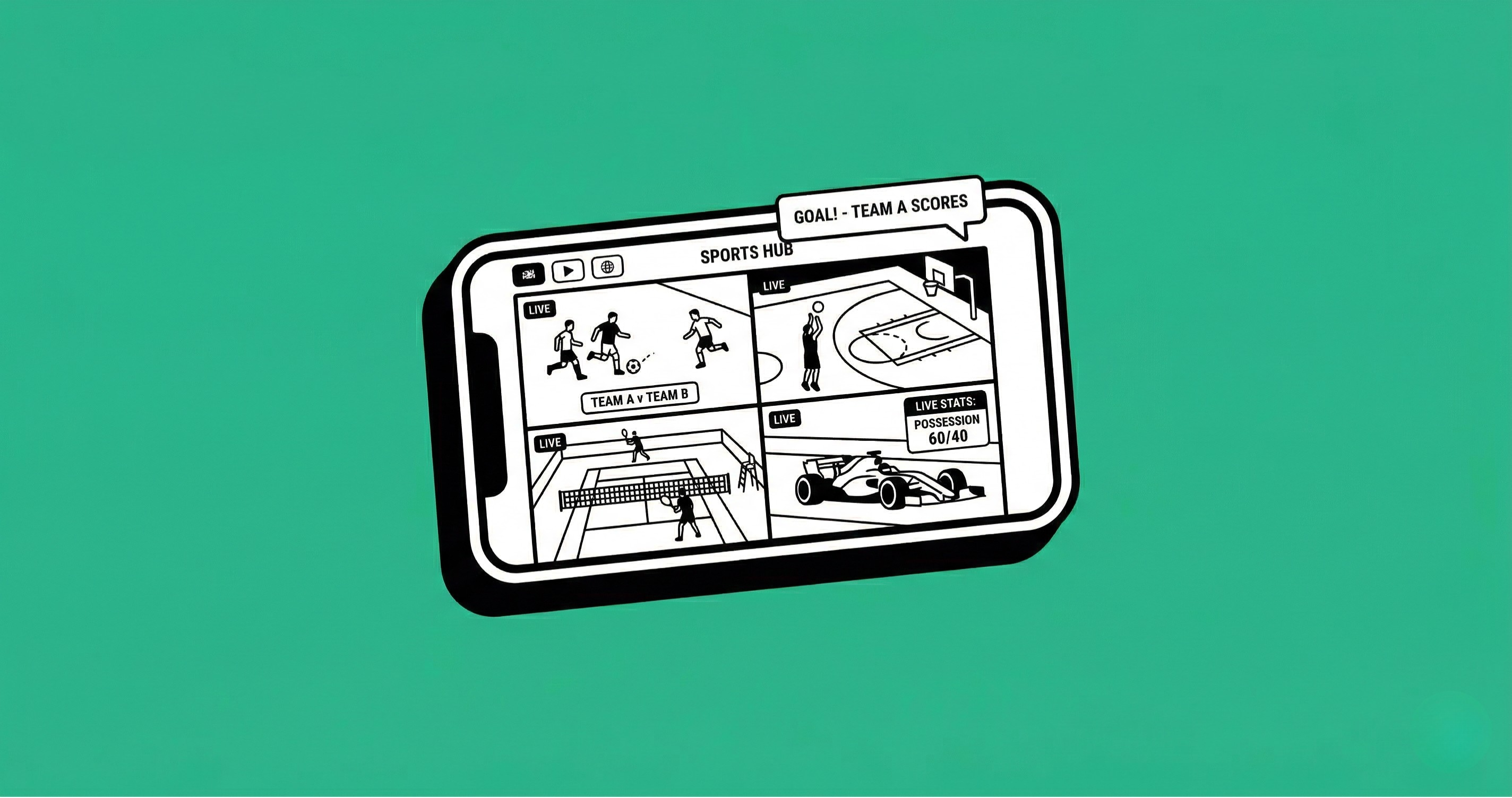
Ari made a point that deserves repeating: video is the only medium left where just-in-time, personalized messaging doesn't exist at scale. Email marketing has had it for years. Push notifications are personalized by default. Display ads are targeted down to the individual. But a live sports broadcast? Everyone sees the same rectangle.
Maestro's approach uses a rule builder, a no-code tool similar to Zapier, where operators define trigger events and map them to personalized overlays. A fantasy football player sees a graphic when they score points in their league. A bettor sees a prompt tied to real-time match action. The metadata drives the creative on the fly, targeted to individual users through tagging.
Early results show higher click-through rates on personalized overlays compared to generic ones, which is consistent with every other form of personalized marketing. The opportunity for sports broadcast personalization is enormous precisely because the bar is so low. LiveLike's own interactive widget suite operates on the same principle: the right prompt, to the right fan, at the right moment, drives meaningfully more engagement than a one-size-fits-all broadcast experience.
The casual fan onboarding gap
The conversation surfaced a problem that almost no sports organization is actively solving: what happens when someone watches a sport for the first time?
Ari shared a personal story about attending a Formula 1 race in the Paddock Club. People around him cheered at moments he didn't understand. He wasn't going to ask why. He left the event unsure whether he'd return, not because the experience was bad, but because nobody helped him understand what he was watching.
This casual fan onboarding experience is a massive, unaddressed opportunity. Platforms know when a user is watching a league for the first time. They could serve a 30-second explainer video on how scoring works. They could simplify commentary overlays based on a viewer's familiarity level. They could use AI tools for sports media organizations to adapt the depth of information dynamically.
The stakes are real. If a first-time viewer doesn't understand what they're watching, they won't come back. The industry spends enormous energy on retaining superfans through features like multiview, but converting a casual viewer into a returning one, that's where the larger growth opportunity sits. A well-designed sports fan engagement platform should address both ends of the funnel.
AI, speed, and the small-organization advantage
The final thread worth pulling is Ari' observation about AI and organizational speed. Small teams adopting AI tools can compress decision-making cycles dramatically. Fewer people means fewer approvals, faster iteration, and more experiments per unit of time. Ari built an entire new product, Maestro's influencer co-streaming tool, largely solo using AI-assisted development.
For larger sports media organizations, the bottleneck is rarely technology. It's inter-departmental coordination: content teams waiting on product teams waiting on broadcast teams waiting on engineering. AI can reduce that friction, whether through automated A/B testing strategy, faster prototyping, or tools like LiveLike's Genie that streamline internal content workflows.
Ari' prediction is worth taking seriously: the AI transformation in small organizations will happen much faster than in large ones, and the resulting disparity will create significant disruption. Sports tech AI startup efficiency is already visible in how quickly new products are reaching market. The organizations that figure out how to apply that same speed internally, regardless of their size, will define the next generation of fan experiences.
Key Takeaways
- Video remains the only major medium without personalized, just-in-time messaging at scale, representing the single largest untapped opportunity in sports streaming.
- Cross-platform delivery, especially to connected TV devices, is a genuine technical moat that most organizations underestimate until they attempt it in-house.
- The casual fan onboarding experience is almost universally neglected, yet it represents the largest addressable audience for growth.
- Freemium monetization principles from gaming, where a small percentage of power users subsidize the majority, apply directly to direct-to-consumer sports strategy.
- AI's most immediate impact on sports media organizations won't be viewer-facing; it will be eliminating the internal coordination friction that slows experimentation.
The sports streaming industry spent a decade getting reliable playback right. The next decade belongs to the organizations that treat every viewer as an individual, from the first-time casual who doesn't know how tennis scoring works to the superfan watching four games on a split screen. The technology exists. The frameworks exist. What separates the leaders from the rest is whether they build the product muscles to actually use them.
Still not sure if personalized interactive sports streaming can be applied to your platform?
NEW YORK, 10 September 2026 – Sports broadcasters and rights holders can now build and schedule live interactive content during a match from a single written instruction, with the video and images pulled automatically from their own media library. The capability comes from a partnership between fan engagement company LiveLike and sports media infrastructure company ScorePlay, announced today ahead of IBC in Amsterdam.
Until now, an exercise such as putting a player of the match poll in front of fans mid-game was manual work under time pressure. A producer had to open the content system, build the program, write the poll options, find and upload an image for each player, then schedule the post. Across a weekend of fixtures that work repeats every time, and the moments that would have made the best content pass while it is being done.
The partnership takes that handwork out. ScorePlay tags video, audio and stills as they are uploaded, identifying the player, the sponsor, the stadium and the fixture. Genie, LiveLike's AI orchestration layer, now reaches into that library directly through ScorePlay's API.
In practice, a producer types what they want. Genie identifies the fixture, requests the relevant assets from ScorePlay, assembles the interactive unit with the correct player imagery already in place, and schedules it to whichever surfaces the broadcaster is running. The producer approves it or moves on.
“Our goal at LiveLike is to use technology to help rights holders deliver unforgettable fan experiences in the moments that matter,” said Miheer Walavalkar, Chief Executive Officer and Co-Founder, LiveLike. “This partnership is the next chapter in that journey. What we have done with ScorePlay is to completely remove the friction between having the idea and getting it in front of fans.”
"Our customers have spent years getting their media properly organized and tagged," said Joshua Krakowsky, Head of Partnerships at ScorePlay. "What they want now is for that library to go to work. LiveLike is one of the first partners to build on our API in a way that puts a customer's own footage in front of fans while the game is still going."
The integration is listed on ScorePlay Connect, ScorePlay’s open platform for partner integrations that customers can access. Both companies are demonstrating it at IBC 2026 at the RAI Amsterdam, in Hall 1 on the ScorePlay booth, 11 to 14 September.
The LiveLike Audience Engagement Suite is a finalist in the region's leading broadcast technology awards, recognising the fan engagement platform's work with sports broadcasters and rights holders
New York, July 31 - LiveLike, the fan engagement platform used by sports broadcasters, streaming services and rights holders worldwide, has been shortlisted for Best in Sports at the BroadcastPro ME Manufacturer Awards 2026 for the LiveLike Audience Engagement Suite.
The awards recognise product innovation, engineering excellence and technology development across the broadcast ecosystem. Finalists were selected across 21 broadcast and satellite categories following industry-wide voting and review by an independent panel of experts. Winners will be announced on Tuesday 6 October 2026 at The Westin Dubai Mina Seyahi Beach Resort & Marina in Dubai, UAE.
The Audience Engagement Suite gives broadcasters and rights holders a way to build interactive experiences directly into their streams and owned platforms - predictions, quizzes, live chat, rewards, loyalty programmes and community hubs - without assembling separate point solutions for each one. Every interaction feeds a single evolving profile of the fan, which the platform then uses to personalise what that fan is offered next.
That combination is the argument LiveLike has been making across the industry this year. Fan engagement has been mischaracterised as a set of features layered onto a broadcast, when the durable value sits underneath: the behavioural graph that every interaction contributes to, and the AI layer operating on top of it. LiveLike's AI layer, Genie, now runs a growing share of the programmes the company operates on behalf of clients, moving the work from manual content management toward automated orchestration.
The Middle East and North Africa is one of the most active regions in the world for this shift. Major tournament rights, rapid growth in sports streaming and rising expectations around second-screen and in-stream interaction have made direct-to-fan engagement a commercial priority for broadcasters across the region rather than an experiment.
"Fan engagement gets treated as a set of features bolted onto a broadcast, and we've never seen it that way," said Miheer Walavalkar, co-founder and CEO of LiveLike. "What we build sits underneath the experience. There are the surfaces fans actually touch, and then there is the profile of that fan which gets sharper every time they touch one. The second part is the part that compounds, and it's the reason a broadcaster can keep getting more out of the platform in year three than they did in year one."
"Being shortlisted in a category assessed by the people who operate live sport in this region carries weight," he added. "They know the difference between something that demos well and something that holds up on a match night."
Sports organisations have spent decades refining three core revenue streams: direct fan spend, media rights, and sponsorship. The playbook is well understood. What is less understood, and far less developed, is the data infrastructure that connects those streams to each other and to the fans who power all of them.
Most organisations know they are sitting on significant amounts of fan data. Ticketing systems, CRM platforms, social channels, digital content interactions: the signals are there. But in the vast majority of cases, that data sits in disconnected silos, producing consulting reports rather than actionable intelligence. The result is a fragmented picture of the fan - one that limits commercial potential across every revenue line.
On a recent episode of Future of Fandom, LiveLike CEO and co-founder Miheer Walavalkar sat down with Aidan Cooney, CEO of Envision Sport Group and co-founder of Opta, to unpack this problem in detail. Cooney has spent 25 years building data and fan intelligence businesses across football, cricket, tennis, and rugby. His perspective on unified fan data, the shift from B2B to B2C thinking, and the convergence of sponsorship and performance marketing offers a practical framework for any organisation trying to move beyond fragmented data toward genuine sports intelligence.
From performance data to fan data: the Opta origin story
Cooney's career started with a simple hypothesis. In the late 1990s, football's status as the world's biggest sport came with surprisingly thin storytelling. Broadcasts offered a scoreline, occasional possession graphics, and goalscorer information. American sports, by contrast, had long used statistics to bring audiences closer to the action.
"If you give fans a higher-resolution understanding of what's happening on the pitch, you bring them closer to the sport they love," Cooney explained. That principle drove the creation of Opta, which transformed how football was analysed, discussed, and consumed. The OptaJoe account became a case study in sports data storytelling, building a following of hundreds of thousands across media, journalism, and the broader sports industry.
But Opta was fundamentally about what happened on the pitch. The return path - how fans reacted to that information and what their behaviour revealed - became the foundation for everything Cooney built next: Ellipse Data, InCrowd, and ultimately Cortex.
The difference between a customer data platform and a fan data platform
One of the most important distinctions Cooney drew in the conversation is the gap between conventional customer data platforms and what a fan data platform actually needs to do. Standard CDPs are designed for rational, price-sensitive purchasers. A fan is something else entirely.
"A fan wants to belong. They're passionate about the player or the team they support. The data that matters to you is very different from a purely rational, transactional data proposition," Cooney said.
The implication is that transactional data - which most sports organisations have invested in through ticketing CRM - is necessary but insufficient. Behavioural data is where the real value sits: how a fan reacts to a particular piece of content, when they react, whether content about a specific player activates more engagement than content about the team as a whole. This is the layer that informs personalisation, shapes content strategy, and ultimately creates trackable, monetizable assets for brand partnerships.
Cooney's platform, Cortex, is designed specifically for this purpose: unifying transactional and behavioural data into a single fan data platform that can activate across channels. LiveLike's engagement and gamification tools then sit on top of that foundation, turning data into community and interaction into measurable value.
The silo problem and why unification comes first
When asked about the most common mistakes sports organisations make with their data, Cooney's answer was immediate: silos.
"Very few organisations have a true single view of their fan base. That is the starting point for everything." Some silos are functional, built by design for specific use cases like ticket sales. Others are structural, created by the relationship between leagues and clubs or by the patchwork of technology vendors an organisation has accumulated over time.
The cost of these silos is not abstract. Without a unified single view, organisations cannot connect their content strategy to their commercial strategy. They cannot attribute sponsorship value to specific fan interactions. They cannot retarget fans who engaged with a poll, a vote, or a piece of branded content. Every disconnected system represents lost compounding value.
Cooney's prescription is direct: "You can't activate until you unify." And the use cases for doing so - from personalised content delivery to integrated brand campaigns - are available now in ways they were not five or even three years ago.
Sponsorship, media, and the hybrid model
One of the most commercially significant ideas in the conversation was Cooney's framing of the convergence between sponsorship and performance marketing. Sponsorship, in its traditional form, has not fundamentally changed since Mark McCormack and Arnold Palmer in the 1960s. It remains an awareness play, hard to attribute, and increasingly constrained as a share of total brand marketing spend.
Performance marketing budgets, by contrast, are growing rapidly. Social media ads, YouTube pre-rolls, programmatic buying: brands are spending heavily on audience acquisition through channels that offer clear attribution. The problem for sports properties is that these two budget pools rarely connect.
"If you create a more diverse set of assets and present them as an integrated media plan, you open up new budget areas within brands," Cooney argued. The opportunity for rights holders is to bridge that gap by combining the premium, trust-based qualities of sponsorship with the attribution model of performance marketing.
In practice, this looks like branded content paired with interactive fan experiences - polls, votes, and predictions that generate first-party data - which can then be used for retargeting and attribution. LiveLike's interactive tools are designed to create exactly these kinds of measurable, brand-integrated fan touchpoints that produce both engagement data and commercial inventory.
AI, personalisation, and the crawl-walk-run path
Both Cooney and Walavalkar addressed the promise and the practical limits of AI-driven fan personalisation. The long-term vision is clear: AI that can serve individual fans with content, offers, and experiences tailored to their specific behaviours and preferences. The economics and infrastructure to do this at true 1-to-1 scale, Walavalkar noted, are still being worked out across every industry.
The pragmatic starting point is cohort-based personalisation. Group fans by location, by behavioural patterns captured in your fan data platform, by engagement tendencies during comebacks or winning streaks. Let cohorts emerge dynamically from the data rather than relying on predefined segments.
"By putting the fan at the centre and serving them at the cohort level, you improve the fan experience, which drives up engagement levels, which drives up the value of the inventory you create on the back of it," Cooney said. "If you then take it to the next level and use AI to super-serve the individual, you drive that engagement and value further."
The compounding logic here is critical. Organisations that delay building cohort-based personalisation while waiting for perfect 1-to-1 capabilities lose years of compounding value - both in fan engagement and in commercial inventory quality.
The B2C shift and why it matters now
Cooney's overarching thesis is that sports organisations are fundamentally B2B businesses today, structured around selling rights to broadcasters and sponsorship packages to brands. The future is B2C: direct, data-informed relationships with fans that create value for both the organisation and its brand partners.
This does not necessarily mean streaming video direct to fans - a path Cooney sees as extremely difficult given the sophistication of existing broadcasters. It means building digital properties that offer genuine value to fans, capturing the behavioural data those interactions generate, and using that data to create a fan balance sheet that reflects the true economic potential of the audience.
"The whole original idea, that the fan base becomes a real balance sheet item, becomes a reality," Cooney said. "And that balance sheet isn't just about the lifetime value of the fan to the sports organisation directly. It's about lifetime value, plus the opportunity for brands to invest in that person over the duration of their fandom."
Listen to the full episode
Hear the full conversation between Aidan Cooney and Miheer Walavalkar on Future of Fandom:
A unified single view of the fan is the prerequisite for every commercial use case in sport, yet most organisations still operate with fragmented data silos.
Fan data platforms differ from standard CDPs because fan behaviour is emotional, making behavioural signals more commercially valuable than transactional data alone.
The convergence of sponsorship and performance marketing opens access to larger brand budgets, but only if rights holders can offer integrated media plans with measurable, interactive assets.
Cohort-based personalisation is the practical starting point for AI-driven fan engagement - delaying it sacrifices years of compounding value in engagement and revenue.
Organisations that treat their fan base as a balance sheet asset - and build the data infrastructure to



.png)
%20(1).png)

.svg)
.png)